A 2025 study by South Korean researchers caught the attention of the astronomy community when it suggested that the evidence behind dark energy could be wrong. Dark energy makes up about 70% of the universe but nobody knows what it is. This makes it a frequent target for scepticism.
Scientists had long known that the universe was expanding. But in the late 1990s, researchers discovered that this expansion was accelerating. Astrophysicists concluded that something must be driving the acceleration. They named this unknown quantity “dark energy”.
The 2025 re-analysis, by a team at Yonsei University in Seoul, suggested that the expansion of the universe was not in fact accelerating.
Our team at the University of Southampton has now gone through the Yonsei team’s findings. Our results, published in Monthly Notices of the Royal Astronomical Society (MNRAS), suggest that the results were a false alarm.
However, the Yonsei University team have said they stand by their results and that a follow up study supports their finding that the universe may not be accelerating.
What is dark energy?
In the late 1990s, cosmology was upended by a startling discovery. Scientists knew the universe was expanding, but they had assumed that gravity was gradually slowing down this expansion.
However, by observing incredibly bright, thermonuclear explosions of white dwarf stars, two independent teams of astronomers found the opposite. Because these explosions, known as Type Ia supernovae, have almost the same intrinsic brightness, comparing how bright they appear gives a precise distance.
In 1998, data revealed that distant supernovae were fainter than they should have been in a slowing universe. Because faintness implies distance, the observations placed these supernovae farther away than expected, and implied that the cosmic expansion was not slowing.
In fact, when the calculations were run, it was clear that the expansion of the universe was actually speeding up.
There was no convincing physical explanation for this “cosmic acceleration”. Physicists labelled the mysterious, repulsive force that causes the acceleration “dark energy”.
Cosmic calibration
To understand the Yonsei University group’s claims, we must understand how astronomers use supernovae as “standard candles” to measure cosmic distances. Type Ia supernovae are remarkably alike, but they are not identical.
Cosmologists correct for these differences. They use subtle calibrations to account for relationships between the brightness of the supernovae and measurements like their colour, the duration of their light curves, and the type of galaxies they explode in.
One of those corrections is well known but subtle. It links the brightness of a supernova to the size of the galaxy it exploded in. Big galaxies hold more stars, and so more mass. After the standard corrections, supernovae in those big (massive) galaxies come out a few per cent brighter than ones in small galaxies. Nobody knows why.
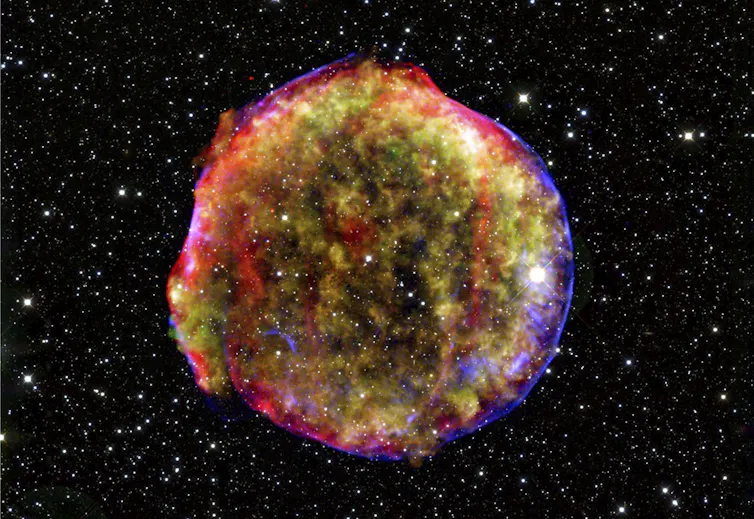
Nasa / JPL-Caltech / CXC / Calar Alto O. Krause /MPIA
But bigger galaxies typically have older stars that are made up of heavier elements, which could in turn influence the properties of the supernovae that some of those stars become. The authors of the 2025 study proposed a far bigger evolutionary effect. They argued that the brightness of Type Ia supernovae changes significantly as the universe ages.
Specifically, they claimed that older white dwarf stars, which are more common in the nearby, present-day universe, produce brighter explosions. That would mean today’s supernovae are inherently much brighter than their distant, early-universe counterparts.
If true, the faintness we observe in distant supernovae would not be a result of their being further away, a relationship that is in turn driven by dark energy, but rather an evolutionary trait of the stars themselves. This claim threatened to dismantle almost three decades of progress in astronomy.
Addressing the claims
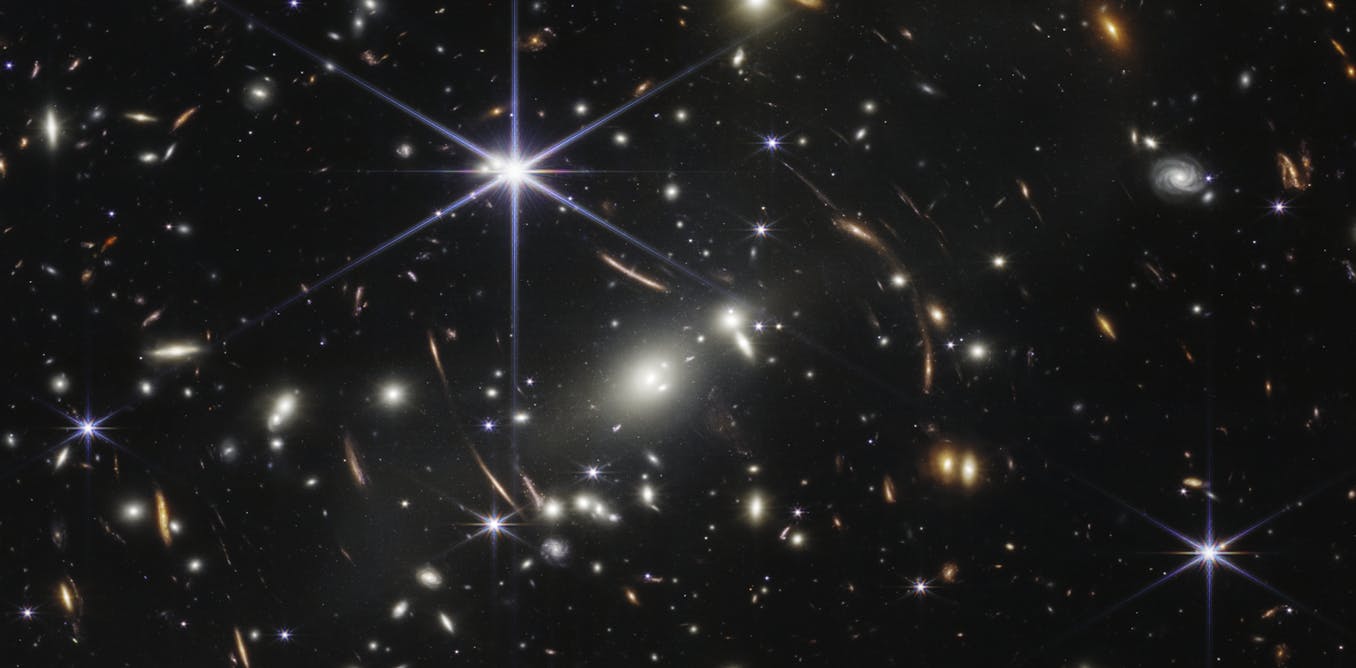
Extraordinary claims need careful testing. At the University of Southampton we embarked on an audit of the data, using observations from the Dark Energy Survey (DES), an astronomy project designed to constrain dark energy’s properties, alongside the same dataset used by the authors of the 2025 work. In doing so, we sought to replicate and test their conclusions.
Our re-analysis revealed what we saw as two problems in the Yonsei study: a technical omission and a flawed assumption about stellar populations. Once corrected, the data fell back in line with standard cosmological results, including those of DES.
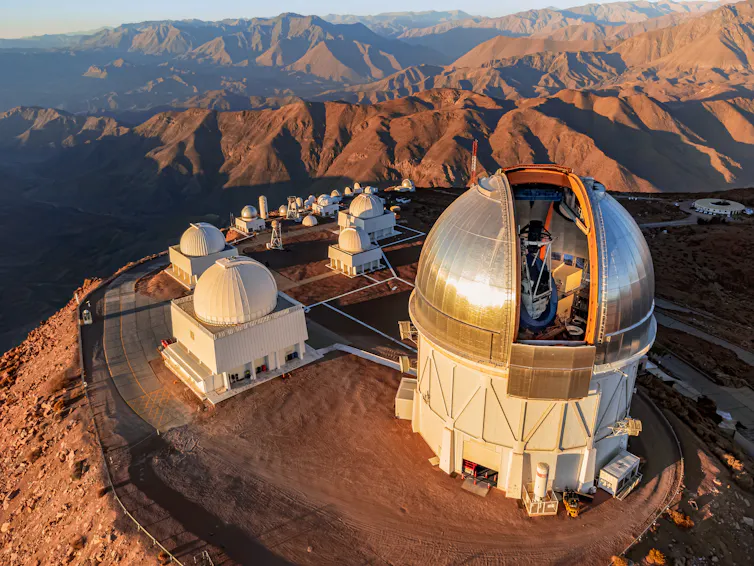
CTIO/NOIRLab/NSF/AURA/T. Matsopoulos, CC BY
Crucially, the 2025 study did not account for how supernovae in big galaxies come out a few per cent brighter than ones in small galaxies. When our team reapplied this correction to the same dataset, the correlation between a supernova’s brightness and galaxy age – presented by the Yonsei team in their paper – became far weaker.
This doesn’t mean that the age of a white dwarf star has no effect on the brightness of a resulting supernova. Indeed, most researchers in the field would likely accept that the brightnesses of supernovae are more affected by the age of the stars that explode than by the mass of the galaxy that it is in.
However, measuring a galaxy’s mass is far less expensive in terms of telescope time and requires fewer technical assumptions than measurements of the ages of galaxies, which are challenging. What we showed is that the galaxy mass calibration is adequate to the accuracy required to constrain dark energy.
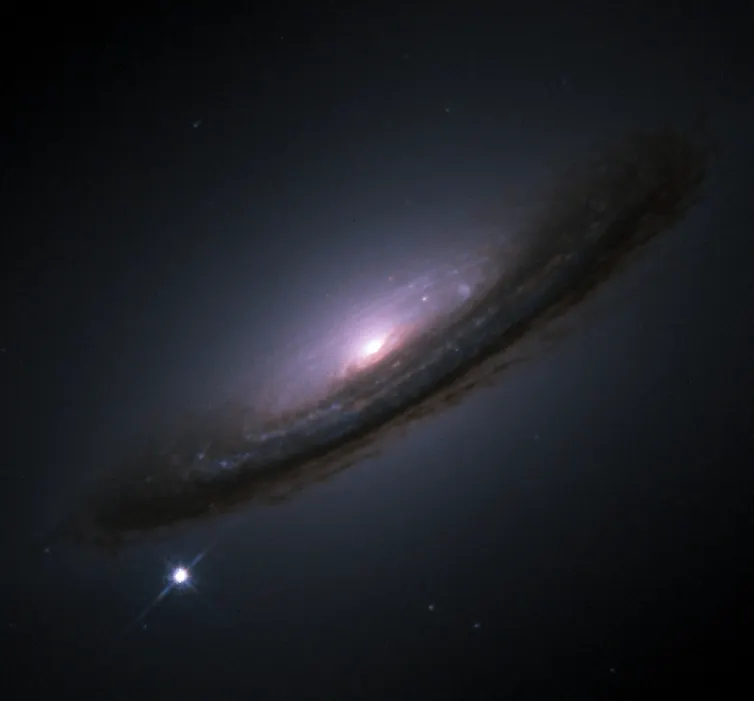
Nasa, Esa, The Hubble Key Project Team, and The High-Z Supernova Search Team
Secondly, the 2025 analysis relied on a flawed proxy, incorrectly assuming that the overall age of a host galaxy is identical to the specific age of the star that exploded. But galaxies are not uniform like this: even large, ancient galaxies contain localised pockets of young stars.
By overestimating the difference in age between the stars that explode nearby and those that explode in the distant universe, by a factor of three to five, the Yonsei University study overestimated the amount by which the age-brightness calibration could bias supernova distance measurements.
Once these omissions were corrected, the data behaved as expected under the standard model of cosmology. As such, evidence for an accelerating universe remains secure.
Science friction
While the 2025 study turned out to be incorrect, the challenge it posed was valuable. Challenging accepted ideas and rigorously testing our observations is fundamental to scientific progress.
Their claims provided an opportunity for cosmology teams to return to their baseline data, interrogate their core assumptions, and test different ways of calibrating the measurements. When measuring distances, however, the age effect and the mass effect are highly correlated, and therefore we (the Southampton team) believe it is incorrect to make a full age-based adjustment to distances that have already been corrected for the mass effect.
The Southampton team was invited, among others, to a workshop at Yonsei in June 2026, where we discussed our methods and talked about ways to include both stellar mass and stellar ages into the brightness corrections.
In a follow up study, recently accepted by MNRAS, the Yonsei University team maintain that the ages of stars have an important effect on the supernovae they produce. They say that two methods used in earlier studies have suppressed the importance of this phenomenon.
When these effects are accounted for consistently, they explain, it leads to results similar to those in the 2025 study. “We therefore continue to find evidence that stellar-population age is an important factor in Type Ia supernova standardisation,” authors Junhyuk Son and Hyejeon Cho, told The Conversation.
“Because the typical ages of supernova host populations change with cosmic time, understanding this effect is important for precision measurements of the Universe’s expansion history.”
Future measurements will depend on understanding supernova explosions better. It is a job we hope the community can take on together. But none of this removes the need for dark energy: it is still there, and still unexplained.
Ultimately, we have shown that existing measurements of dark energy are robust. Rather than debating whether cosmic acceleration exists, the astrophysical community can return to the exciting task of figuring out what dark energy actually is and how we best measure it.
Over the next 10 years, the Vera C. Rubin Observatory in Chile will carry out a project known as the Legacy Survey of Space and Time, which will produce a sample of supernovae 20 times larger than the DES sample used in our analysis. There is no better time to be investigating the mysteries of dark energy.

Dr Phil Wiseman receives funding from the Science and Technology Facilities Council.
Mark Sullivan receives funding from the Science and Technology Facilities Council.