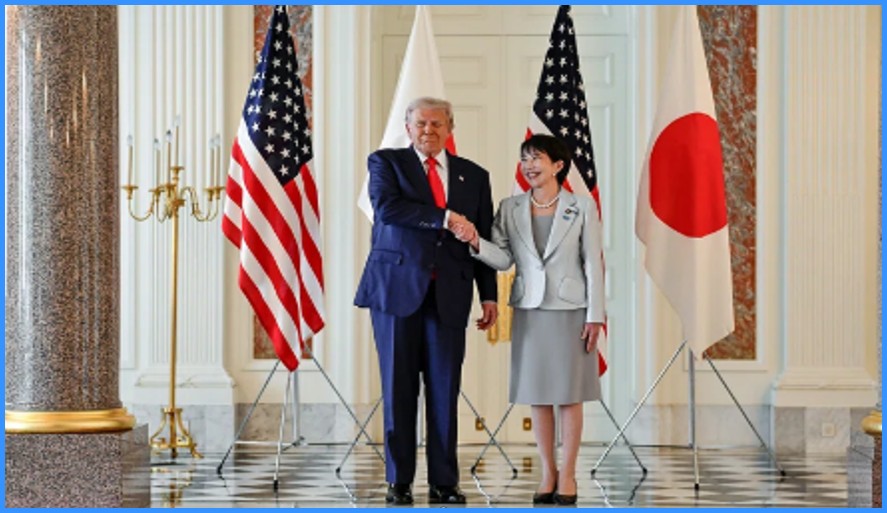
WASHINGTON, D.C. — In a high-stakes demonstration of the “Indo-Pacific anchor,” President Donald J. Trump hosted Japanese Prime Minister Sane Takaichi at the White House on Thursday, March 19, 2026. The summit—Takaichi’s first to Washington since her historic election as Japan’s first female leader—focused on insulating the global economy from the ongoing Middle East conflict and finalizing a massive $550 billion (¥87 trillion) strategic investment package.
The meeting underscores a deepening personal and political alignment between the two leaders, both of whom recently secured expanded domestic mandates.
The $550 Billion “Second Round”
The centerpiece of the bilateral talks was the formalization of the second phase of the U.S.-Japan Trade and Investment Agreement. Following a primary round of $36 billion in February, the two leaders announced a new $63 billion (¥10 trillion) tranche of Japanese-led projects on American soil.
- Energy Security: A major portion of the funding is earmarked for the construction of next-generation nuclear power reactors and a high-efficiency natural gas-fired power plant in the United States.
- Technological Sovereignty: The deal includes a $13 billion Japan Display plant designed to service the U.S. automotive, medical, and defense sectors, alongside new joint ventures in artificial intelligence (AI) and semiconductors.
- Critical Minerals: Building on their October 2025 accord, the two nations launched the “U.S.-Japan Critical Minerals Project” with new mining and processing facilities in Indiana, North Carolina, and Arizona to counter Chinese market dominance.
Navigating the “Iran Shadow”
While the economic agenda was robust, the shadow of the Strait of Hormuz blockade dominated the security discussions. Prime Minister Takaichi arrived under pressure following President Trump’s recent public calls for allies to provide naval escorts for oil tankers.
- The “What We Can Do” Approach: Takaichi, who commands a two-thirds “supermajority” in the Japanese Diet, navigated the legal constraints of Japan’s pacifist Constitution by offering logistical and economic support rather than direct combat involvement.
- Strategic Reserves: Japan reaffirmed its commitment to the International Energy Agency (IEA) collective action, providing 80 million barrels from its national reserves to stabilize global prices.
- De-escalation Mandate: Takaichi emphasized that “global peace and stability are being threatened,” calling for an urgent de-escalation of hostilities to protect the energy arteries that supply 90% of Japan’s crude oil.
The “Survival-Threatening” Taiwan Shift
The leaders also addressed the growing friction with Beijing. Despite a recent U.S. intelligence report describing Takaichi’s rhetoric on Taiwan as a “significant shift,” the Prime Minister stood by her assertion that a crisis in the Taiwan Strait could constitute a “survival-threatening situation” for Japan.
President Trump, who recently delayed a planned trip to China to focus on West Asia, praised Takaichi for “stepping up to the plate,” signaling that Washington views her reformist “Sanaenomics” as a vital component of the U.S. strategy in the Pacific.
US President Trump and Japan Prime Minister Takaichi Picture from Rawpixel