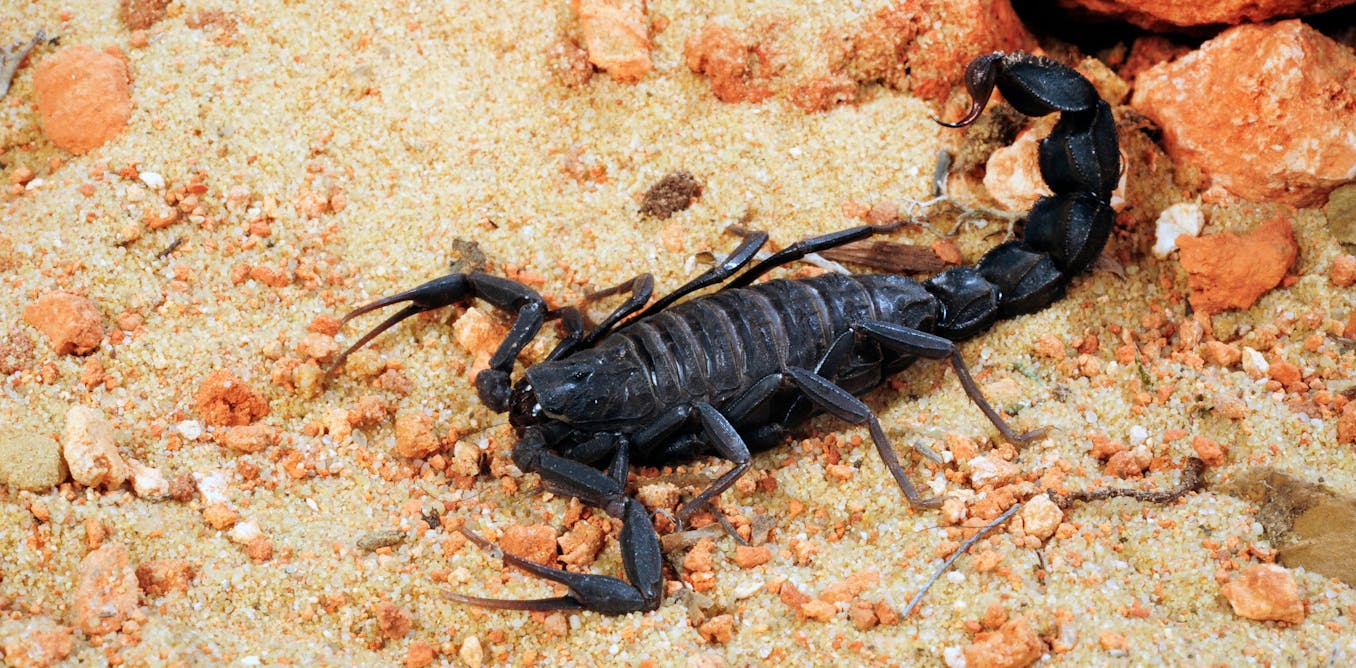
For people living in temperate regions of Europe, the Americas and much of Asia, scorpion stings are rarely a concern. But for millions of children growing up across the subtropical belt, a scorpion sting can have devastating consequences.
While snakebites are receiving increasing international attention and funding under the leadership of the World Health Organization, scorpionism (the medical term for illness caused by scorpion venom) remains under-reported, under-funded and under-researched. Worse still, this silent epidemic appears to be growing, fuelled by a combination of climate change, urbanisation, global trade and human encroachment into natural habitats.
In Brazil, scorpion stings have tripled over the past decade, as scorpions settle in major cities around the country. In Sudan, the construction of the Merowe Dam in 2009 and the rapid development of gold mining complexes displaced scorpion populations into nearby settlements, triggering localised epidemics.
In November 2021, torrential rains in Aswan, southern Egypt, drove thousands of deathstalker scorpions into homes and in the streets, injuring more than 450 residents and overwhelming local hospitals.
Globally, at least 1.2 million scorpion stings are recorded each year. While most victims recover fully, an estimated 3,000 people die annually as a direct result of scorpion stings, mostly children under the age of 13, typically from poor rural communities.
Global hotspots for scorpion deaths:
Michel Dugon, CC BY
Scorpionism is not evenly distributed across the tropics. Most fatal cases occur in a dozen geographic hotspots including parts of Latin America, north Africa, the Levant, Iran and western India. All these areas have warm climates with seasonal extremes that favour scorpion activity, as well as poor housing, rapid urbanisation and limited access to healthcare that also contribute to the problem.
Scorpions thrive where people live and work – in cracks in walls, beneath rubble, among stored goods, in outdoor latrines and across agricultural land. But they are not aggressive animals. Most stings occur defensively when a scorpion is accidentally trapped or pressed against the skin.
Lethal scorpions
Of the roughly 2,500 known scorpion species worldwide, only 50 to 100 are considered lethal to humans. Severe envenoming – cases that requiring extensive medical attention and a hospital stay – usually involves intense local pain rapidly followed by profuse sweating, excessive salivation, vomiting and irregular heartbeat. In severe cases, fluid accumulates in the lungs, leading to respiratory failure.
Intensive care beds, ventilation support and medications that stabilise heart and lung function are essential to help young patients withstand the first 24 to 36 hours following severe envenoming.
Antivenom serum developed over a century ago has significantly helped to reduce death rates in parts of Mexico, South America and Egypt. But it is not a magic bullet.
The antivenom must be administered early, requires trained personnel and appropriate facilities, and is only effective if it matches the venom of the species responsible for the sting. It can also cause severe allergic reactions including anaphylaxis. For many vulnerable communities, its cost and limited availability remain major barriers to effective treatment.
Morocco’s scorpion hotspots
Morocco illustrates the complexity of managing scorpion stings. The country hosts more than 55 scorpion species including some of the most dangerous in the world, such as members of the genus Androctonus (“man-killer” in Greek).
After years of limited success with antivenom therapy, in the early 2000s Moroccan health authorities shifted away from antivenom to focus on using respirators and other drugs to control patients’ heart rates and maintain vital organ function while in intensive care. They also began large-scale public education campaigns.
This led to a significant drop in the death rate due to scorpion stings.
Today, Morocco records around 25,000 stings annually, resulting in 50 to 100 deaths. But some areas are much more at risk than others. The rural district of Kalaat Sraghna on the northern slopes of the Atlas Mountains, for example, represents less than 2% of Morocco’s population but accounts for roughly 20% of stings nationwide. Geographic isolation, scorpion diversity and urban expansion are all likely to be contributing factors.
In most cases, the species responsible for a sting is never identified, yet this information can be critical for diagnosis and treatment. Scorpions often look similar and typically escape immediately after stinging. Neither victims nor healthcare workers can reasonably be expected to identify them accurately.
This is where zoology and ecology intersect with public health. In a new study, our team comprising Moroccan and Irish researchers conducted field surveys of 19 scorpion species and then used machine learning (a type of artificial intelligence) to understand where else they might be located throughout Morocco.
Our model identifies the environmental conditions scorpion hotspots might share, including average or extreme seasonal temperatures, annual rainfall, vegetation type and land use. It then scans the landscape for areas with similar conditions, generating probability maps of where each species is most likely to occur.
In our study, we found that soil type was the most important variable driving the distribution of high-risk scorpions across central Morocco.
We recently presented our results at the Pasteur Institute of Morocco in Casablanca, part of the country’s public health system. Our predictive maps can help prioritise intensive care capacity, ensure medications are available locally, and strengthen emergency response in rural areas by helping doctors anticipate which species have been responsible for the stings.
Importantly, this approach can be adapted to other countries facing similar challenges. Scorpionism is still overlooked on the global health agenda. But better integration of ecology, climate science and clinical sciences offers a powerful tool to prevent deaths, especially among vulnerable children.

Michel Dugon receives funding from the EU Erasmus Plus programme for staff and student mobility between the University Ibn Zohr of Agadir (Morocco) and the University of Galway (Ireland)