Wenzhi Liu, Wuhan Botanical Garden, Chinese Academy of Sciences, discusses their article: Plant diversity–mediated variation in root exudates regulates anaerobic nitrogen transformations in soil
When we think about plant diversity, we often notice differences in leaves, flowers, and plant height. Yet plants also differ belowground. Their roots release sugars, organic acids, amino acids, and other compounds into the soil. These root exudates provide resources for soil organisms and can influence nutrient cycling. This raises an important question: does plant diversity alter the quantity and chemical composition of root exudates, and how might these changes affect whether soil retains or loses nitrogen?
In oxygen-poor soil, microorganisms transform nitrogen through several pathways. Dissimilatory nitrate reduction to ammonium (DNRA) converts nitrate into ammonium, helping retain nitrogen in soil. Denitrification and anaerobic ammonium oxidation (anammox), by contrast, converts reactive nitrogen into nitrogen gas, removing it from the available pool. Understanding what regulates these pathways can help explain how ecosystems retain and lose nitrogen.
Two experiments to explore how plant diversity affects root exudates
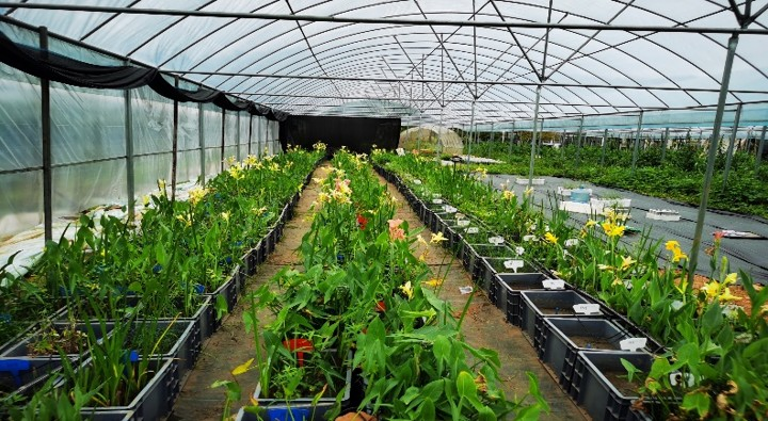
We conducted two complementary experiments. First, we selected 12 herbaceous plant species, with communities containing one, two, four, or eight species. We analysed rhizosphere soil to determine how plant diversity was related to the variety of metabolites. Next, we collected natural root exudates from six plant species and mixed them to represent communities containing one, two, four, or six species. We added these mixtures to soil at two carbon input levels and measured nitrogen transformation rates. Together, these experiments linked plant diversity with root exudates and explored how exudate properties were associated with nitrogen cycling.

How do root exudates shape soil nitrogen cycling?
We found that greater plant diversity was associated with greater chemodiversity in both rhizosphere soil and root exudates. Notably, phylogenetic diversity, which reflects how distantly related plant species are, was a stronger predictor of root exudate chemodiversity than species richness or functional group diversity. This suggests that the evolutionary relationships among plants help explain variation in the chemicals they release, beyond simply counting the number of species present.
The quantity and quality of root exudates were also associated with nitrogen transformations in different ways. Higher exudate carbon content significantly enhanced DNRA and denitrification, whereas exudate chemodiversity was negatively correlated with these two processes but was positively associated with anammox.
The composition of metabolites was equally important. Carbohydrates and organic acids were more influential in explaining variation in N transformations than amino acids, with sucrose and shikimic acid emerging as important metabolites associated with nitrogen transformations. Our findings suggest that the quantity and chemical composition of root exudates are associated with nitrogen cycling partly through changes in the nitrogen available for transformation, rather than simply through differences in microbial diversity. This provides a metabolite-level perspective on how plant diversity shapes ecosystem nutrient cycling.