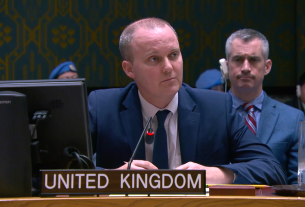
Mr Chair,
I’m honoured to deliver this statement on behalf of the following OSCE participating States: Canada, Czechia, Denmark, Estonia, Finland, Germany, Iceland, Italy, Latvia, Lithuania, Netherlands, Norway, Poland, Sweden, the United Kingdom and, my own country, France.
In the 1991 Moscow Document, OSCE participating States agreed that commitments undertaken in the field of the human dimension are matters of direct and legitimate concern to all participating States and do not belong exclusively to the internal affairs of the State concerned. This was subsequently reaffirmed, inter alia, at the Seventh OSCE Summit of Heads of State, held in Astana in December 2010.
In keeping with this commitment, we have expressed our gravest concerns about the broader human rights situation in the Russian Federation on numerous occasions. Among these were 28 July 2022, when 38 participating States activated the Moscow Mechanism, and the subsequent Vienna Mechanism on 23 March 2024, invoked by 41 participating States.
In that regard, we are deeply concerned by the Russian Supreme Court decision to classify the “international public movement Memorial” as an “extremist organization”. This is a clear attempt to ban the work of Nobel Peace Prize-winning organisation Memorial as well as all Memorial-related organizations.
Mr Chair,
Memorial is one of Russia’s oldest and most reputable human rights organisations, dedicated to preserving the memory of Soviet-era repression in Russia and abroad. Memorial has long been targeted by the Russian state.
This is another example of Russia’s attempts to bury the memory of both the terror’s victims and its perpetrators, by criminalising those who are brave enough to speak about it openly and their audience.
On the same day that Memorial was labelled an extremist organisation, the offices of “Novaya Gazeta” were subject to a several-hours-long search conducted by Russian investigating authorities.
The day after, on 8 April 2026, six activists from the “Vesna” Youth Movement, that has been designated as extremist by the Russian authorities in 2022, were also sentenced to long prison terms.
These outcomes are clearly underpinned by political motivations and form part of a broader pattern of repression against independent voices and civil society in the Russian Federation.
We strongly condemn the continuing deterioration in the Kremlin’s domestic human rights record. The Russian authorities must repeal their extensive repressive legislation and bring their laws and practices into line with their international obligations and OSCE commitments. This would include ending the practice of these politically motivated trials, ceasing the persecution of independent media, releasing all persons arbitrarily detained for political reasons, and immediately and unconditionally abandoning the legal proceedings initiated against them.