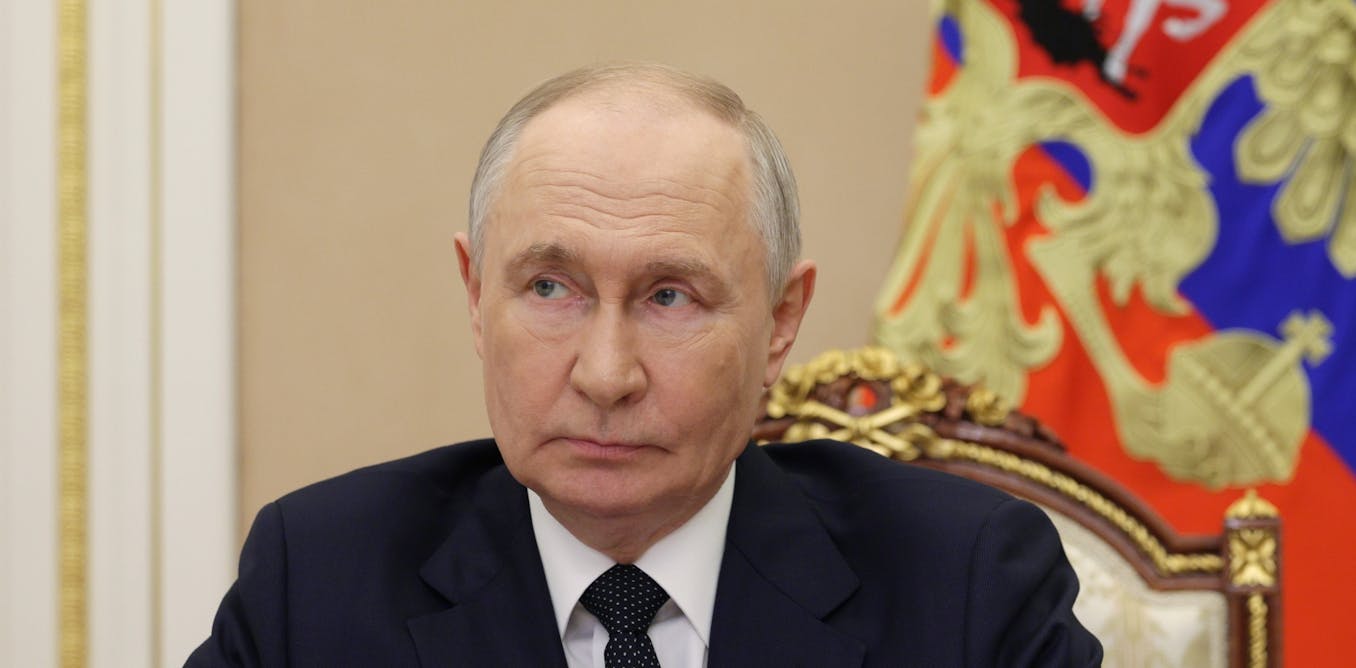
Russia’s war against Ukraine is not going according to Vladimir Putin’s original plan. The Russian president’s initial strategy called for the war to be won within ten days, but Ukraine’s spirited defence in the first months of the war robbed Russia of the initiative. Now, four and a half years later, the frontline inside Ukraine has remained largely static for months.
Meanwhile, the human cost continues to mount, particularly for the invaders. British intelligence estimates suggest that the number of Russian soldiers killed during the conflict is approaching half a million since the full-scale invasion began in February 2022. Rumours are growing about a new round of mobilisation.
Ukraine has also intensified drone strikes against Russian energy infrastructure, targeting both occupied Crimea and locations deep inside Russia, including Moscow and St Petersburg.
Fuel shortages and internet outages are now affecting much of the country, and public frustration appears to be growing. The Russian president himself has publicly acknowledged that Russia is facing difficult circumstances.
There has been a great deal of speculation that Putin’s position is increasingly tenuous. The most recent survey by Russia’s state pollster, VCIOM, for June 22-28, found that Putin’s job approval rating fell to 66.9%, down from 70.4% the previous week. The percentage saying they disapprove of his performance rose from 19.7% to 21.3%. His trust rating, meanwhile, fell from 76.7% to 73.3% over the same period.
It’s Putin’s lowest rating since the beginning of the full-scale invasion in 2022. But this still doesn’t indicate that his presidency is in particular peril. The Russian president remains by far the most popular political leader according to the VCIOM poll, and his party, United Russia, sits at the top of the list when it comes to people’s voting intentions.
But there are certainly some indications that Putin himself may feel increasingly vulnerable. His decision to massively scale down the annual Victory Day parade on Moscow’s Red Square on May 9 suggested heightened concerns about the danger of drone attacks from Ukraine. Putin has also become increasingly secretive about his whereabouts. Reports of his use of multiple identical offices, combined with longstanding speculation about body doubles, have reinforced an image of a leader preoccupied with security.
Such precautions may be intended to counter external threats. But they may also reflect anxiety about potential challenges from within the Russian elite.
Recent events have highlighted this possibility. Earlier this month, prominent blogger Ilya Remeslo, once a staunch supporter of the Russian president, was remanded in custody for two months on suspicion of spreading false information against the military. In March 2026, he published a blog post under the headline: “Five reasons why I stopped supporting Vladimir Putin”.
Similarly, on June 25, Aleksandr Lunin, a veteran of the war in Ukraine who has become a prominent “milblogger” – online commentators of military affairs, often, like Lunin, ex-military – posted a video warning of possible mutiny, demanding a televised conversation with Putin about Russia’s military failures. He has also been detained, which effectively ended his public campaign. Nevertheless, the incident revealed signs of discontent in parts of the military and invited comparisons with the time preceding Yevgeny Prigozhin’s mutiny in June 2023.
EPA/Gavril Grigorov/Sputnik/Kremin pool
Job for life
But history tells us how hard it is to unseat a Russian (or Soviet) leader. Since the revolution in 1917, the vast majority have died in office – and the likeliest scenario is still that Putin will follow this pattern. After the constitutional amendments of 2020, there is nothing, save physical health issues, stopping him from remaining in office until the year 2036, at which point he will be 84.
With the exception of the short-term interim leader Georgy Malenkov, who took power after the death of Josef Stalin in 1953, only to be outmanoeuvred and replaced by Nikita Khrushchev within two years, only two leaders have faced outright coup attempts. The only one who was ousted was Nikita Khrushchev. He narrowly escaped a coup attempt already in 1957 but was finally ousted in 1964 .
Then there was Mikhail Gorbachev in 1991. Like Khrushchev, he faced considerable opposition from hardliners in the Soviet power structure and was forced to resign only months after an attempted military coup by conservatives opposed to his programme of reforms, which they believed threatened the cohesion of the Soviet Union.
However, his downfall was inseparable from the dissolution of the Soviet Union itself. The Soviet system collapsed immediately after his resignation on December 25, leaving the way clear for Boris Yeltsin to assume control of an independent Russia.
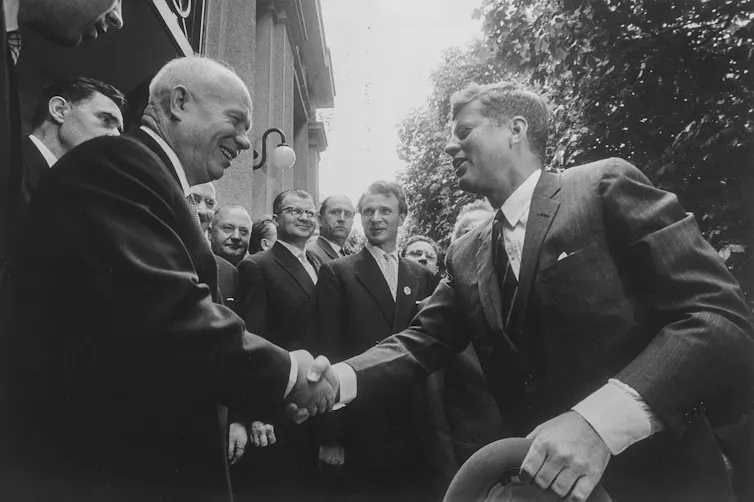
The ousting of Khrushchev may, therefore, offer more relevant parallels, happening as it did in a period of considerable international tension at the height of the cold war. Krushchev had been badly damaged in the eyes of Kremlin hardliners by the failures of his Berlin policy and during the Cuban missile crisis in 1962.
Regarding the former, he had twice demanded in 1958 and 1961 that western powers leave West Berlin within six months and turn it into a “free city”. Both Dwight D. Eisenhower and his successor, John F. Kennedy, refused to comply. It was a very public embarrassment for the Soviet leader.
Stanley Tretick/US National Archives and Records Administration
On top of this, the Cuban missile crisis, during which the Soviet Union installed medium-range nuclear missiles on the Caribbean island within 100 miles of the US mainland, only to back down under intense diplomatic pressure, was seen as another huge blow to Soviet prestige.
And here’s a similarity between Khruschev and Putin. Rather than the Russian president coming under pressure from powerful players wanting to end the war in Ukraine, any palace coup in Putin’s Russia would probably come from hardliners dissatisfied with what they see as insufficiently aggressive policies. Any plotting successor emerging from the security establishment would probably be even more committed to continuing the war than Putin himself.
But this remains unlikely. Since coming to power on New Year’s Eve in 1999, the Russian president has entrenched himself in a political system centred on himself as leader. As a result, the strongest historical precedent may be the simplest one: like most Kremlin leaders before him, Vladimir Putin is most likely to die with his boots on.