AUSTIN, Texas — Database software and cloud giant Oracle Corporation filed plans with the U.S. Securities and Exchange Commission (SEC) on November 2, 2026, to raise $20 billion through a combined offering of equity and debt to fund its aggressive artificial intelligence infrastructure buildout.
The dual filing—split evenly between $10 billion in common stock and $10 billion in senior unsecured notes—represents one of the largest corporate capital-raising efforts of the year. The announcement follows details outlined during the company’s annual investor day, where executives specified that the $20 billion capital injection will fund data center expansion through fiscal year 2030 to meet soaring enterprise demand for AI compute capacity.
Following the SEC filing, Oracle shares slipped over 3% in early trading, as Wall Street digested the near-term dilution and added leverage required to support its cloud transformation.
Breakdown of the $20 Billion Capital Plan
The capital-raising structure is designed to balance equity dilution against debt obligations as Oracle accelerates capital expenditures for multi-gigawatt cloud facilities.
Oracle $20 Billion Capital Raising Breakdown
+-------------------------------------------------------------------------+
| TOTAL CAPITAL TO BE RAISED: $20 Billion                                |
| COMMON STOCK OFFERING: $10 Billion (At-The-Market equity program)      |
| DEBT ISSUANCE: $10 Billion (Senior Unsecured Investment-Grade Notes)    |
| CAPITAL EXPEDITION CAP: Fixed limit for new capital through FY2030      |
| USE OF PROCEEDS: AI data center expansion, GPUs, debt repayment         |
| EARLIEST FREE CASH FLOW POSITIVE: H2 Fiscal 2028                        |
+-------------------------------------------------------------------------+
Oracle Chief Financial Officer Hilary Maxson clarified at the company’s recent investor conference that the $20 billion framework, divided equally between debt and equity, constitutes the final required external capital raise to cover the current AI infrastructure investment cycle. The company confirmed that data center capital spending is expected to peak over the current and upcoming fiscal years before normalizing by fiscal 2029.
Hyperscale AI Demand vs. Debt Infrastructure Load
Oracle’s rapid push into cloud infrastructure has been driven by high-profile AI hosting agreements, including massive compute clusters supplied to OpenAI and other frontier AI labs. However, the cost of scaling hardware and securing grid power has significantly increased the company’s financial leverage.
Oracle Financial Overview & Infrastructure Metrics
+-------------------------------------------------------------------------+
| CAPITAL EXPENDITURES (FY2026): ~$55.7 Billion spent on data centers     |
| TOTAL LIABILITIES (As of Aug 31, 2026): ~$236.1 Billion                 |
| SENIOR UNSECURED BORROWINGS: ~$125.3 Billion                            |
| 2026 STOCK PERFORMANCE: Down ~33% YTD amid market tech corrections      |
| RATING PROFILE: Investment-Grade (Unsecured Senior Notes)               |
+-------------------------------------------------------------------------+
As of August 31, 2026, Oracle reported approximately $236.1 billion in total liabilities, including $125.3 billion in senior unsecured borrowings. The new $10 billion bond sale will rank equally with existing unsecured debt, with proceeds earmarked to cover immediate infrastructure outlays while maintaining liquidity.
Two-Sided Perspectives on Oracle’s AI Buildout
The $20 billion fundraise highlights a broader debate among Wall Street analysts regarding hyper-scaler debt levels and long-term AI monetization.
Perspectives on Oracle's $20 Billion Financing Package
+-------------------------------------------------------------------------+
| BULLISH STRATEGISTS & CLOUD OPTIMISTS                                   |
| * Argue early capital deployment locks in long-term AI cloud contracts |
|   with major enterprise customers and AI research labs.                 |
| * View the $20 billion cap through FY2030 as a disciplined framework   |
|   that provides financial clarity and limits unexpected leverage.       |
+-------------------------------------------------------------------------+
| BEARISH ANALYSTS & CREDIT RISK SKEPTICS                                 |
| * Point to heavy total debt load ($236.1B liabilities) and equity       |
|   dilution during an broader tech market downturn.                      |
| * Warn that delayed free-cash-flow conversion (H2 2028) exposes the     |
|   firm to operational risks if AI software demand slows down.          |
+-------------------------------------------------------------------------+
Bullish View: Securing Market Leadership
Cloud sector analysts supporting Oracle’s expansion emphasize that the company’s Generation 2 Cloud architecture offers performance and cost advantages for training complex AI models. Proponents argue that locking in multi-year agreements with leading AI firms ensures sustained revenue backlogs, justifying the heavy capital expenditure cycle.
Bearish View: Debt Burdens and Capex Scrutiny
Conversely, credit analysts and market skeptics point out that Oracle’s aggressive capital spending comes during a period of market-wide scrutiny over tech sector returns. With Oracle stock down roughly 33% in 2026, critics caution that raising equity at lower valuations while accumulating additional debt creates balance sheet friction, especially if energy grid bottlenecks or chip supply chains delay data center online dates.
Operational Roadmap
With regulatory filings completed, Oracle expects to execute the bond offering across multiple tranches over the coming days, with share sales conducted periodically based on market conditions.
As global hyper-scalers race to build out the physical infrastructure underpinning artificial intelligence, Oracle’s $20 billion capital push marks one of the decisive financial commitments defining the tech industry’s structural transition toward next-generation computing.
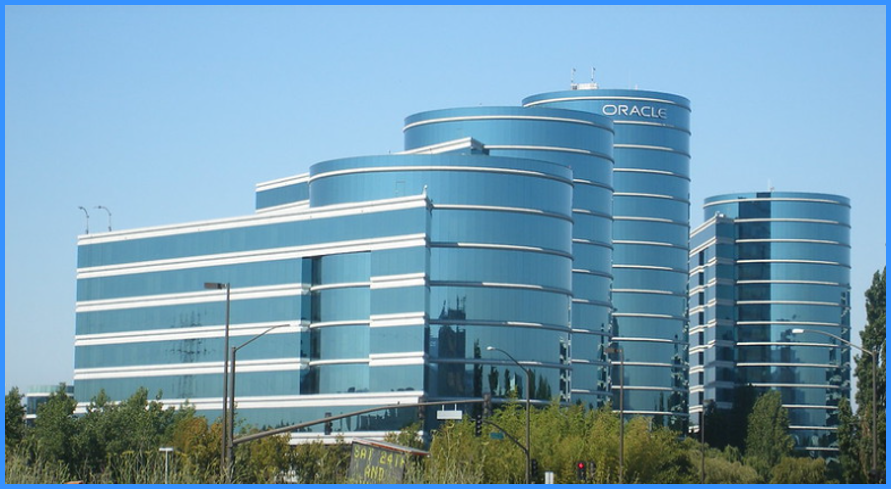
The futuristic Oracle Office Hq building complex, San Francisco. Flickr Picture by Steve Parker