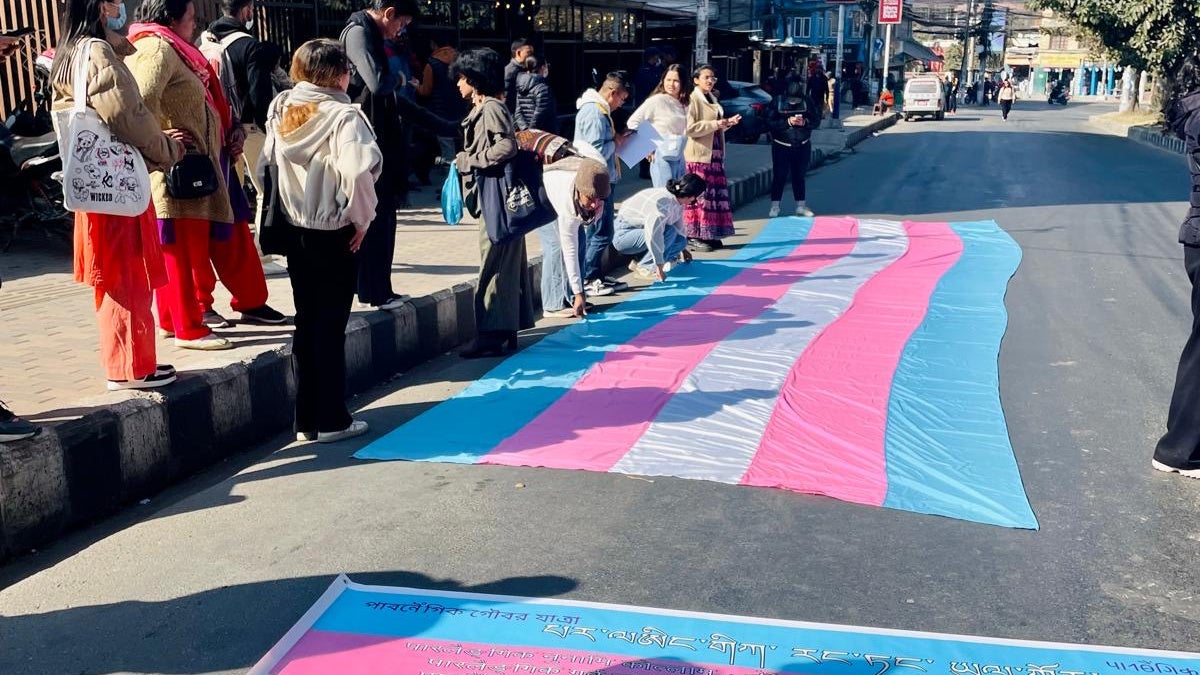
- Nepali authorities have stopped processing applications for transgender people to change their legal gender on identity documents.
- The authorities’ actions are regressing on years of progress and undermining the fundamental right of recognition before the law.
- The Nepal government should immediately process pending applications and create a clear policy for legal gender recognition aligned with international human rights law.
(Berlin, April 30, 2026) – Nepali authorities have stopped processing applications for transgender people to change their legal gender on identity documents, regressing on years of progress and undermining the fundamental right of recognition before the law, Human Rights Watch said today. Policymakers in Nepal should reject attempts to undermine the fundamental rights of sexual and gender minorities.
The Nepali authorities’ recognition of trans people’s rights based on self-identification following a court ruling in 2007 garnered widespread praise and made the country an important global touchpoint for rights related to gender identity and expression. Despite this jurisprudence, and a range of implementation measures, national authorities never specified the process trans individuals should follow to change their legal gender, creating bureaucratic confusion and leaving those seeking recognition at the whim of local officials and social pressure campaigns.
“Nepal has a proud history of principled legal developments that protected the rights of lesbian, gay, bisexual, and transgender people, and has played an important role on the global stage” said Alex Müller, LGBT Rights Director at Human Rights Watch. “The authorities should not allow disingenuous attacks to derail their work to uphold Nepal’s obligations under international human rights law.”
In December 2025, Human Rights watch interviewed 11 trans people in Nepal, over half of whom were in the midst of stalled legal gender recognition processes. This research followed the publication of a 2024 report, “‘We Have to Beg So Many People’: Human Rights Violations in Nepal’s Legal Gender Recognition Practices”, which called for the end of the use of medical examinations and the creation of a rights-based legal gender recognition policy.
While some trans people have been able to successfully change their legal gender through individual court cases, interactions between trans people and the state have been fraught for several years, Human Rights Watch found. Some officials demand medical certificates proving that individuals have undergone genital surgery, which is not and should not be required under Nepali law.
For some trans people, including those who had tried multiple times to change their legal gender to “other” in accordance with the 2007 Supreme Court judgment, the creeping medicalization established an additional hurdle. For others, it created a prohibitive barrier, leaving them in limbo as their documents undergo years-long processing.
Starting in early 2025, the situation worsened significantly following an increase in public and, apparently in private, “anti-gender” advocacy with authorities by groups opposed to rights-based trans legal recognition. In recent months the Ministry of Home Affairs paused all processing of applications, even in cases where applicants have received the support of district officials and courts, effectively ending legal gender recognition in the country.
Human Rights Watch wrote to the Ministry of Home Affairs on April 8, 2026, inquiring about the research findings that the legal gender recognition process had halted. At the time of publication, we had not received a response.
Trans people who cannot obtain documents that list their self-declared legal gender face extensive obstacles. People interviewed said that they faced problems accessing education, health care, and employment, and that they lived with the fear that at any moment, someone could come across their documents, realize they were trans, and mistreat them.
Human rights law, which has been influential in Nepali jurisprudence to date, holds that people have a right to be recognized before the law, and that there are specific protections for those who seek to change their legal gender.
Balen Shah, the new prime minister, should direct his government to immediately process pending applications and create a clear policy for legal gender recognition—the ability of transgender people to change their gender on legal documents—aligned with Nepal’s commitments under international human rights law.
“The Supreme Court made it clear in 2007 that trans people should be legally recognized based on their self-identification, and practices since then has indicated that this means as male, female, or other,” Müller said. “Trans people in Nepal are being abandoned by authorities who appear to be listening to anti-gender ideology talking points”
Impact of Inadequate Legal Gender Recognition Policy
As documented in the Human Rights Watch 2024 report, since 2007, various Nepali government offices have, in response to advocacy and individual applicants, erected a haphazard and para-official process for transgender people to change their legal gender. Some people have been able to obtain documents reading “third gender” or “other;” others have been denied entirely or told they must have surgery to be eligible.
A small number of people have been able to change their documents from “male” to “female,” but doing so invariably involves an invasive and humiliating physical exam in a medical setting, and an individual petition to the Home Affairs Ministry or a court. There is no law or policy in Nepal that mandates surgery for legal gender change. And there are no government-mandated processes to guide applicants seeking legal gender recognition, or the officials processing the applications.
Trans people’s experiences reveal that Nepal’s ad hoc processes have been often confusing, slow, and rife with human rights violations. Their names have been withheld in this report for their privacy.
Rashima K., a 31-year-old trans woman in Kathmandu, started her legal gender recognition process in 2022 at the district office in Jhapa but, three years later, had not received her documents. “I brought a medical certificate, which I got without an exam because my sister worked at the hospital, and the [chief district officer, CDO] denied me, saying the district court needed to make the decision,” she said. When Human Rights Watch spoke with her she was hoping to have a court hearing sometime in 2026.
Rashima said carrying a citizenship certificate that lists her as male causes a range of problems for her, in particular in running her business. “I import materials for my company, but every time I went to get them, I got turned away by customs because they said I was a fraud.” Her solution was to register the business in her brother’s name and send him to pick up all of the shipments. “It works, but it only works because I am lucky to have a supportive sibling; not everyone has that,” she said.
Aneesh L., a 31-year-old trans woman who is raising a child with her partner, said that while she underwent gender-affirming surgery in India in 2016, she had not pursued legal gender recognition until 2023. Once she began the process, she faced resistance from bureaucrats who invoked nonexistent requirements.
“The chief district officer demanded a medical certificate. I told him that wasn’t a requirement and he said yes, it was, so I went to Bir Hospital and got examined,” she said. “When I returned with the medical certificate, he said ‘well the media know about this issue now, so it has to be decided by the Ministry of Home Affairs (MOHA), not me.’”
With help from advocacy groups, Aneesh submitted her application at the ministry in July 2025. Later that year, she said, she received a phone call telling her the process was being paused for all applicants. “The person who called me from MOHA said the reason they stopped the process is someone in the community told MOHA to stop the process because they said all trans women are biological males,” she said.
“My son’s school and our landlord keep asking for our documents, and we keep avoiding it in the hopes mine can say female soon so we cannot face discrimination, but the pressure is getting too high.” Aneesh said she is concerned that school officials or her landlord will cause problems for her if they discover she is transgender.
Ratika T., a 30-year-old trans woman, said that she had started the legal gender recognition process in 2022, been denied by the chef district officer in her home district, and then received a positive ruling from the district court. Still, even after the court order, the district officer directed her case to the Home Affairs Ministry. “I got my court ruling in June of 2025 and filed it immediately with my application to MOHA. Then I found out from a news story that MOHA was pausing all applications,” she said. She has not heard from the ministry since.
Living with a citizenship certificate that lists her as male has negatively affected Ratika’s ability to find formal employment throughout her adult life. She has trained for specific jobs only to be denied the job once she reaches the interview stage, during which she needs to furnish her legal documents to prove employment eligibility. Ratika said: “Once they get confirmation that I’m trans, they just seem to lose interest in me.”
Arbitrary, Inconsistent Requirements for Legal Gender Recognition
While the Supreme Court has continued to issue judgments in individual cases that were promising for rights-based legal gender recognition, the process of changing legal gender for trans people across the country has been inconsistent. Some people are able to make a few visits to government offices in their home district and successfully obtain new documents; others are coerced into medical procedures they may not want, and still face delays or denials of new documents.
Over time, authorities began requesting medical practitioners to “verify” the sex of trans people even though this process was never explicitly written in policy and does not have grounding in medical standards or international law.
Such a process that required the involvement of medical practitioners became quickly embedded, with activists publicly noting as early as 2013 that government officials were demanding letters from doctors for trans people to change their legal gender. By 2019, discussions around amending the citizenship law featured arguments for including a “medical proof” clause for legal gender change in the new law. While this informal requirement for “medical approval” is most consistently applied to people seeking binary legal recognition as male or female, Human Rights Watch documented accounts of people seeking third (or “other”) gender legal recognition also being asked by authorities for medical verification.
This creeping but arbitrary use of medical approval has created an ad hoc and harmful pathway to legal gender recognition in Nepal. It amounts to a para-official process in which trans people are subjected to the scrutiny of bureaucrats and physicians to “prove” they are transgender. This is antithetical to the Nepal Supreme Court’s orders, international human rights law, and international medical best practices, all of which uphold self-identification as a core tenet. And now, with the process completely halted by the Home Affairs Ministry, even those who subject themselves to invasive and unnecessary medical examinations for the sake of changing their documents are left in the lurch.
For everyone who was compelled to undergo a medical verification procedure, the new para-official procedure resulted in them being subjected to unnecessary, invasive, and humiliating intervention that violated their rights to privacy, health, and bodily autonomy. Human Rights Watch documented the experience of one trans woman who underwent this medical exam at Bir Hospital in 2023.
This separation of legal gender recognition from medical procedure also has been emphasized by the World Professional Association for Transgender Health (WPATH). The WPATH statement on Identity Recognition:
[R]ecognizes the right of all people to identity documents consistent with their gender identity, including those documents which confer legal gender status…. Transgender people, regardless of how they identify or appear, should enjoy the gender recognition all persons expect and deserve. Medical and other barriers to gender recognition for transgender individuals may harm physical and mental health. WPATH opposes all medical requirements that act as barriers to those wishing to change legal sex or gender markers on documents.
Discriminatory Pushback
The current pause on processing applications appears related to an increase in public and private “anti-gender” advocacy that has clouded Nepal’s once-strong reputation for good faith policy processes regarding protections for sexual orientation, gender identity, and expression.
In February 2024, letters from a nongovernmental organization to the Home Affairs Ministry reviewed by Human Rights Watch, said that the organization had “received information that individuals assigned male at birth have submitted applications to obtain citizenship certificates identifying them as female, and that individuals assigned female at birth have submitted applications to obtain citizenship certificates identifying them as male.”
The group said that while people had been obtaining third gender documents marked “other” since 2012, they were concerned about a new group of trans people receiving documents that legally recognized them as male or female. The group claimed that allowing trans people to be recognized as male or female “has created confusion and inconsistency even among the authorities responsible for issuing citizenship certificates to members of the same community.”
On July 9, 2025, a news website, accused trans rights activists of being “foreign agents” and causing “chaos” because they were advocating legally recognizing trans women as women and trans men as men. These arguments being deployed against Nepal’s self-identification-based legal gender recognition practices echo growing “anti-gender” activism around the world.
First propagated by the Vatican in the 1990s, “anti-gender” arguments are based on “gender ideology,” a term used to refer to a supposed gay and feminist-led movement aiming to subvert traditional families and social values. Since then, it has developed into a catch-all phrase and shorthand for various anxieties about social change and gained significant traction.
As Human Rights Watch has analyzed globally, the term “gender ideology” has increasingly has become a hammer wielded variously to attack feminism, transgender equality, the existence of intersex bodies, the elimination of sex stereotyping, family law reform, same-sex marriage, access to abortion, contraception, and comprehensive sexuality education. Nepali policymakers should be wary of arguments that attempt to undermine human rights obligations.
If the authorities are listening to and acting on claims that brand trans activists who seek legal recognition as men or women as “creating confusion” and “foreign agents,” this will undermine Nepal’s progress toward rights-based legal recognition for all, Human Rights Watch said.
Nepal’s Obligations Under Domestic Law and International Standards
The Supreme Court has been an important venue for advancing the rights of transgender people in Nepal, starting from the 2007 judgment in Sunil Babu Pant and Others v. Nepal. This case concerned a petition asking the Supreme Court to recognize and protect the rights of LGBT people, including legal recognition of same-sex relationships. The court ruled that all individuals are entitled to dignity and equal protection regardless of sexual orientation or gender identity. Among other orders, the court directed the government to issue identity documents reflecting individuals’ self-identified gender.
In filing the case in 2006, LGBT rights activists exercised a new and important tool: the Yogyakarta Principles. These principles—formally the Yogyakarta Principles on the Application of International Human Rights Law in Relation to Sexual Orientation and Gender Identity—had just been published. The Yogyakarta Principles, are an interpretation of international human rights law as it applies to sexual orientation, gender identity and expression, and sex characteristics.
The Yogyakarta Principles—compiled by a group of experts, including Nepali LGBT rights activist and former member of parliament Sunil Babu Pant—state that each person’s self-defined sexual orientation and gender identity is “integral to their personality” and is a basic aspect of identity, personal autonomy, dignity, and freedom. The principles are clear that gender recognition may involve, “if freely chosen, modification of bodily appearance or function by medical, surgical or other means.” Put simply, the process for legal recognition should be separate from any medical interventions. But if an individual’s personal transition process requires medical support, those services should be available and accessible.
Pant and his co-litigants petitioned the Supreme Court to recognize the Yogyakarta Principles in Nepali law. The Nepali Supreme Court’s final judgment required the government to legally recognize a third gender category based on the self-identification of the individual, audit all laws to identify those that discriminated against LGBT people, and form a committee to study legal recognition of same-sex relationships.
Within weeks of the ruling, Richard Bennett, the representative of the United Nations Office of the High Commissioner for Human Rights (OHCHR) in Nepal at the time, called the judgment “truly a ground-breaking decision on gender identity and sexual orientation in South Asia and perhaps worldwide.” Courts in the United States and India, as well as the European Court of Human Rights, have cited Pant v. Nepal (2007) in their consideration of comparative law on how to recognize transgender people’s rights.
In 2011, Nepal became the first country to include a third gender option on its federal census. And in 2015, the government started issuing passports that recognized three genders. That same year, Nepal became the world’s tenth country to specifically protect LGBT people in its constitution.
While the 2007 judgment relied heavily on international law and examples from around the world, later jurisprudence could more exclusively analyze the Nepali context and developments that had taken place domestically.
In a 2023 case, Pokhrel v Nepal, the court explained important details about terminology related to sexual orientation and gender identity in Nepal, while acknowledging that a range of identities may be understood under a “third gender” heading and some people may pursue legal recognition as “third gender,” others may identify as male, female, or a range of indigenous identity terms.
The court wrote: “Generally speaking, the term ‘third gender’ is used to indicate communities other than men and women. In several documents, the use of ‘third gender’ also refers to the transgender community. Given the current context where various terms of gender identity have been developed and individuals are openly identifying themselves with those identities, ‘third gender’ cannot denote everyone and, therefore, the use of such a term can potentially diminish the identity of the members of the gender and sexual minority community as a whole.”
A critical component of evolving international standards on transgender people’s rights—and states’ implementation of those standards—has been the clear separation of medical procedures related to gender transition, and legal procedures related to gender recognition.
Such developments have resonated globally and provided important citations in jurisprudence around the world. Nonetheless, and especially since 2025 with the suspension of legal gender recognition, Nepal continues to fall short of its international human rights obligations.