Douglas Sheil, Wageningen University and Research in the Netherlands, discusses his article: Stability of monodominant and mixed tropical forests: Implications from a biomass-based competition model
I first encountered monodominant tropical forests, where one tree species makes up over half the canopy, during my doctorate research in Uganda, where I used long-term plot data to explore how some forests became dominated by large, buttressed Cynometra alexandri. Why do such forests develop, and what do they reveal about competition and disturbance? My work was a follow up on Joe Eggeling’s work that was published in the Journal of Ecology in 1947. The questions stayed with me.
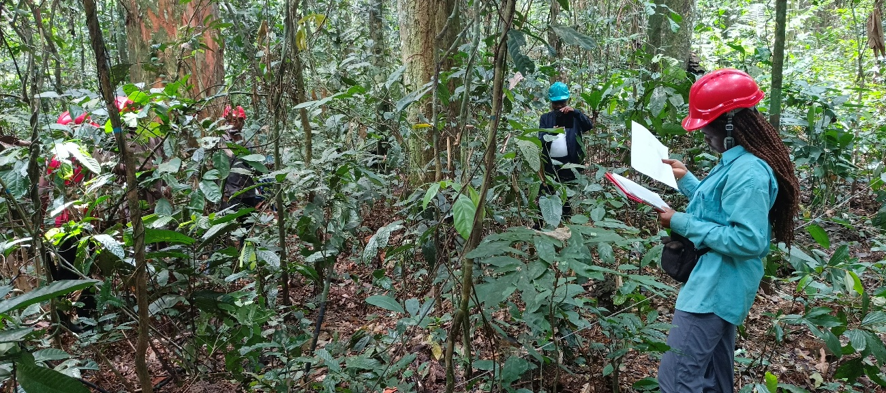
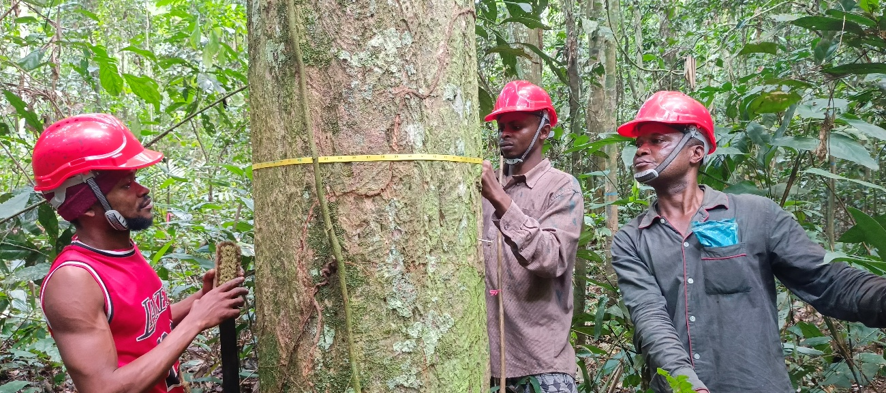
Our new paper, led by Takashi Kohyama, returns to these questions using long-term census data and a simple biomass-based competition model, focusing on forests in the Democratic Republic of Congo, where monodominant and mixed forests occur side by side.
When tropical forests are not so diverse
Tropical forests are famous for their diversity, and much ecological theory addresses how so many tree species coexist. Yet in some forests, one species appears to take over. We were curious if our model was sufficient to reproduce, and thus potentially explain, both outcomes.
Consider the claim that diversity bolsters ecosystem functioning. Different species may use resources in different ways, allowing a diverse community to produce more biomass than a less diverse one. While this idea has been supported in many ecological studies, the underlying relationships remain debated. Furthermore, monodominant forests appear to offer a striking counterexample.
Our study builds on recent work at Pasoh in Malaysia, where the same framework explored how hundreds of tree species coexist. The model is deliberately simple: each species’ growth is reduced by the leaf biomass of its own species and of all others combined. This reduces each species to three properties: its intrinsic growth rate, its sensitivity to its own species, and its sensitivity to others. We can then ask which combinations allow species to coexist or dominate.
At Pasoh, the model reproduced which species persisted and their relative abundances. Could it also explain something apparently very different, the monodominant forests of Ituri, in the Democratic Republic of Congo? It can.
What makes a species dominant?
We often assume a dominant species must be a strong competitor that beats others and thus becomes abundant. Our analysis suggests otherwise. A species capable of becoming monodominant tolerates its own kind unusually well: in our model, its growth is only weakly limited by its own abundance.
Most tropical tree species appear constrained by competition with their own species. A species that is less affected by its own neighbours can continue accumulating biomass when many individuals of that species are present. Monodominance thus depends not only on how a species competes with others, but on how strongly it limits itself.
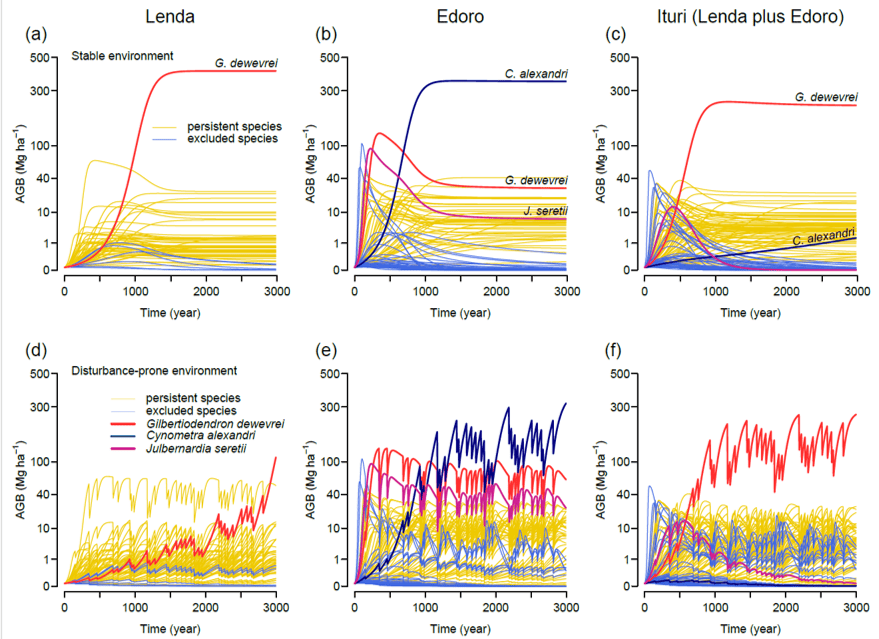
For Gilbertiodendron dewevrei, the main monodominant species in this study, its ability to dominate large areas of forest is associated with its ability to accumulate high biomass. The model reproduces the observed contrast between the monodominant forest and nearby mixed forest.
It takes time
Another striking feature is time. In our simulations, monodominance can take hundreds or thousands of years to arise, which puts disturbance in a different light. If a potential dominant needs that long to accumulate enough biomass to exclude others, even occasional storms that kill biomass set the process back, and repeated disturbance may prevent monodominance altogether.
This provides insight into the Intermediate Disturbance Hypothesis. Disturbance may maintain diversity not simply by creating space for disturbance-dependent species, but by interrupting and reversing the slow rise of species that might otherwise dominate. Under constant conditions, the dominant species can slowly build up its biomass. When disturbance is introduced, that process is repeatedly interrupted.
Lower diversity but greater biomass
Our model also leads to a striking result. If we remove the species capable of becoming monodominant, the forest is ultimately more diverse but also less productive and with less biomass. This differs from our previous analyses and simulations for Pasoh, Malaysia, where more diverse forests yield greater productivity and biomass.
In our simulations, a species with the right demographic properties can accumulate so much biomass that its presence raises total forest biomass and woody productivity, even though it reduces species richness and diversity. This does not mean diversity is unimportant, or that diverse forests are generally less productive. Rather, diversity alone cannot determine these relationships; the characteristics of the species matter too.
Why are these forests not common?
Why aren’t monodominant forests common? Our results suggest that several conditions must coincide, and that most tree species lack the necessary properties. We can only speculate why, such as that pests and pathogens may eventually catch up with those species. Even where such species are present, disturbance can prevent dominance.
This explains why neighbouring tropical forests can contain both exceptionally diverse communities and forests dominated by just one or a few species. They are not different ecological worlds but result from the same basic processes unfolding over very long periods. It is satisfying that a simple model offers insight not only into monodominance but also competition, diversity, and ecosystem functioning.