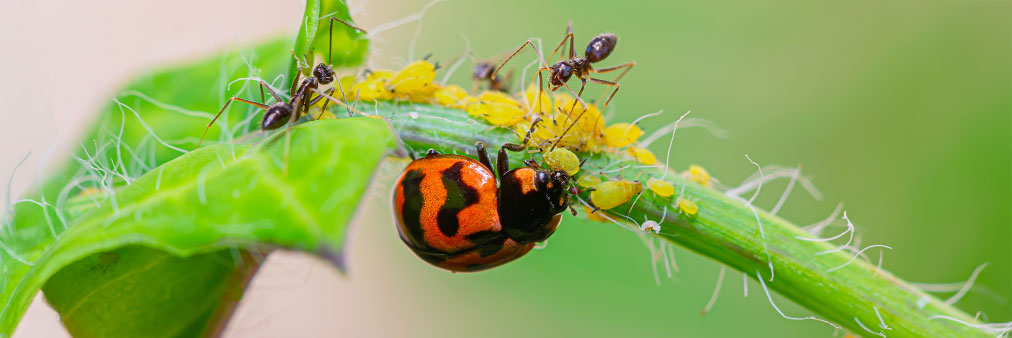
At first glance, planting strips of faba beans alongside rows of apple trees might seem an unusual way to fight an insect infestation. But in French orchards, researchers are testing whether simply giving nature a helping hand could be enough to protect apple trees against one of growers’ most troublesome pests – the rosy apple aphid (Dysaphis plantaginea).
Faba beans offer nectar and other resources that can help parasitic wasps and predators such as spiders and ladybirds survive. These natural enemies can then attack apple pests, including aphids and leafroller caterpillars.
Dr Pierre Franck of France’s National Research Institute for Agriculture, Food and Environment (INRAE) and his colleagues sowed faba bean strips along orchard borders in autumn 2025 as part of a series of field experiments.
“When we assessed the apple trees in June 2026, we found on average 30% less aphid damage on trees associated with the faba bean strips compared with control trees,” he said.
Natural defences
The experiment is part of a wider effort by European researchers to find effective alternatives to chemical pesticides.
Professor John Vontas leads one of these efforts. He coordinates NextGenBioPest, a four-year EU-funded project that brings together researchers, companies and agricultural organisations to find new ways of managing some of the most difficult pests and diseases affecting fruit and vegetables.
Vontas, an expert in insecticide resistance and insect control, is the director of the Institute of Molecular Biology and Biotechnology at the Foundation for Research and Technology – Hellas (FORTH) in Greece.
“
We found on average 30% less aphid damage on trees associated with the faba bean strips compared with control trees.
The research, due to conclude in February 2028, supports the EU’s aim to halve the use and risk of chemical pesticides by 2030 and promote alternatives such as biopesticides.
For Vontas, finding those alternatives has become increasingly urgent. As pests spread into new areas and resistance to existing pesticides grows, the number of chemical products farmers can still use shrinks.
“Resistance is developing to the few chemical pesticides that are still available so farmers are running out of alternatives,” he said.
Biological options, however, have long struggled to match the performance and price of chemicals.
“Generally, biological alternatives are not as effective as chemical insecticides,” said Vontas. “They are also more expensive.”
That is why researchers are not looking for a single substitute. Instead, they are exploring different ways of combining natural pest control, new biological products and precision technologies. This way, farmers can intervene only when and where needed.
Friendly predators
Some approaches use organisms that already feed on crop pests. Vontas and his colleagues have looked at which organisms would be well-suited to managing pests in greenhouse crops, including tomatoes, peppers and cucumbers. According to Vontas, some can tackle more than one type of threat, including insect pests and fungi.
Tests in Belgium and Greece have produced promising results. Vontas said one biological control solution developed with Belgian company Biobest is already on the market. It uses tiny predatory insects to target pests like the Thrips parvispinus – an invasive species causing serious problems for pepper growers in Spain.
In orange groves around Valencia, Spain, researchers are taking a different approach. They are making orchards better homes for friendly insects, such as ladybirds, that can be helpful in managing pests. They are also planting “companion” plants that provide suitable habitats, and offering pollen as food when other resources are scarce.
This can help these so-called “beneficial” insects grow their populations before pests arrive. According to Professor Apostolos Pekas, a senior scientist in Biobest’s R&D department, trials in Valencia have shown that crops were well protected with this approach without the need to use chemical insecticides.
The French apple trials follow a similar principle. Researchers are changing conditions in and around the orchard to favour natural pest control. That could be increasingly valuable for apple growers, according to Pascal Borioli, who advises GRCETA, a producer organisation in the Basse Durance Valley.
Borioli said controlling the rosy apple aphid has become particularly difficult in France over the past five years. He thinks that might be because the aphids are becoming resistant to existing treatments, or a result of changing climatic conditions.
According to Borioli, affected French orchards can produce as much as 10% to 15% less, rising to over 50% in severe cases. Growers are therefore looking for complementary approaches. These include encouraging beneficial insects that can both manage infestations in spring and limit how many eggs aphids can lay in autumn.
Precision protection
Researchers are also borrowing ideas from medicine to make crop protection more precise.
Vontas compares the approach to precision medicine, where information about an individual patient helps doctors select the treatment most likely to work. In agriculture, molecular diagnostic devices could give farmers more information about the pests present in a particular field.
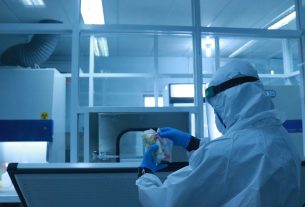
With the help of a portable device they developed, the researchers can collect and analyse insects present in a greenhouse. The results are ready within around half an hour. This can show, for example, whether insects carry plant viruses or genetic mutations associated with pesticide resistance.
“
Resistance is developing to the few chemical pesticides that are still available so farmers are running out of alternatives.
Such information could help farmers make better decisions about when, where and how to use pesticides.
AI is also speeding up the search for new pesticides derived from nature. Plants and microorganisms produce thousands of defensive compounds, but identifying useful candidates can be slow. Vontas said AI can screen hundreds of thousands of candidates and narrow them down to around 20 for laboratory testing in just a few weeks. Without AI, identifying this shortlist could take up to 10 years.
Researchers are also developing pesticides based on double-stranded RNA (dsRNA), a genetic molecule that can disrupt specific genes in target pests.
Building farmer confidence
Finding something that works in the laboratory is only part of the challenge. Farmers must also be confident that switching from a familiar pesticide will not put their harvest – and livelihood – at risk.
Vontas and his team carried out some surveys as part of their research. The results suggest that some farmers can be reluctant to adopt biological products, particularly when they cost more and their effectiveness has not yet been fully established.
“The farmers want a lot of evidence before they accept and adopt them,” he said.
That makes field demonstrations particularly important. Franck’s apple orchard experiment offers one example of researching in real farming conditions. Although the researchers did not assess pesticide use itself, the roughly 30% reduction in aphid damage due to faba beans is an encouraging result for growers.
For the NextGenBioPest team, the coming years will be about turning promising approaches into products farmers can use in their everyday work.
Among the candidates being explored are pesticides based on dsRNA, developed with project partner GreenLight Biosciences. The company has submitted regulatory dossiers to the EU for a novel RNA-based fungicide designed to control Erysiphe necator, the fungus responsible for grape powdery mildew.
By the time the project ends in 2028, the researchers hope that one or two of the products they are testing today will have moved closer to the market.
The shift away from conventional pesticides does not depend on finding one perfect substitute. It will mean protecting crops differently: working with nature, intervening more precisely and giving farmers effective alternatives that perform under real farming conditions.
Research in this article was funded by the EU’s Horizon Programme. The views of the interviewees don’t necessarily reflect those of the European Commission. If you liked this article, please consider sharing it on social media.
This article was originally published on https://projects.research-and-innovation.ec.europa.eu/en/horizon-magazine/ladybirds-and-faba-beans-help-fight-crop-pests. It is shared here under a Creative Commons license.