(Beirut) – Israeli road closures in the West Bank on July 27, 2026, badly delayed an ambulance transporting a pregnant Palestinian woman in critical condition, with dire consequences, Human Rights Watch said today. The woman’s fetus did not survive an emergency delivery, and her life was further endangered when soldiers forced the ambulance crew to turn off their medical equipment for at least 20 minutes.
From January to June, the World Health Organization documented 50 cases of delays in medical care to Palestinians in the West Bank. Israeli forces imposed even more extensive closures at checkpoints and roadblocks in the Nablus governorate following a settler attack on July 24 that led to the killings of two Israelis, including a soldier, and four Palestinians, and “significantly impeded” access to health care, including by delaying ambulances, the United Nations Office for the Coordination of Humanitarian Affairs (OCHA) reported.
“Israeli forces in the West Bank are not only failing to ensure Palestinians’ access to emergency care but also delaying ambulances from taking patients to hospitals,” said Bill Van Esveld, associate children’s rights director at Human Rights Watch. “Israel is forcing long detours or waits for patients with medical emergencies with appalling regularity, as the precious minutes needed to save their lives tick by.”
Bashar al-Qaryuti, a paramedic, and Sabreen Atallah, a nurse and midwife, told Human Rights Watch that at around 6:30 a.m. on July 27 they took a woman who was six months pregnant from the village of Qaryut. She was prematurely in active labor, bleeding heavily, and drifting in and out of consciousness. With the woman’s husband, they carried her to al-Qaryuti’s ambulance, placed her on oxygen and set out for Rafidia Hospital in Nablus.
The previous day, July 26, the woman had experienced bleeding and went to a hospital in Ramallah after the Israeli military had blocked routes to the nearest hospital in Nablus and returned home at around midnight because of delays at a checkpoint, Atallah said.
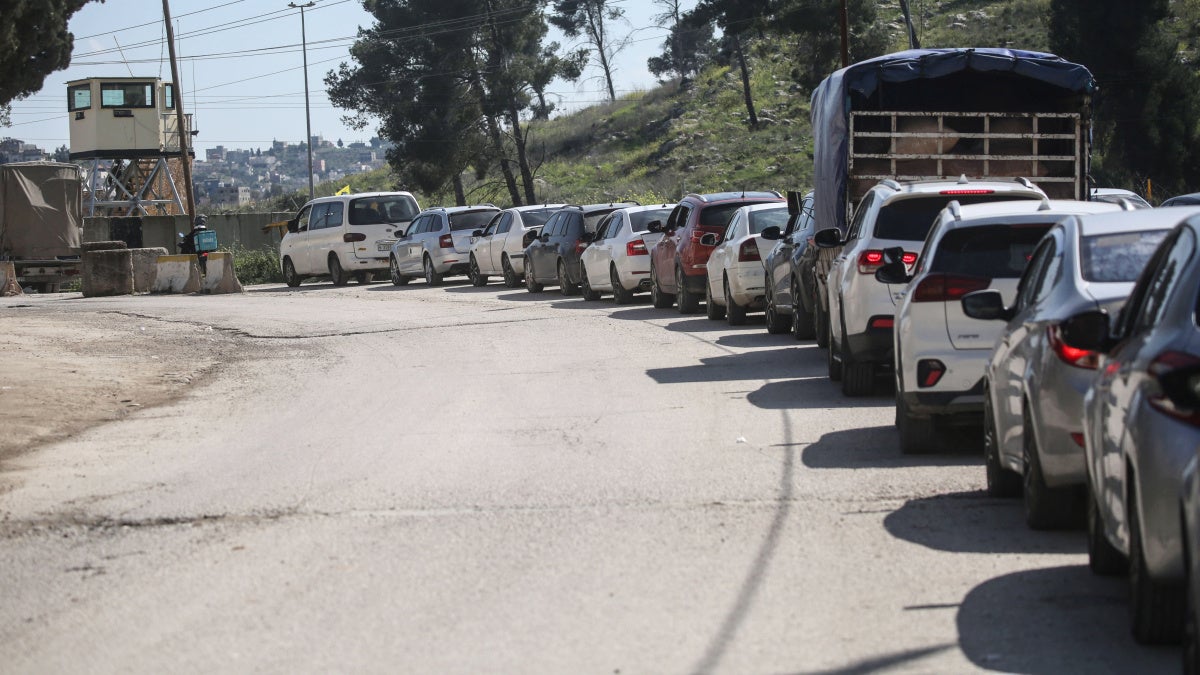
Nablus is about 30 kilometers away along the main north-south highway (#60) in the West Bank, but Israeli roadblocks and checkpoints bar Palestinians from the road. Al-Qaryuti said that he drove along the village’s only access road but found the Israeli military had closed a gate. He tried a dirt road through agricultural fields but was blocked by another gate. He rerouted again and managed to continue toward the Awarta checkpoint.
Israel set up 120 new road gates affecting Palestinians in 2025, among hundreds of checkpoints and other restrictions, according to the UN.
![A video shot by the ambulance driver as they reached the Awarta checkpoint checkpoint on July 27, 2026. The driver states, “[We're] at Awarta checkpoint. The checkpoint is closed. We're waiting for the gate to open as soon as possible because we have an urgent case [that should be driven] fast to Refidia Hospital.”](https://www.hrw.org/sites/default/files/2026-08/202608mena_palestine_bashar%20al%20qaryuti%20video%20at%20checkpoint_still.jpg)
Read a text description of this video
A video shot by the ambulance driver as they reached the Awarta checkpoint checkpoint on July 27, 2026. The driver states, “[We’re] at Awarta checkpoint. The checkpoint is closed. We’re waiting for the gate to open as soon as possible because we have an urgent case [that should be driven] fast to Refidia Hospital” Human Rights Watch reviewed the video, timestamped 7:33 a.m. © Private
As the ambulance faced delays, the woman’s condition worsened dramatically and she was at risk of hemorrhaging to death, Atallah said. “She was in dire condition. I have been working since 2014, and I can tell you I never saw bleeding like this before,” Atallah said. Atallah, struggling to save the woman’s life, said she had no choice but to help the woman give birth shortly before reaching the Awarta checkpoint. The baby died soon afterward.
When the ambulance reached the checkpoint, al-Qaryuti drove to the front of the line, and recorded a video in which he states, “[We’re] at Awarta checkpoint. The checkpoint is closed. We’re waiting for the gate to open as soon as possible because we have an urgent case [that should be driven] fast to Rafidia Hospital.” Human Rights Watch reviewed the video, timestamped 7:33 a.m.
Two Israeli soldiers ordered al-Qaryuti to turn off the ambulance, he said. He told them in basic Hebrew that a critical patient’s medical equipment relied on the engine for power, but the soldiers “were yelling, not willing to listen, and telling me, ‘Shut up.’” The ambulance’s oxygen supply, powered by the engine, stopped working, and there were no pressurized oxygen cylinders, a symptom of chronic medical shortages, Atallah said. The devices she was using to monitor the patient’s blood pressure, temperature, and oxygen level—a dangerously low 84 percent at the time—all shut off.
The soldiers pointed their guns at al-Qaryuti and ordered him to open the back doors, he said. They then, Atallah said, raised their weapons at her. Atallah was frightened but told them, in English, “The patient is bleeding and might die.” She said they ignored her warning. “They screamed at me, ‘Shut up!’”
The soldiers took the ID cards of al-Qaryuti, Atallah, the patient, and her husband. About 30 minutes later they returned the IDs, then walked to a medical vehicle for kidney dialysis patients waiting in line. The soldiers searched it and checked the IDs of those onboard before allowing al-Qaryuti to drive through the checkpoint along with the other vehicle.
The Israeli military spokesperson’s office reportedly stated that “the claim that IDF soldiers delayed an ambulance at the Awarta checkpoint is false” and that “no such report regarding such an incident was received.”
Al-Qaryuti arrived at Rafidia Hospital shortly before 8:16 a.m., when he took a timestamped photograph of the entrance to the Obstetrics and Gynecology Department. The trip “took an hour and a half, for a road that usually takes 25 minutes,” he said.
The patient received three units of blood and was sent to emergency surgery, al-Qaryuti said. She was still recovering as of July 31, an obstetrician treating her told Atallah. “I felt a deep sorrow when they told me I had lost my child,” the woman told Middle East Eye. “I was waiting for his arrival, choosing names, and preparing to buy his clothes.”
The incident illustrates the risks to life of Israel’s recent tightening of movement restrictions amid increasing settler violence, Human Rights Watch said. Atallah said that because of Israeli movement restrictions she has had to deliver three babies in ambulances in 2026. Al-Qaryuti said he was delayed at the Awarta checkpoint with a patient suffering cardiac arrest on July 26, and that settlers had attacked his ambulance five times, killing a volunteer driver in 2024. The UN documented other recent cases, which news media also reported.
- On July 18, a 30-year-old woman reportedly died of cardiac arrest after soldiers failed to open an entrance gate the military had installed to her town, Sinjil, OCHA reported.
- On July 5, at the entrance to Deir Ammar village, Israeli soldiers prevented people from carrying an unresponsive infant to an ambulance waiting on the other side of a checkpoint for about 25 minutes, and fired tear gas and flash-bang grenades, OCHA reported. The ambulance had to take a 40-kilometer detour due to checkpoints. The infant died.
- In late June and early July, soldiers and roadblocks delayed ambulances from reaching Palestinian communities with people in need of emergency medical care due to Israeli settler attacks, OCHA reported. Settlers have carried out about 1,400 attacks so far in 2026.
- In March, a woman in labor had to cross a checkpoint in Salfit on foot because Israeli forces blocked her ambulance, among other incidents where Israeli forces detained ambulances at gunpoint, according to the World Health Organization (WHO).
Israel, as the occupying power, is obliged to ensure Palestinians’ access to emergency health care and respect and protect medical transports, pregnant women, and children. Israel’s severe restrictions on movement for Palestinians, but not Israeli settlers, are inhumane acts and an element of apartheid.
As of mid-June, Israel’s military was restricting ambulances in 5 of the West Bank’s 11 governorates, OCHA reported. As of May 31, the WHO had documented 987 attacks on and delays to health care in the West Bank since October 7, 2023, affecting 673 ambulances, resulting in 39 deaths.
Governments should act to prevent further grave Israeli abuses by imposing targeted sanctions, suspending arms transfers, banning trade with illegal settlements, consider suspending preferential trade agreements, and supporting the International Criminal Court and its investigations, including by executing its arrest warrants.
“Amid rampant attacks on civilians and mass forced displacement in the West Bank, Israeli forces are delaying Palestinians from reaching hospitals, including even infants and pregnant women experiencing dangerous labor,” Van Esveld said. “No country should be supporting unlawful acts by Israel’s military or its settlements.”