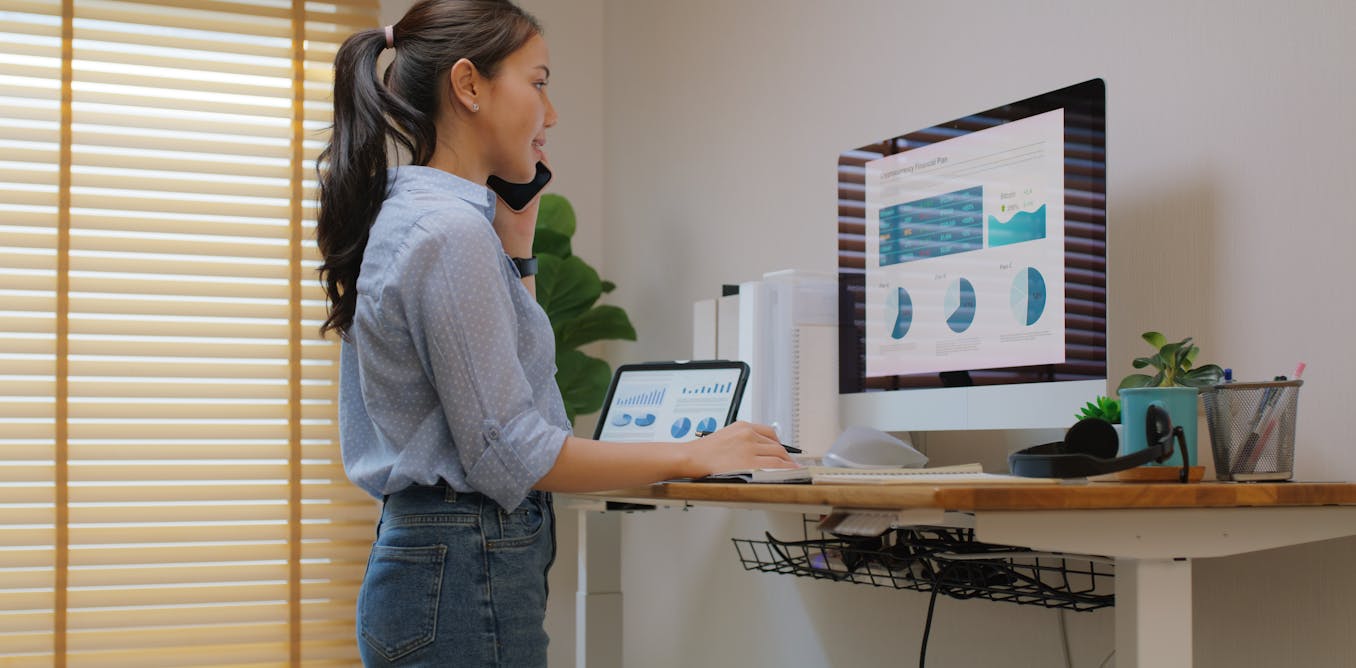
For years, we’ve been told that “sitting is the new smoking”. It’s a catchy phrase that seems to sum up a very real problem, but it’s also a huge oversimplification. If sitting were always the worst option, we could solve the problem by just standing up, and that is not the case.
For millions of people, working while standing up is not a healthy alternative but a daily demand. Healthcare and industry workers, teachers, salespeople, waiters and hairdressers spend innumerable hours on their feet — and this also takes a toll on their health.
Musculoskeletal disorders – which affect the back, neck, shoulders, legs and feet – are the most common workplace health problem in Europe. In Spain, for instance, 29% of work-related accidents resulting in sick leave in 2024 were the result of physical overexertion, while musculoskeletal disorders accounted for 78% of work-related illnesses.
The body is not made to sit still
So: is it better to work standing up or sitting down? Well, this might actually be the wrong question to ask. In truth, the most important thing is how long we spend in any given position, and how often we move throughout the day.
The human body does not respond well to any prolonged, static posture. While sitting for long periods tends to cause problems in the lumbar, neck and shoulders, hours spent standing are more linked to fatigue, lumbar pain and excessive pressure on the legs and feet.
Standing and sitting may not hurt the same – but without a doubt, neither is harmless if we do it for too long.
Don’t forget about feet
When we think of work-related aches and pains, we almost always think of the back. But the body’s workday begins much lower down.
The foot is the mechanical foundation on which everything else rests: it makes contact with the ground, distributes pressure, and transmits forces to the ankle, knee, hip and spine. If that foundation spends hours working non-stop, the rest of the body can also suffer.
In fact, in a recent study of assembly line workers, a full day of standing work was associated with measurable changes in posture and in the distribution of pressure on the soles of the feet, as well as frequent discomfort in the lower back, knees and feet themselves.
In other words, not all feet respond in the same way to the same workplace demands, and this biomechanical difference can contribute to the onset of discomfort.
So which is best?
As the European Agency for Safety and Health at Work (EU-OSHA) emphasises, it is generally healthier to vary your posture, incorporate movement, and reduce the amount of time spent in static positions.
This sometimes leads us to look for innovative solutions, such as height-adjustable desks, specially designed chairs and insoles, or gadgets such as posture correctors, ergonomic cushions and ready-made lumbar supports. Some of these tools can help, but none of them alone can make up for a poorly designed workday.
The preventative measures that actually work aren’t so exciting. They include regular short breaks, task rotation, workstation adjustments, suitable footwear, physical exercise, and a schedule that allows for movement.
Ultimately, there’s no need to demonise the chair or idealise standing. We need to understand that the body is designed to change, adapt and move. When work forces us to stay in the same position for too long, that’s when the problems start.
A weekly e-mail in English featuring expertise from scholars and researchers. It provides an introduction to the diversity of research coming out of the continent and considers some of the key issues facing European countries. Get the newsletter!