Feixue Yu, Inner Mongolia University, discusses her article: Nitrogen addition weakens drought-driven coupling between plant, arthropod, and soil nematode functional groups
The concurrent increase in drought and atmospheric nitrogen deposition has profoundly impacted multitrophic biodiversity and ecosystem functioning in grasslands. Nitrogen enrichment is frequently assumed to alleviate drought stress by stimulating plant growth, but this view largely focuses on plants alone and overlooks the complex associations that link organisms across trophic levels. Despite the well-documented individual effects of reduced precipitation and nitrogen enrichment, their interactive effects, especially on multitrophic cascading responses (e.g., plant, nematode, and arthropod communities), remain poorly understood.
In our study, we asked a simple but important question: how do drought and nitrogen addition together shape the relationships among plants, ground-dwelling arthropods, and soil nematodes, and further alter grassland productivity?
To answer this question, we conducted a four-year field experiment in a typical temperate grassland in Inner Mongolia. We explored the effects of nitrogen addition (+10 g N m–2 yr–1) and three distinct drought scenarios: intense drought (exclusion of 100% of rainfall in June), reduced precipitation frequency (by reducing rainfall events by 50% without changing total rainfall from June to August), and chronic drought (exclusion of 50% of each rainfall event from June to August) on species diversity, functional group abundance, and functional group associations within and between trophic levels, including plant, ground-dwelling arthropod (i.e., larger surface-active arthropods such as beetles and spiders), and soil nematode communities, as well as their relationships to grassland productivity.
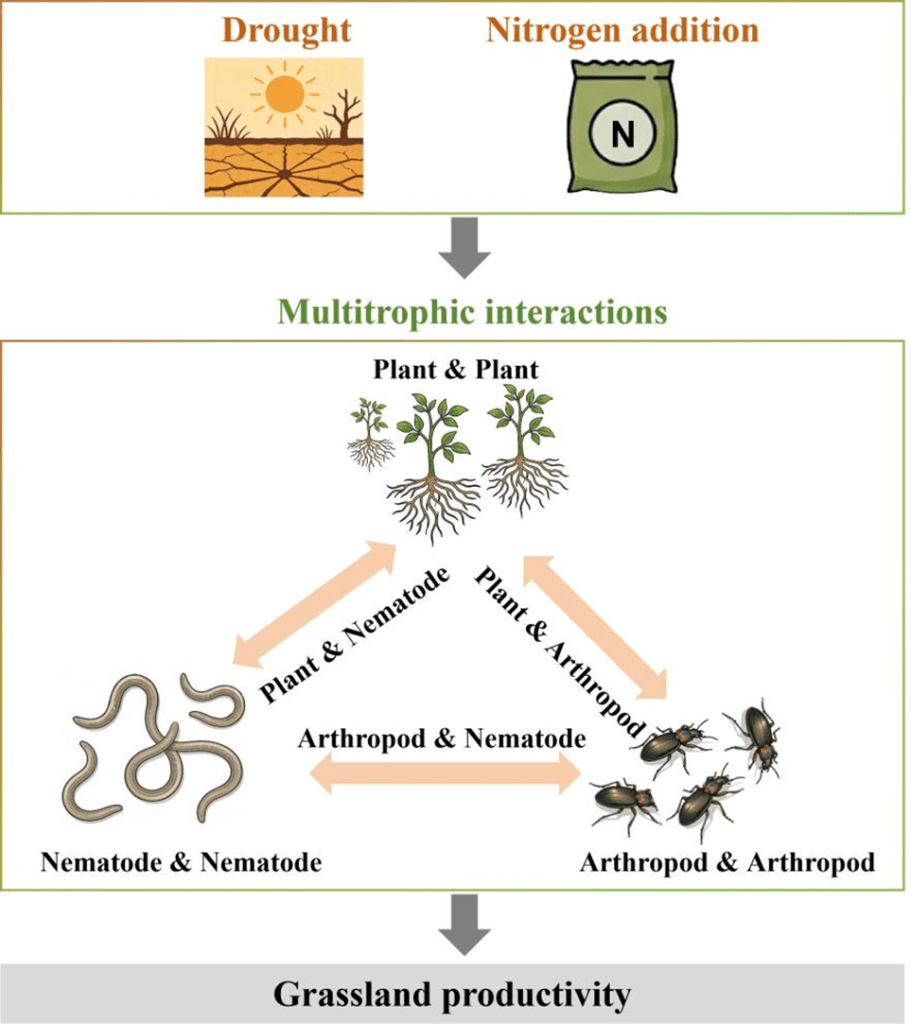
Our study found that communities at different trophic levels respond differently to various drought scenarios and nitrogen addition. Chronic drought was associated with decreased aboveground net primary productivity (ANPP) regardless of nitrogen addition. Intense drought was associated with increased microbial-feeding nematodes (bacterivorous and fungivorous), while nitrogen addition appeared to counteract this effect. Reduced precipitation frequency had limited associations with communities or ANPP.
Our study also revealed that drought, especially chronic drought, strengthened positive associations between ground-dwelling arthropod and soil nematode functional groups, whereas nitrogen addition reduced these linkages, leading to fewer multitrophic connections. Furthermore, the higher ANPP observed under nitrogen addition was associated with weaker positive associations among functional groups within and across trophic levels. It should be noted that these results were based on cross-sectional, single-season data collected in 2021 after 4 years of drought and nitrogen addition treatments and should therefore be interpreted as ecological patterns rather than definitive causal relationships. Overall, our results demonstrate that ecosystem responses to global change cannot be fully understood by looking at plants or productivity in isolation. Nitrogen deposition may boost plant growth, but at the same time weaken the biological connections that support ecosystem stability. Drought, although reducing productivity, can reorganise associations across trophic levels in unexpected ways.
These findings highlight the importance of considering multitrophic interactions when predicting grassland responses to future environmental change. Maintaining ecosystem functioning in a changing world may depend not only on sustaining biomass, but also on preserving the ecological networks that link organisms above- and belowground. These insights may improve models of grassland dynamics and inform adaptive management strategies under global change.