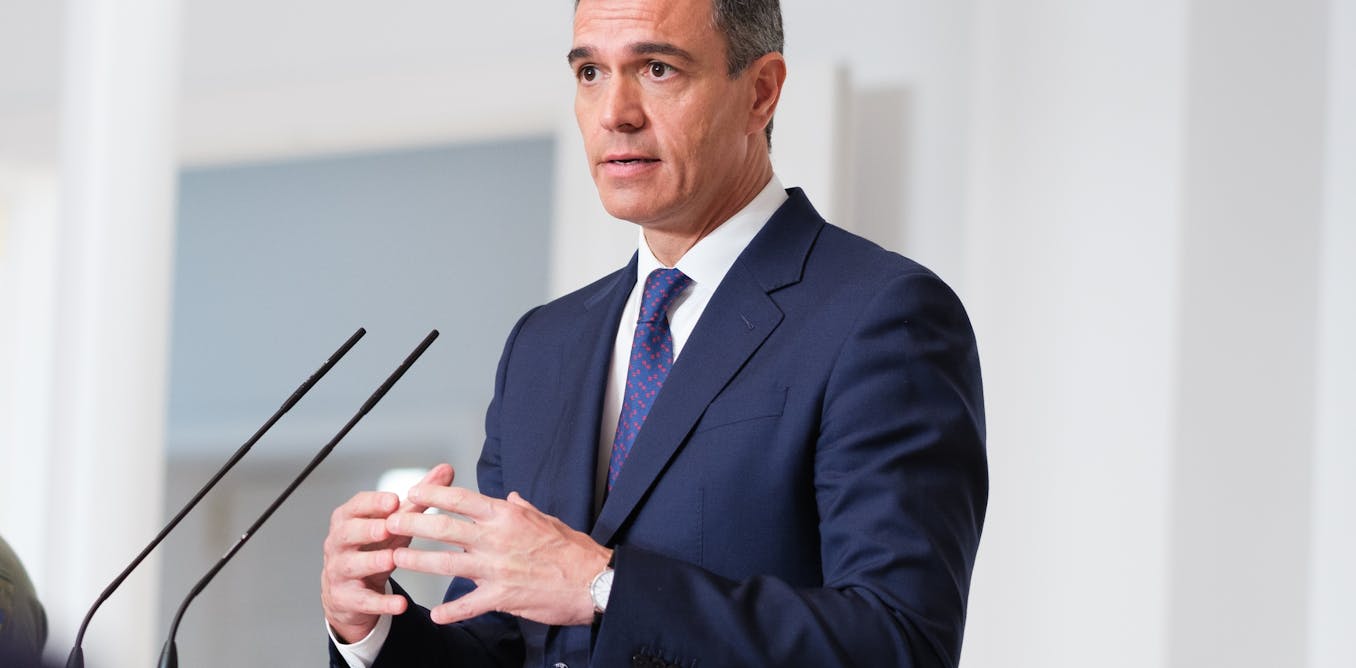
In recent months, corruption allegations have increasingly surrounded figures close to Spanish Prime Minister Pedro Sánchez, from his wife and brother to former senior officials of his party and even former prime minister José Luis Rodríguez Zapatero.
Eight years ago, on June 1 2018, Pedro Sánchez became Spain’s prime minister after a successful vote of no confidence against the conservative government of Mariano Rajoy. The motion was triggered by the Gürtel corruption scandal, and was supported by a broad coalition of left-wing and nationalist parties.
That parliamentary majority then became the foundation of a new political cycle in Spain. Since then, Sánchez has governed through a complex alliance bringing together three different groups: his own Socialist Workers’ Party (PSOE), parties to its left (first Unidas Podemos and later Sumar), and a diverse set of peripheral nationalist forces, mainly located in the Basque Country and Catalonia.
This coalition proved more resilient than many expected. It has survived the pandemic, delivered major social and labour reforms, and secured enough parliamentary support for Sánchez to remain in office after the 2023 general election.
Yet the coalition has now become increasingly fragile. And for the first time since 2018, the source of instability may be the PSOE itself.
The first signs of weakness appeared among the parties to the left of the PSOE. The alliance that once revolved around Unidas Podemos fragmented, while its successor, Sumar, struggled to maintain unity among its constituent parties. The coalition’s second pillar, the nationalist and regional parties that support Sánchez in parliament, has also become more difficult to manage.
The consequences are visible. The government has not approved a new state budget since 2022, relying instead on extensions of previous budgets, and parliamentary defeats have become commonplace.
Despite these difficulties, the PSOE – and Sánchez himself – remained the coalition’s strongest asset. Sánchez consistently outperformed expectations, survived electoral setbacks, and maintained a central position in Spanish politics. While coalition partners generated uncertainty, the Socialists provided stability. That may now be changing.
Read more:
Why the rise of a new far-right party in Catalonia spells danger for the Spanish government
Corruption allegations
Over the past two years, a growing number of investigations and allegations have affected figures connected to the PSOE and Sánchez’s inner circle. The cases involve former senior party officials, members of the prime minister’s inner circle, and individuals close to the government.
Supporters of the government argue that these investigations are textbook “lawfare” – politically motivated use of the courts to undermine or directly attack enemies. There is evidence to support this view, as some of the corruption allegations have been brought forward by Manos Limpias (“Clean Hands”), a self-styled trade union with far-right links. Critics, meanwhile, maintain that the cases reflect legitimate judicial scrutiny of those in power.
Regardless of which interpretation prevails, the political consequences are already evident.
The attorney general was disqualified last year in a case involving the disclosure of confidential information. Sánchez’s brother is currently on trial over allegations related to his appointment to a public-sector post, and Sánchez’s wife is also under investigation. The most damaging case for the PSOE has been the Koldo scandal, which allegedly involved former ministers and senior party officials in a corruption scheme linked to the purchase of face masks during the pandemic.
Other controversies have only added to the pressure. PSOE member Leire Díez is accused of seeking information and exerting pressure on judges investigating corruption cases involving the party, with support of party officials.
While Sánchez himself has not been implicated in any of the cases, allegations of bribery, leaked recordings, favouritism and political interference have combined to create a perfect storm around him.
The latest blow came with the investigation into former Socialist prime minister José Luis Rodríguez Zapatero over his alleged links to Venezuela and the airline Plus Ultra. For the PSOE, the significance is not only judicial but also political. Zapatero remains the most prominent member of the party’s old guard. He is widely regarded as a totem of the Spanish left, and has consistently backed Sánchez.
Gil Corzo/Shutterstock
Zapatero symbolises not only the PSOE but also the generation of Socialists who governed Spain between 2004 and 2011. He is remembered above all for expanding social rights, particularly through the legalisation of same-sex marriage and abortion reform. This image as a progressive leader has largely overshadowed memories of his austerity measures, spending cuts and agreements with the right-wing Popular Party (PP).
The allegations against him have resonated strongly on the left. Speaking in Spain’s national congress on May 20, left-wing Catalan leader Gabriel Rufián summarised the mood succinctly: “If it’s true, it’s shit. But if it’s a lie, it’s even worse.”
Read more:
NATO has deep divisions – but why is Spain its most openly critical member?
Losing control of the narrative
As a result of these allegations, the issue dominating public debate is no longer one chosen by the government. Housing, inflation and public services remain major concerns for Spanish voters, but corruption allegations have increasingly come to dominate political and media attention.
This represents a significant challenge for any government. One of the main advantages of incumbency is the ability to shape the political agenda. When governments lose that capacity, they often find themselves on the back foot, reacting to events rather than steering them.
The symbolism is particularly striking in Sánchez’s case. His rise to power in 2018 came through a vote of no confidence in Mariano Rajoy’s PP, after it became mired in its own string of corruption scandals. Eight years later, his opponents are attempting to frame the PSOE through a similar lens.
The end of a political cycle?
At this point, some perspective is needed. Spanish politics has experienced remarkable continuity since 2018. Sánchez has remained in office longer than many observers expected, navigating a fragmented parliament and an increasingly polarised political environment.
The current left-wing government is one of the longest-lasting of Spain’s democratic period. Sánchez’ eight year tenure is second only to Felipe González, also of the PSOE, who governed from 1982 to 1996.
We also cannot ignore the possibility that some of the current wave of allegations could be politically or judicially motivated lawfare. The words of former PP prime minister José María Aznar, spoken after Sánchez secured a second term in 2023, still resonate on the right: “Whoever can do it, do it.” In other words, remove the government by whatever means are available.

EPP/Flickr, CC BY
Sánchez’s governments have achieved notable policy successes, including labour market reforms, increases in the minimum wage, and an active role in European and international affairs. More recently, the government has pushed ahead with the regularisation of more than 500,000 undocumented migrants.
Even his critics acknowledge Sánchez’s extraordinary capacity for political survival. Still, after eight years in office, some observers, particularly on the right, believe Spain may be approaching the end of a political cycle.
If this is the case, it is not solely the result of corruption allegations and judicial investigations. The parties to the left of the PSOE are weaker than they once were, and relations with parliamentary allies have become more complicated. Legislative productivity has slowed. The party has performed poorly in regional elections in Extremadura, Castile and León, Aragón and its former stronghold of Andalusia.
This does not necessarily mean that Sánchez’s government is approaching immediate collapse. The prime minister has little incentive to call a snap election, particularly when most opinion polls suggest that a coalition between the PP and far-right Vox could emerge as the alternative. Nor is it clear that voters have definitively turned against the Socialists. Spanish politics has repeatedly shown that public opinion can shift rapidly, especially during election campaigns. Nevertheless, the mood has changed.
For years, the PSOE functioned as the strongest pillar supporting Spain’s governing coalition. Problems usually came from junior coalition partners or parliamentary allies. Now, for the first time, the main source of uncertainty appears to be the party at the coalition’s centre.
Whether the current allegations ultimately lead to convictions, exonerations or political dead ends, their impact is already being felt. They have weakened the government’s control of the political agenda, increased tensions among coalition partners, and fuelled speculation about the durability of the ruling coalition established in 2018.
There are echoes here of the final years of Felipe González’s premiership in the 90s, which was marked by corruption allegations and the GAL scandal. Those last years are often remembered as the slow decline of a long Socialist government and the prelude to José María Aznar’s victory in 1996.
So, 30 years later, are we witnessing the final stage of the Sánchez era and the prelude to a new coalition of right-wing and far-right forces? It would be premature to answer yes. But the broad coalition that brought Sánchez to power seems more fragile today than at any other point over the last eight years.

A weekly e-mail in English featuring expertise from scholars and researchers. It provides an introduction to the diversity of research coming out of the continent and considers some of the key issues facing European countries. Get the newsletter!