– Advertisement –
There is a side effect of wind turbines and wind farms that is still rarely discussed: offshore wind farms, located in coastal waters, are creating new habitats under the sea. Around their foundations, protected reef-like structures are forming, where more crabs settle than on the surrounding seabed. These wind farms are therefore not only relevant for the energy transition but can also support sustainable fishing.
Numerous brown crabs and lobsters live around the foundations of wind turbines in the southern North Sea. Coastal fisheries in Germany could benefit from this — if they switch from trawl nets to crab pots. The Thünen Institute is examining how this could work until 2029.
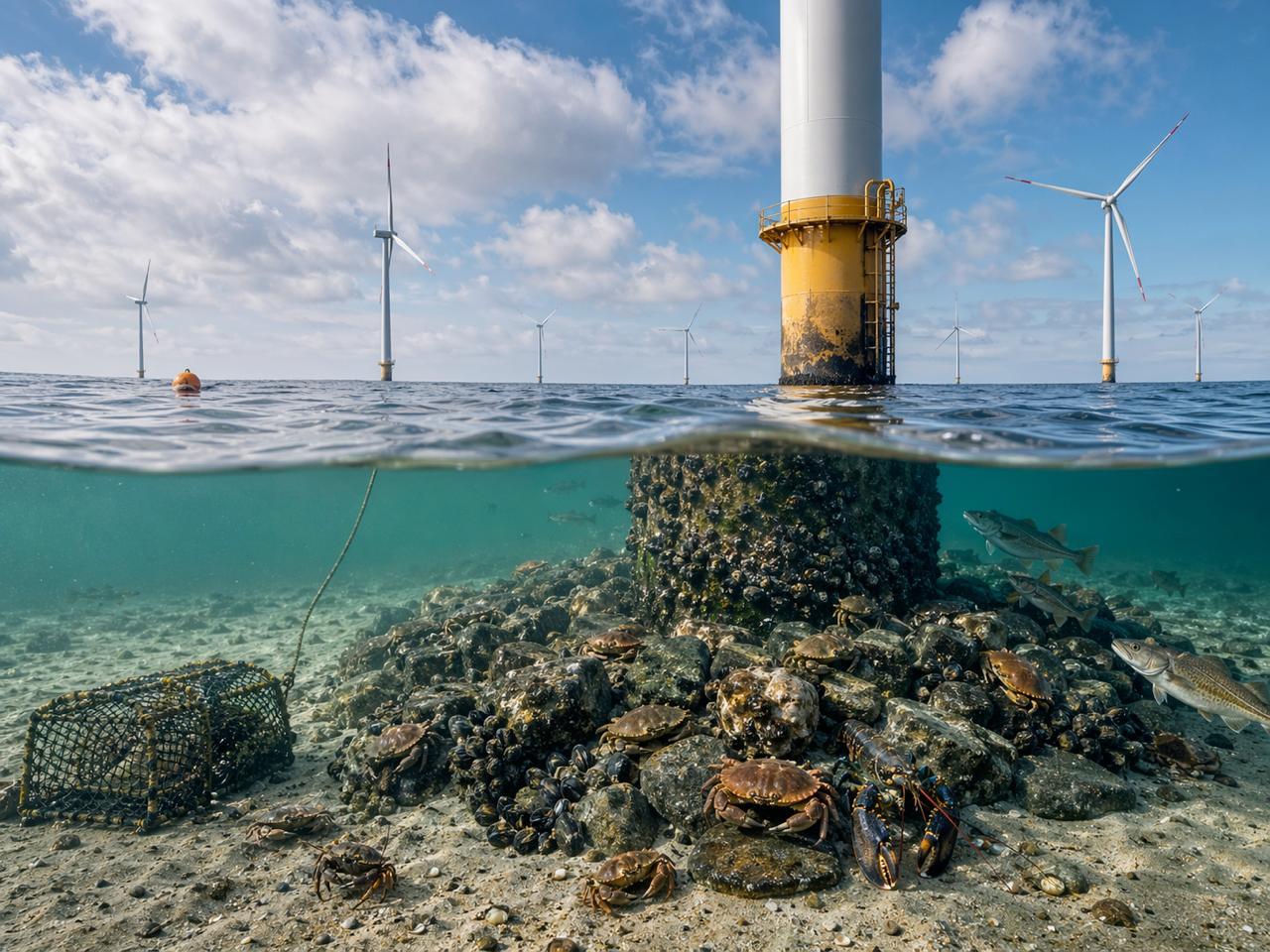
Wind turbines are not simply placed on a bare seabed. Around each foundation, operators pile up large rocks to prevent currents from washing away the sand beneath the structures. For marine life in the North Sea, this rock armour acts like an artificial reef. On the soft sandy seabed, crabs and mussels would otherwise struggle to find a foothold. On the rocks, they can attach themselves, find shelter and grow.
Far more crabs gather at turbine foundations than on the natural seabed
The Thünen Institute, a German federal research institute for fisheries, forestry and rural areas, has been observing this effect for some time. About ten years ago, researchers counted up to 5,000 brown crabs at individual foundations – many times more than on the surrounding sandy seabed. Cod and lobsters are also found around the structures. Young crabs grow there, while adult animals migrate up to one kilometre into surrounding waters.
For coastal fishers, the expansion of wind farms was initially bad news. Trawl nets are banned between turbines because they could damage cables and pipelines on the seabed. This meant the loss of important fishing grounds.
Rethinking fishing: crab pots instead of trawling
In the PassFisch project, the Thünen Institute is investigating whether fisheries can adapt – moving away from trawling and towards crab pots. These are stationary traps placed on the seabed. Crabs crawl inside, the seabed remains undisturbed, and bycatch is minimal.
Because trawling is not allowed in wind farms, these areas also act as refuges. The seabed is not disturbed, allowing juvenile species to grow undisturbed. Some later migrate into surrounding waters, strengthening local stocks. Project leader Vanessa Stelzenmüller says wind farms could, in some areas, provide a sustainable and economically viable alternative to traditional shrimp fishing.
By August 2029, the team aims to determine the actual size of the stocks, whether crab fishing is economically viable for businesses, what prices brown crab and lobster can achieve, and under what conditions wind farm operators will allow crab pots between their turbines. The project is funded by the state of Lower Saxony through an EU fisheries fund.
The rights to the content remain with the original publisher.
Post Views: 14
– Advertisement –