
Smriti Pehim Limbu, University of Georgia, discusses her article: Drought legacies weaken resistance and plant‐mycorrhizal associations but not recovery
Grasslands are increasingly facing extreme droughts, yet we still know relatively little about how past drought shapes the response to future events. A grassland experiencing drought today may still carry the effects of droughts that occurred years earlier, and those legacies can influence not only productivity but also plant traits and belowground interactions. Understanding these legacies requires experiments that run long enough for ecological history to accumulate. Our study used exactly that kind of experiment. At Konza Prairie Biological Station in Kansas, the Climate Extreme Experiment has exposed native tallgrass prairie to repeated extreme droughts since 2010. Rainout shelters reduce growing-season precipitation by 66%, allowing us to follow how the same grassland responds to drought, recovers, and then faces another extreme drought. By the time I joined the project as a Ph.D. student at the Johns Hopkins University, the experiment was already about a decade old. Earlier work had shown that drought strongly reduced aboveground plant production, followed by substantial recovery once rainfall returned. Other work examined how previous drought affected roots. I was interested in whether other parts of the ecosystem also carried a legacy of past drought.
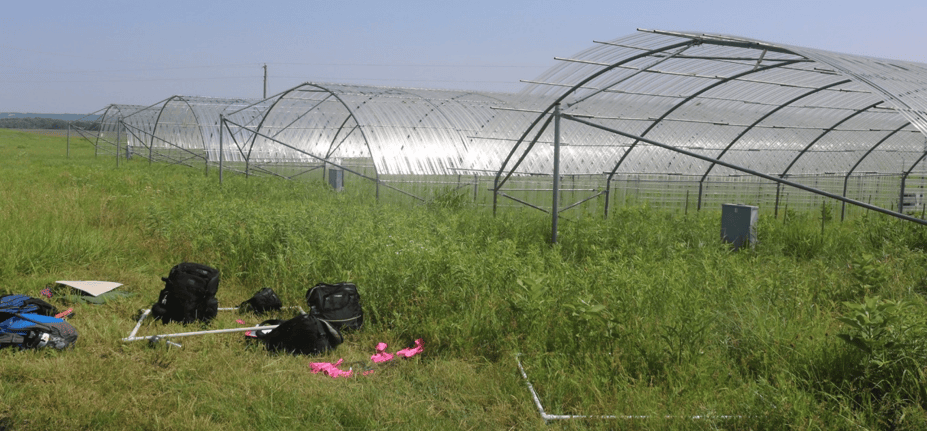
Building new questions onto a long-term experiment, and the disruption of COVID-19
One of the things I find most exciting about long-term ecological experiments is that they allow us to ask questions beyond those they were originally designed to address. As ecological history accumulates, these experiments create opportunities to ask new questions. In our study, we looked beyond total plant production to ask whether repeated drought also altered the plant community, the characteristics of dominant grasses, and their relationships with arbuscular mycorrhizal fungi – symbiotic fungi that live in plant roots and exchange soil nutrients for plant carbon.
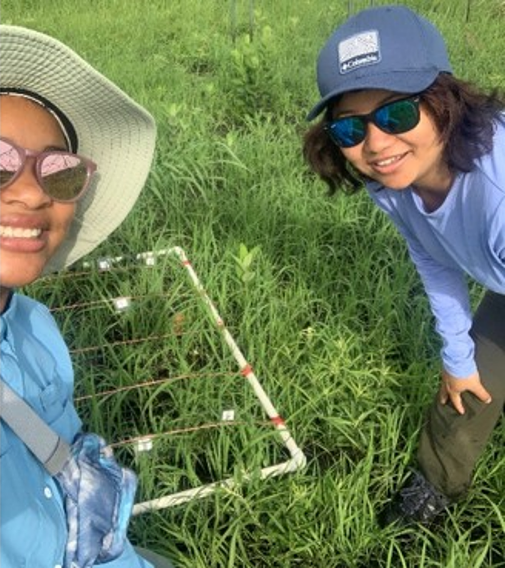
The experiment also reflects the realities of doing long-term ecology. Our most recent drought treatment ran from 2018 through 2021 and overlapped with the COVID-19 pandemic. As with many field projects during that period, we were unable to collect some measurements. Long-term datasets are rarely perfectly tidy records of ecological change. They also reflect the circumstances under which science is done. What makes experiments like this so valuable is that their duration still allows us to detect patterns that would be difficult to capture in a one- or two-year study.
The effects of drought history were not always obvious
For much of the four-year drought, previous drought exposure had surprisingly little effect on aboveground productivity. The strength of the experimental drought also depended on background climate. In 2019, for example, unusually wet conditions meant that even after excluding 66% of growing-season precipitation, droughted plots still received substantial rainfall, and differences among drought-history treatments were relatively small. By the final and most severe drought year, however, plots that had already experienced two previous extreme droughts were less resistant than plots with no previous drought exposure.
After the experimental drought ended in 2021, all plots received ambient rainfall in 2022. Productivity recovered similarly across all drought-history treatments. The plant community also remained relatively stable. If we had measured only aboveground productivity, we might have concluded that the grassland had largely bounced back. But other responses revealed a different picture. Previous drought altered traits of the dominant grasses and weakened their associations with arbuscular mycorrhizal fungi. These responses remained evident even when differences in aboveground productivity were no longer apparent.
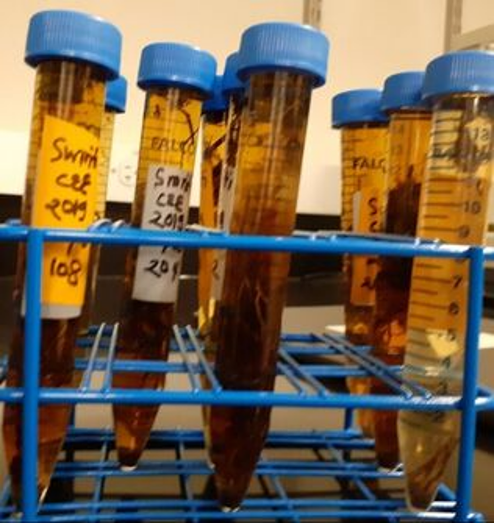
Recovery is more than becoming green again
For me, one of the most important lessons from this study is that resilience depends on what we measure. Aboveground productivity recovered similarly across drought-history treatments in 2022, but other responses still reflected past drought. Traits of the dominant grasses had shifted, and arbuscular mycorrhizal fungal colonization remained reduced in plots with drought legacies. These differences may influence how the grassland responds to future stress, even when productivity appears to have recovered. Long-term experiments such as the Climate Extreme Experiment give us a rare opportunity not only to ask whether ecosystems recover, but also which components recover, which do not, and which continue to carry the effects of past drought.








