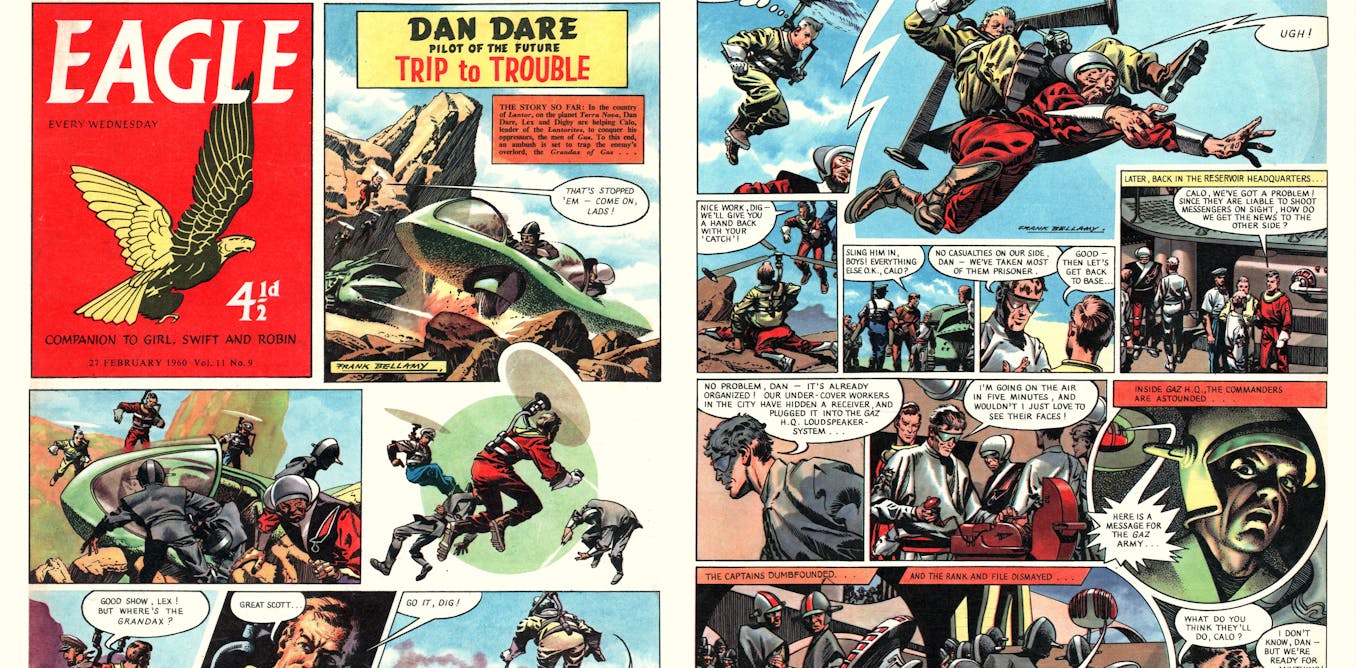
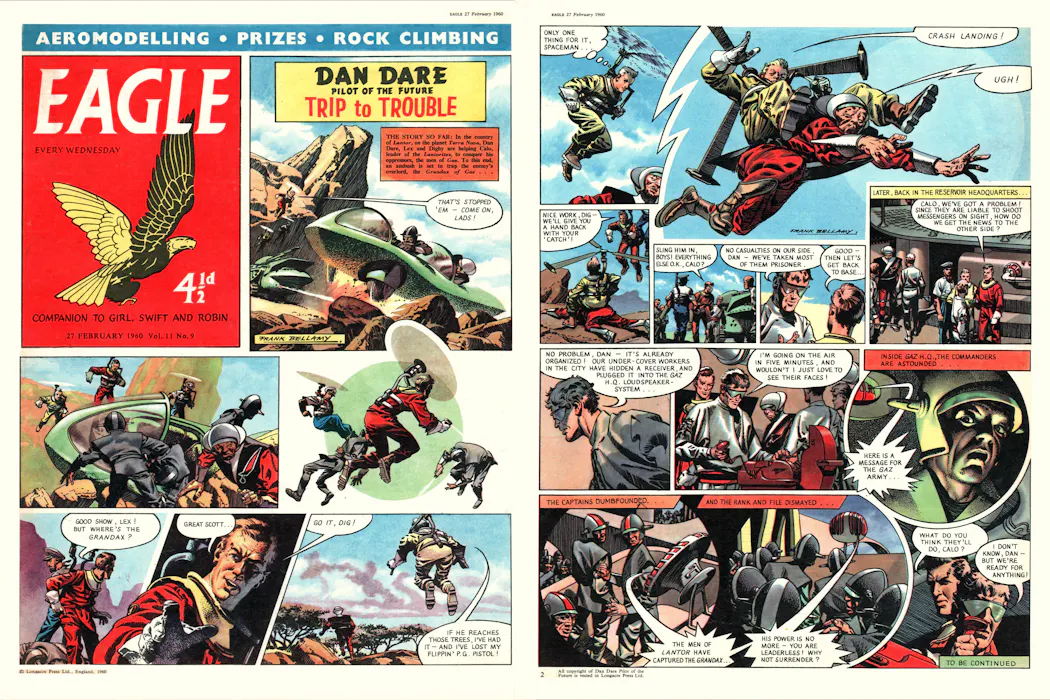
Dan Dare: Pilot of the Future was a groundbreaking science fiction comic serial, first appearing in the UK comic The Eagle in 1950. Now, more than 75 years later, a reinvention of the series is underway, with the first new graphic novel written by Alex de Campi (Bad Girls and Madi) with art by Marc Laming (Marvel’s Star Wars). set for later this year.
As science fiction enthusiast and a scientist, I am excited to see what it will be like. I’m sure I’m not alone, as a number of scientists – including the late astrophysicist and cosmologist
Stephen Hawking and planetary scientist Colin Pillinger – cited Dan Dare’s exciting vision of the future as instrumental in their decision to pursue science.
Daniel McGregor Dare is an officer in the Britain-based Interplanet Space Force (ISF). Faced with overpopulation and starvation on Earth, the ISF is tasked with exploring the possibility of crop production or trade on Venus. After initial problems, Dan Dare and a small group of colleagues are able to reach the surface of the planet. Once there, they find a habitable world with two native species: the friendly Therons, and the inimical Treens, with the latter led by their “super-scientist” the Mekon. Defeating the Mekon, and making arrangements for food supply with the Therons, Dare opens up the solar system, and ultimately the wider galaxy, to humanity.
While the concept of Dan Dare originated with a clergyman, Marcus Morris, its formative years and storylines were shaped by a very different man. Writer and artist Frank Hampson was known for the attention he paid to the science, working from detailed models and reference photographs. He gave thought to plausible design and stayed abreast of developing vehicle technologies and concepts, while also working with a scientific advisor.
In an early story, “The Red Moon Mystery” (serialised in The Eagle in 1952), for instance, he had the character Professor Peabody explain planetary orbits, magnetic fields and spectroscopic biosignatures to a young audience. He also drew a sequence with accurate representations of the Royal Observatory at Herstmonceux in Sussex, and a character closely based on the astronomer royal of the time, Sir Harold Spencer Jones.
This level of precision both added to the verisimilitude of his stories and appealed to an enthusiastic audience that saw a bright future in space exploration, an audience that included budding scientists Hawking and Pillinger.
Sadly, the level of scientific accuracy in the series declined after Hampson’s departure, with writers introducing more bizarre aliens and unexplained interstellar travel. But its engagement, from the very beginning, with technical accuracy and scientific plausibility, continues in many ways and is also part of the reason for its longevity and why it remains relevant.
A new Dan Dare
Despite its many reinventions over the decades, much of this premise has remained unchanged. Dare has always represented humanity’s best, and is typically shown as an optimistic exemplar of bravery, chivalry and honour. The Kickstarter page for the new Dan Dare: First Contact novel makes it clear that the current creative team respects the character’s origins. As the new reboot’s writer Alex de Campi says:
if you are already a Dan Dare fan, there’s a ton of references to the classic stories as well as a sincere respect for Frank Hampson’s legacy from our entire creative team.
But like the 1990s graphic novel written by Scottish comic writer Grant Morrison or the 2010s audio dramas made by B7 Productions, there will be some changes in the story. For instance, these iterations have given more agency to Dare’s female scientist colleague Professor Jocelyn Peabody. They have also typically been darker and more cynical regarding the political or commercial interests funding human spaceflight.

Wikimedia
The new Dan Dare team also acknowledge Hampson would have expected changes in scientific and contextual representation:
In First Contact, the science is updated, making Dan’s world one we can understand from our current point of view: a world of bickering oligarchs, broken nations, and climate disaster. The stakes are immediate: humanity is only just getting faster-than-light travel.
As I’ve discussed in my own work on the relationship between science and science fiction, the stories have always reflected our changing understanding of solar system habitability. Already by 1950, scientific studies were making it clear that Venus was uninhabitable, although popular culture and even school textbooks often retained the older visions. As a result, more recent versions have tended to gloss over issues such as the origin of the Treens, sometimes relocating their civilisation to cloud cities high in the atmosphere of Venus.
The changing science shouldn’t be a surprise: the role of science fiction has always been to mirror and extrapolate as much from the sociopolitical concerns of a time as from its technology and science. Good science fiction has always balanced accurate science with fine storytelling and a critical eye towards social trends and their logical extremes. The new Dan Dare project will do so for a new audience, adding to a remarkable eight-decade long record of popular engagement with space science.

Elizabeth Stanway does not work for, consult, own shares in or receive funding from any company or organisation that would benefit from this article, and has disclosed no relevant affiliations beyond their academic appointment.