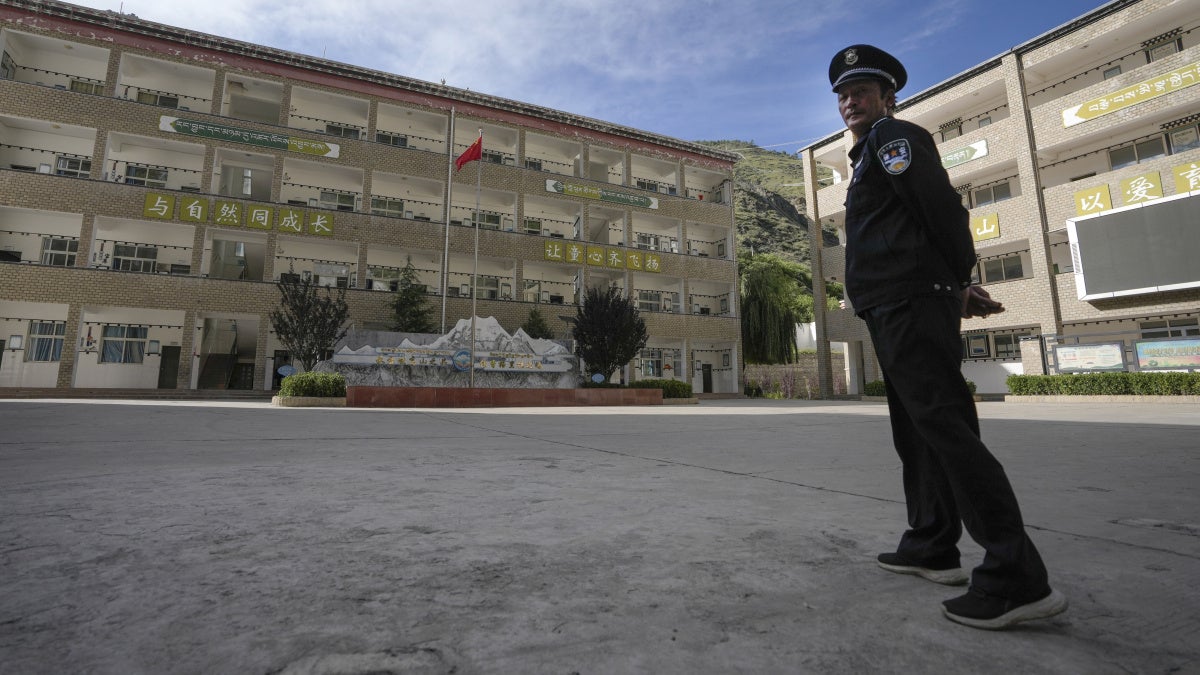
- A 2021 Ministry of Education directive—the Children’s Speech Harmonization plan—mandates the use of standard Mandarin Chinese for all preschool instruction and care, including in ethnic minority areas.
- By severely limiting Tibetan-language education in early childhood, and imposing ideological indoctrination on kindergarten children, the Chinese government is speeding up its erasure of Tibetan language and culture.
- The Chinese government should end political indoctrination in early childhood and ensure that Tibetan children are able to learn and use Tibetan in kindergartens. Foreign governments should press the Chinese government to free detained advocates of Tibetan language and allow independent access to Tibetan areas.
(New York) – The Chinese government is imposing Chinese-medium education and ideological indoctrination on kindergarten children in its efforts to force Tibetans to assimilate, Human Rights Watch said in a report released today.
The 72-page report, “Start with the Youngest Children: China Uses Preschools to ‘Integrate’ Tibetans,” documents that a 2021 Ministry of Education directive—the Children’s Speech Harmonization plan—mandates the use of standard Mandarin Chinese for all preschool instruction in ethnic minority areas. While the kindergartens in theory can still offer supplementary sessions for minority children in their own language, minorities no longer have the legal authority to do so. By severely limiting Tibetan-language education in early childhood, a stage critical for language acquisition and identity formation, the Chinese government is speeding up its erasure of Tibetan language and culture.
“The Chinese government, by targeting kindergarteners, is accelerating its campaign to deprive Tibetan children of their mother tongue and their culture and identity,” said Maya Wang, deputy Asia director at Human Rights Watch. “This policy is not about education quality, but about forcibly assimilating Tibetans at an early age into a Han-centric national identity.”
The report is based on an analysis of Chinese laws and policy documents, and academic and media sources. Human Rights Watch also interviewed seven Tibetans and scholars with recent, direct knowledge of conditions in Tibetan areas, where access is extremely restricted.
Human Rights Watch found that many Tibetan children emerge from preschool unable or unwilling to speak Tibetan, even with family members. Parents reported that within weeks or months of starting kindergarten, children switch almost entirely to Chinese.
The 2021 Harmonization Plan is the culmination of decades-long policy shifts reducing mother-tongue education for minorities. Since the 1984 Regional National Autonomy Law, China has moved in five stages to mandatory Chinese-instruction at progressively younger ages. While this process had been completed in primary and secondary schools, kindergartens were long the last setting where Tibetan could still be used as a main language of instruction.
In 2021, the Education Ministry ordered all kindergartens in minority areas to use the “national common language,” or standard Chinese, for all teaching and care activities. Official references to “bilingual education” disappeared from policy documents. A series of legal rulings, education laws, and government policies eliminated remaining legal and policy space for minority language education while embedding political and cultural indoctrination throughout the school system, including at the preschool level. This culminated in the 2026 Law on Promoting Ethnic Unity and Progress, which imposes legal penalties for anyone deemed to “obstruct” the learning and use of Chinese.
Although preschool is not compulsory in China, Human Rights Watch found that in Tibetan areas it has become obligatory in practice. Primary schools in urban areas increasingly require proof of kindergarten attendance for enrollment, leaving parents little choice but to send their children to Chinese-language preschools.
The authorities also require kindergartens to encourage or pressure parents and children to speak Chinese in their homes and to submit videos of them doing so. Government-appointed examiners have tested preschoolers’ Mandarin skills through interviews and observation, despite regulations that prohibit examinations and other academic pressure in kindergartens.
The language policy is paired with intensified political and cultural indoctrination. Preschool curriculums in Tibetan areas increasingly emphasize “patriotic education,” loyalty to the Chinese Communist Party, and identification as members of the “Chinese nation.” Children are taught to celebrate Han Chinese festivals, recite Chinese classics, sing patriotic songs, and participate in activities glorifying the military and revolutionary history. Tibetan Buddhism and Tibetan cultural practices—core elements of cultural and ethnic identities—are absent from the curriculum.
The accelerating language loss among ever younger Tibetans has profound cultural consequences, Human Rights Watch said. These include weakening communication between children and elders, altering family dynamics, reduced transmission of religious and cultural knowledge, and the growing perception among children that Tibetan language and identity are inferior.
China’s policies contravene its obligations under international human rights law, including the United Nations Convention on the Rights of the Child, which guarantees children belonging to minorities the right to use their own language and obligates states to ensure education respects children’s cultural identity.
The Chinese government should reverse policies that mandate Chinese-medium education in preschools, restore genuine bilingual education options, and end political indoctrination in early childhood settings, Human Rights Watch said. Foreign governments and the UN should also press the Chinese government to comply with its international obligations and to allow independent access to Tibetan areas and schools.
“Language loss on the scale taking place in Tibet is not accidental – it is Chinese government policy,” Wang said. “Unless China’s practices change, an entire generation of Tibetan children will grow up cut off from their own language, culture, and heritage.”
Selected Quotes:
“Education must penetrate the blood and reach into the soul; it must be grasped from an early age, starting in kindergarten. We must do a good job with patriotic education, planting the seeds of love for China deep in every child’s heart, and ensuring that the core socialist values take root and grow in the minds of the next generation. All ethnic groups must teach children to develop a sense of belonging to the Chinese nation, so they do not only identify with their own ethnicity, but first and foremost recognize themselves as part of the Chinese nation.”
– Chinese Communist Party General Secretary Xi Jinping, in a speech at the Central Nationalities Work Conference on September 28, 2014.
“This is not only about not teaching the Tibetan language. … It is carefully done to manage the way children think and believe.… The problem is that the kindergarten platform is designed in favor of the Han Chinese nationality – the way you talk, the topic, how to recognize objects, any knowledge that is introduced. Not even a whiff of the Tibetan way of thinking is there. The result is that when the children come out of kindergarten at age 6, even if both parents are Tibetan, the children think that they are Chinese.… In a decade or two, maybe the culture will die, and be only in a museum.”
– Tibetan official involved in cultural policy implementation, interviewed by Human Rights Watch in mid-2025.
“Even though she is still able to understand it [Tibetan], she only answers in Chinese. After some time, she managed to give me some simple (single word) answers in Tibetan, but it was obvious she was making a great effort to do so…. There are two preschools in the town, and the mother chose the one where Tibetan language is not completely banned: the children are only spoken to in Chinese, but they are allowed to speak Tibetan in the playground.”
– Scholar who specializes in linguistics, interviewed in writing by Human Rights Watch on March 5 and 6, 2025.
“All kids below 10 speak Chinese to each other. They do not speak Tibetan to each other. If you force them to, they speak Tibetan, but how well depends on the parents. It’s a lost cause – and it’s happened in one generation.”
– Tibetan Studies scholar, interviewed by Human Rights Watch via text message on October 10, 2025.