Delivered by Innovate UK on behalf of the Department for Business, Innovation, Science and Trade, the competition is designed to support UK businesses and researchers to develop new battery technologies.
The competition focused on sourcing and processing battery materials, recycling valuable materials, strengthening UK manufacturing and reducing reliance on overseas supply chains.
Recycling batteries
Lithium Battery Recyclers Ltd has been awarded more than £1.2 million to lead project Reclaim, to develop a new UK process for recycling end-of-life electric vehicle batteries.
The process, developed by the University of Leicester, uses a tiny quantity of vegetable oil in water to separate valuable battery materials, including graphite, without acid leaching or hazardous chemicals.
The project will scale up the technology at a pilot facility in Widnes, Cheshire, and test the recovered materials for reuse in new batteries.
It aims to reduce the energy needed for recycling and keep valuable battery materials in the UK to support domestic manufacturing.
Reducing waste
Hyperbat, now part of Unipart Manufacturing Group, has received more than £2.4 million to lead a project.
This aims to reduce the number of electric vehicles written off because their batteries are damaged or no longer working as expected.
At present, it can be difficult to assess whether these batteries are safe to repair or reuse.
This can lead to unnecessary vehicle write-offs, higher insurance costs and valuable materials being lost.
The project will develop a clear process for checking each battery and deciding whether it can be repaired, reused , given a second life for energy storage or safely recycled.
The work could keep batteries in use for longer, reduce waste and create skilled jobs in the UK.
Feasibility studies
The competition has also awarded just over £6.2 million to 15 shorter feasibility studies exploring new ideas across the battery supply chain.
Running for between six and 12 months, these projects will test whether early-stage technologies could improve how batteries are made, used, reused and recycled.
This will help the most promising ideas move towards further development and commercial use.
Superdielectrics Group and Sytronix have been awarded almost £500,000 to test a new type of battery that could help data centres manage the rapid changes in electricity demand.
The water-based battery is designed to store and release power quickly, helping data centres run more AI servers without placing additional strain on local electricity networks.
The project will build on an existing battery pack and test how it responds to the changing power needs of AI systems.
If successful, the technology could help data centres make better use of their existing grid connections and expand without requiring immediate upgrades to local power supplies.
It could also provide a safer alternative to conventional lithium-ion batteries and reduce reliance on imported battery materials.
Investment in skills
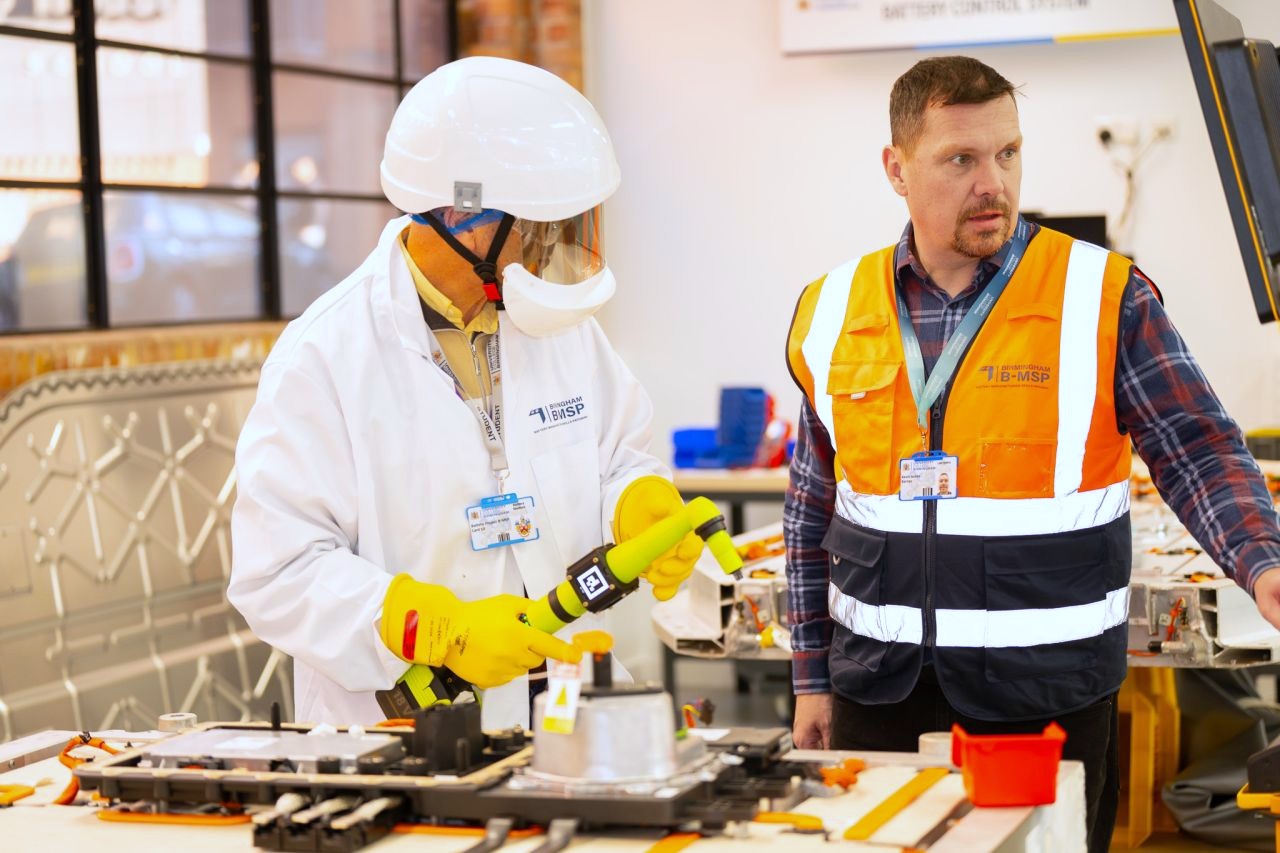
The Battery Innovation Programme has also awarded £3.6 million to three regional skills initiatives.
These will accelerate the development of the UK’s battery manufacturing workforce and strengthen national capability across the battery value chain.
The investment will support the delivery of industry-focused nationally accredited training programmes across England.
These will equip learners with the skills needed to secure careers in one of the UK’s fastest-growing advanced manufacturing sectors, and help businesses access talent to meet increasing demand.
University Centre Somerset will deliver Level 2 and 3 battery manufacturing training for the South West battery cluster.
University College Birmingham, and Newcastle University with New College Durham in the North East, will expand their training to Levels 4 and 5.
Dr Valentina Gentili, Director of the Battery Innovation Programme, said:
As global demand for batteries continues to grow, it is increasingly important that the UK focuses on the areas where it can deliver the greatest impact and strategic value. The projects supported through this competition demonstrate the breadth of innovation taking place across the UK battery sector.
By investing in new technologies, strengthening supply chains and supporting business growth, we are helping to build the capabilities, expertise and partnerships that will further strengthen UK sovereign capability and position the UK as a leader in battery innovation.
Minister for Reindustrialisation Blair McDougall, said:
This funding will give Britain’s battery manufacturing industry the support they need to power the industries of the future and keep our country at the cutting edge of innovation.
Through our Modern Industrial Strategy we’re doubling down on Britain’s high-growth sectors like advanced manufacturing, and I want to congratulate all the winners on their success and their role in reinforcing Britain’s leadership in this fast-growing industry.
Further information
Round 2: Concept development winners
Nine projects were awarded £18.74 million in grant funding.
Genesis
Direct production of battery-grade lithium hydroxide at uk mine sites through integrated sustainable processing
Lead: Evove Ltd
Silife+
Drop-in silicon anodes for long-life li-ion batteries
Lead: Amplisi
Restore
Recycling and second-life technology for energy storage
Lead: Hyperbat, now part of Unipart Manufacturing Group
Project Stockman
Strategic treatment of critical materials: keeping value and materials nationally
Lead: Battery Mineral Ltd
Sustainable fluorochemical supply chain for li-ion battery production
Lead: Fluorok Ltd
Hermes
Hazardous energy recycling: methods for emerging specialist chemistries
Lead: Recyclus Group
Project Shredder
Sustainable high-value recovery via engineered deconstruction of energy storage for reuse
Lead: Ecobat Solutions UK Ltd
Reclaim
Recovery and circularity of lithium-ion assets into UK manufacturing
Lead: Lithium Battery Recyclers Ltd
Cascade
Critical metal acquisition via sustainable chemistry and diverse extractants
Lead: Reore Technologies
Round 2: Feasibility studies winners
15 projects were awarded £6.23 million in grant funding.
EcoPreCat
Advanced eco-friendly precursors for cost-effective L(M)FP cathodes
Lead: Integrals Power Ltd
Engineered proteins for selective rare earth recovery from end-of-life battery leachates
Lead: LanthaGen Bio Ltd
CREST
Coastal resilient energy storage technology
Lead: AceOn Battery Solar Technology Ltd
Smart battery formation with sensors
Lead: DZP Technologies Ltd
Pulsetherm
Pulsed-flow thermal management for ultra-fast electrified mobility charging
Lead: Altra Solutions Ltd
ReB-DC
BESS Digital Twin and performance optimisation for data centre stationary storage
Lead: RE24 Ltd
Magiq
Magnetic field assistance across the full cell finishing sequence
Lead: Gaussion Ltd
A breakthrough rack-level battery orchestration layer for power-aware AI data centres
Lead: Superdielectrics Group plc
Phase-BMS
State-aware SOC/SOH estimation intelligence for software-defined BMS of LFP BESSs
Lead: ChargeRevive Ltd
High temperature ALD/CVD manufacturing technology for lithium-sulphur battery electrodes
Lead: Novacore Technologies Ltd
Gas-anode
Graphitic anode supply from industrial waste gas
Lead: Entropyst Ltd
Vanadium 4 polarisation organic wattage electrolytic redox, Vanadium4POWER
Lead: PuriFire Labs Ltd
Dura-anode
Carbon-additive-driven asset life extension for grid-scale battery storage
Lead: Gavion Ltd
Project Atlas
AI-optimised twin for low-cost aqueous aluminium-ion multi-day storage
Lead: Stortera Ltd
SuReMat
Sustainable recovery of metals for battery remanufacturing
Lead: Nanomox Ltd
Battery skills competition winners
Three projects were awarded £3.6 million in grant funding.
Somerset battery manufacturing training
University Centre Somerset
Level 2 and Level 3 battery manufacturing training supporting the South West battery cluster, including opportunities connected with the Agratas Gigafactory near Bridgwater.
Birmingham Battery Manufacturing Skills Pathway
University College Birmingham
Expansion of its existing pathway to include Levels 4 and 5 advanced technical training.
North East battery manufacturing training initiative
Newcastle University and New College Durham
Expansion of battery manufacturing training to Levels 4 and 5, building on collaboration with AESC.
This article was originally published on https://www.ukri.org/news/charging-towards-the-battery-electric-future/. It is shared here under a Creative Commons license.