The work applies decades of fast ignition research to a commercial inertial fusion design.
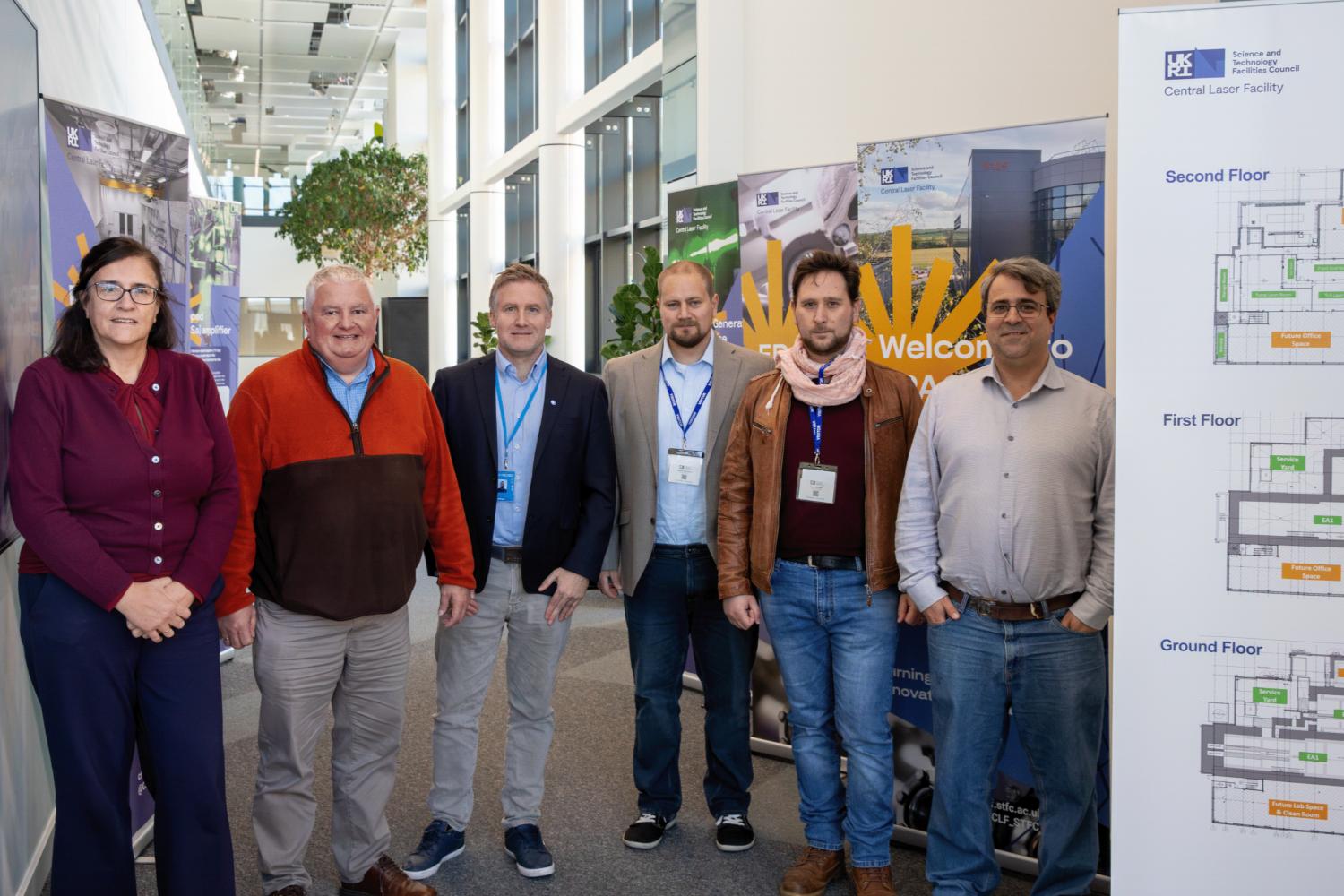
The Science and Technology Facilities Council (STFC) Central Laser Facility (CLF) has begun working with First Light Fusion.
Together they will develop the fast ignition physics at the centre of First Light’s FLARE (Fusion via Low-power Assembly and Rapid Excitation) approach to inertial fusion.
The work shows how UK national laboratories and private fusion companies can combine their capabilities.
It will also increase the UK’s expertise in high power lasers and high energy density physics in the pursuit of commercial fusion energy.
Professor John Collier, director of the STFC Central Laser Facility, said:
This collaboration applies CLF’s fast ignition modelling and experimental expertise to a clearly defined system challenge. By working together, we can identify the most robust approaches and target the experiments that will deliver the greatest value.
How fast ignition separates compression from heating
Fast ignition separates the two steps needed for fusion. The first is compressing deuterium-tritium fuel to high density.
The second is heating the fuel rapidly to start fusion burn.
First Light has already validated the compression step. It tested FLARE’s multi-shell compression architecture on its M3 facility.
CLF will now work on the second step, using its experience in short-pulse laser technology to establish how best to heat the compressed fuel.
Researchers have studied fast ignition internationally for several decades, including at CLF.
Modelling the ignition step
CLF scientists will model how a short, intense laser pulse generates energetic electrons.
They will also model how those electrons travel through the plasma, and how efficiently they deposit their energy into dense fusion fuel.
The programme will explore approaches including engineered target structures and magnetic fields.
These are designed to guide energetic electrons into the ignition region.
The aim is to reduce further the laser energy needed for ignition.
This builds on the savings already offered by FLARE’s target concept.
Designing the ignition system with the fusion system
FLARE offers the opportunity to design the compression system, ignition system and target together from the outset.
Its cylindrical geometry gives clean, direct access to a large area of compressed fuel compared with standard laser fast ignition approaches.
This considerably widens the design options.
CLF and First Light will not optimise laser performance in isolation.
They will assess the physics alongside the efficiency, cost, engineering and scalability requirements of an eventual fusion system.
Reducing the energy needed to start fusion burn
A central objective is to minimise the energy needed to start burn while maintaining the high fusion gain needed for a practical power plant.
High gain reduces the required repetition rate.
It also places less demanding requirements on the driver, chamber and fuel delivery systems.
This offers a lower cost route to commercial fusion power.
Dr Jonathan Skidmore, chief scientist at First Light Fusion, said:
We have validated the first half of the FLARE concept using the target itself to create the pressure history needed to assemble fuel at high density, with a relatively simple pulsed power driver. The next phase is to heat that dense fuel rapidly. The CLF has world-leading expertise in laser and plasma physics to accelerate this step.
Bringing these two phases together gives us a clear route towards integrated FLARE experiments.
What CLF and First Light each bring to the work
CLF is based at STFC’s Rutherford Appleton Laboratory.
It brings expertise in high-power lasers, plasma modelling, target fabrication, diagnostics and engineering.
It also has extensive experience in fast ignition and energetic electron transport.
First Light brings its proprietary FLARE concept. The company developed it over 15 years of work in inertial fusion energy, spanning pulsed power technology, target design, machine learning and simulation.
Next steps
The work is already under way.
Over the next year, CLF’s modelling will help define the laser requirements for ignition and, in future, for a potential high-gain demonstrator.
Applying CLF’s foundational laser-plasma research to FLARE gives the UK a clear pathway to develop low-cost, high-gain inertial fusion.
This article was originally published on https://www.ukri.org/news/central-laser-facility-partners-with-first-light-fusion/. It is shared here under a Creative Commons license.