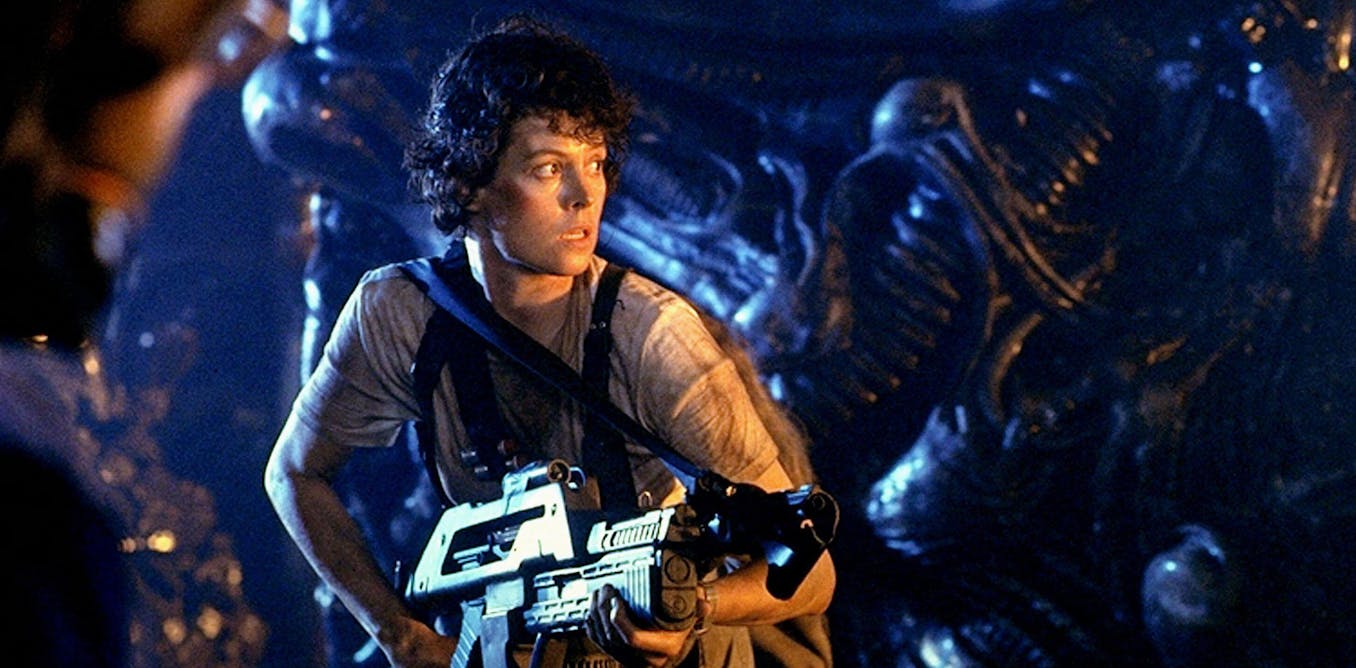
Director James Cameron’s acclaimed sci-fi movie Aliens turns 40 in August. It’s a sequel to Ridley Scott’s claustrophobic breakout hit Alien, made in 1979. Where the original featured one terrifying creature, Cameron’s movie features hundreds – and pits them against a squad of space marines.
A host of intriguing technologies make an appearance, including interstellar travel, hypersleep (where humans are preserved in stasis for long space journeys) and terraforming (making other worlds liveable for humans).
Some of the technologies in the film have already come to pass – or look likely to soon. But others were missed and some remain firmly in the realms of science fiction.
In Aliens, the marines travel to a distant moon to investigate the disappearance of over 100 human settlers. Ellen Ripley (Sigourney Weaver), the main protagonist of the first film, goes along to advise.
On arrival, they run into a six-year-old girl, called Newt, who managed to escape the grisly fate of the other colonists. When the marines encounter the alien hive, chaos and carnage ensue.
The technology featured in Aliens appears to be there to support the wonderful storytelling, rather than predict the path of innovation, as a futurologist might.
But let’s take a look at it. The film is set in 2179, 153 years into our future. Journeying 153 years into the past would land us in 1893, when common technologies were horse drawn and steam streetcars and gas lighting. Typewriters with Qwerty keyboards went on sale the following year.
Industrial aesthetic
We’ve moved on considerably, but the future world of Aliens feels less distant in many respects. Company executives use clunky business cards to trigger low-resolution video calls and wave computer printouts during meeting room showdowns.
For modern audiences, however, the lack of personal electronic devices may be jarring. One can only assume that they must have fallen out of favour by 2179.
The gritty, industrial visual style established in the first film was taken further here. Aliens introduces a variety of military vehicles that contain futuristic elements while drawing on real hardware used in the Vietnam war. The movie’s look influenced later films, but it has also been described as “everyday” and “ugly”.
An exception is the tracking technology: the motion detectors, wearable cameras and biosensors embedded into wristbands. These feel broadly “current”. But if we extrapolate from the present day, one might expect engineers in 2179 to make greater use of surveillance cameras and computer vision (a sub-field of AI where machines are trained to “understand” images and video).
A network of “smart cameras” throughout the moon colony could have tracked both the aliens and humans. Similar networks today monitor crowds and individuals – and watch for suspicious behaviour – on city streets and public transport.
Sentry guns and exoskeletons
The robots of Aliens are striking. Some are not so far removed from hardware used today, but with notable differences. In two separate scenes, Ripley straps into a massive mechanical suit known as a “loader”.
They are mainly used to move cargo, but, conveniently, can be appropriated for fighting xenomorphs. The loaders are a type of exoskeleton, real life wearable tech that may enhance human strength or movement.
Exoskeletons aren’t generally used for this kind of task yet. Large autonomous or teleoperated factory robots are the go-to technology for lifting heavy hardware. This is safer than having humans operate in such hazardous environments.
Current exoskeletons are smaller in scale than the loaders. They are helping people walk again after traumatic injury and commercial versions are available to support those with mobility issues to hill walk.
The war in Ukraine, meanwhile, has familiarised us with autonomous combat robots. One or two share a striking resemblance to the film’s automated sentry guns, which guard an entrance passage in the colony. But drone aircraft, in heavy use today, are notable by their absence.
However, one robot in Aliens operates at a level far beyond the rest: the android Bishop, played by Lance Henriksen. Bishop looks like a human on the outside and is referred to in the film as a “synthetic”.
By 2179, synthetics appear to be approaching human levels of cognitive function – something known as artificial general intelligence (AGI). They even seem to observe the laws of robotics devised by scientist and author Isaac Asimov. In one scene, Bishop tells crew members that he cannot harm a human or allow one to be harmed – Asimov’s first law.
Synthetics occupy capable and realistic bodies which seem to incorporate soft robotics. In this real research area, scientists create robots with flexible materials instead of hard ones, such as metal. Fluids or pressurised air generate movement rather than conventional electric actuators.
The synthetics probably have soft robotic systems overlaid on a rigid framework, similar to flesh on bone. They are therefore likely to be a mixture of soft and conventional robotics.
Tech conundrum
Some of the tech in Aliens remains well out of reach. We don’t have propulsion systems capable of sending crews to other stars and back within a lifetime. As regards hypersleep, in rare cases, humans have survived extreme hypothermia for over an hour, but this is not recommended. Terraforming, meanwhile, remains resolutely theoretical. But what of the synthetics?
Rightly or wrongly, many researchers and companies aspire to create humanoid robots and achieve AGI. We are bombarded with visions of their latest efforts on social media. But some proportion of those working on such ventures are looking to raise money. Many experts would argue that synthetic humans like those in the Alien movies are still far beyond today’s capabilities.
This leads us to a striking conundrum at the heart of Aliens. Why aren’t there more synthetics? Why not send a population of them to terraform worlds or fight aggressive ETs?
Perhaps humans are more expendable: maybe we will end up doing AI’s dirty work because we are the cheaper commodity. But there is a more optimistic answer. Maybe, despite all of our apparent failings and weaknesses, humans are the more capable being.
After all, it is Ripley – not Bishop – who, wildly improvising with available technologies and driven by her unstoppable desire to protect Newt, defeats the alien queen. Perhaps there is hope yet for our species.

Steve Benford does not work for, consult, own shares in or receive funding from any company or organisation that would benefit from this article, and has disclosed no relevant affiliations beyond their academic appointment.