People are walking along this busy main road as merchants sell fruit and household goods from small stalls.
This city scene is perhaps unremarkable, were it not for the fact that the fear of gang violence amongst the population has frequently scared people off the streets of the capital.
It is estimated that at least 26, sometimes heavily armed, gangs control perhaps up to 90 per cent of Port-au-Prince and surrounding areas fomenting terror amongst Haitians through violence, summary executions, extortion and kidnappings for ransom and preventing commerce by blocking the free flow of goods.
Since the beginning of the year, gang violence has left more than 2,300 people dead and more than 1,100 injured.
The Gang Suppression Force is based at Camp Vertières in the east of the Haitian capital, Port-au-Prince.
What is different now is the mounting of patrols by a new UN Security Council-backed force called the Gang Suppression Force, or GSF, the base for which is located just a few blocks from the Boulevard du 15 Octobre.
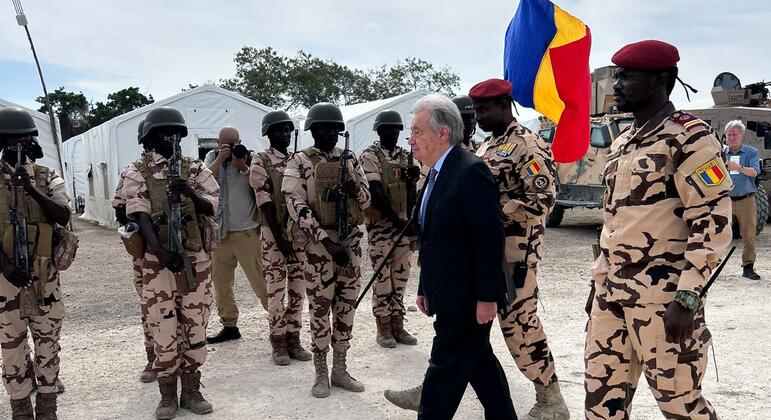
On Tuesday, the UN Secretary-General António Guterres toured the base during a visit to Port-au-Prince.
“Their deployment offers a real opportunity to curb violence and restore the authority of the State,” he told journalists after the visit. “We have no right to waste this opportunity.”
He added that “gangs must be disarmed and dismantled and their members reintegrated – in a Haitian-led process,” reiterating that security alone is not enough, “it must be accompanied by political progress.”
The GSF is receiving logistical, operational and technical support, including the supply of rations, medical care, and transportation from the recently established UN Support Office in Haiti (UNSOH).
It plays a critical role in enabling the force to operate effectively, in its main tasks to neutralize gangs, protect vulnerable populations, and support humanitarian access.
“The objective is clear: to degrade the operational capacity of gangs to a level that Haitian institutions can sustainably manage,” the GSF head Jack Christofides told the Security Council in April.
It’s base, known as Camp Vertières, is in the process of being equipped to receive some of the 5550 personnel, which the Security Council mandated. Troops deployed from multiple countries are currently living on base and offices are being established in shipping containers.
Years of instability
Haiti has suffered years of instability. Gang violence has contributed to some 1.5 million Haitians fleeing their homes.
Millions more Haitians require humanitarian support as poverty deepens, while the country has not had an elected president since the last incumbent, Jovenel Moïse, was assassinated in July 2021.
During his visit to Haiti, the UN chief also spoke to people who had been forced to flee due to gang violence.
“I met families who have lost everything and yet are holding on, together, with a courage and a dignity that command admiration,” Mr. Guterres said. “These families did not ask for my sympathy. They are waiting for action.”
People who have fled violence are living in camps in the Haitian capital Port-au-Prince.
Renewed hope
Despite the challenges Haiti faces, there is renewed hope that as the GSF builds towards its mandated operational capacity, it will be able to make a positive difference to the everyday lives of Haitians, working alongside Haiti’s security forces.
The start of foot patrols and the establishment of forward operating bases across Port-au-Prince and outside the capital, will provide a greater sense of security to Haitians and help bring some normality back to their daily lives.
However, the GSF is expected to have a deeper and longer-lasting impact.
Working with countries in the region to disrupt the supply of guns and ammunition, by focusing more on border crossings and maritime smuggling routes, as well as interrupting financial flows to armed groups, it aims to ensure that gangs can no longer wage war.
Indifference of world to Haiti’s plight
“For the first time in many years, there’s finally some light at the end of the tunnel,” said Mr. Guterres at the end of his visit. “Haiti has a chance to turn a corner – but only if the international community assumes its responsibilities. Let’s be clear: gangs have been terrorizing Haiti. Institutions have been weakened,” he added.
“But the biggest disgrace is indifference, the indifference of a world that has looked away.”
If the partnership between the Haitian authorities, the GSF and the United Nations to tackle Haiti’s unprecedented security situation is a success then even more people will return with confidence to Boulevard du 15 Octobre and other parts of the capital.