Authors: Erin Smith and Sarah Rijkenberg
Collaborative research approaches with local practitioners and community members are creating more meaningful environmental research. This process is often called ‘knowledge coproduction’, and it’s been shown to increase uptake of scientific findings, build interpersonal trust, and strengthen relationships between researchers and practitioners. Co-production is, however, not easy. We are still figuring out the best practices to make it work in different settings.
What did we do?
In this project, we applied knowledge co-production best practices to a contentious issue in south-central Ontario lakes: aquatic plant management. In this region, many homeowners dislike the dense stands of aquatic vegetation along their shorelines, which impacts recreational opportunities and even lowers property values. At the same time, aquatic plants are highly valued by researchers and environmental practitioners, due to their roles in helping to keep water clean and providing habitat for fish and other aquatic organisms.
To address these conflicting viewpoints, we brought community members, researchers and practitioners together to co-develop approaches to maintain aquatic ecosystem health while managing aquatic plant cover. As part of our study called “Trent-Severn Aquatic Plant Experimental Removal (TAPER)”, we surveyed waterfront property owners on their previous management of aquatic plants and interest in removal at their property. Researchers worked with practitioners to select aquatic plant removal methods based on existing approaches (raking, mechanical harvesting) and an emerging technique (aquatic thrusters). Together, we developed a plan to monitor ecosystem health before and after aquatic plant removal to identify impacts of removal type on ecosystem health. We shared these findings with the homeowners and practitioners and are building future research on the findings from aquatic plant removal and the co-production approach.
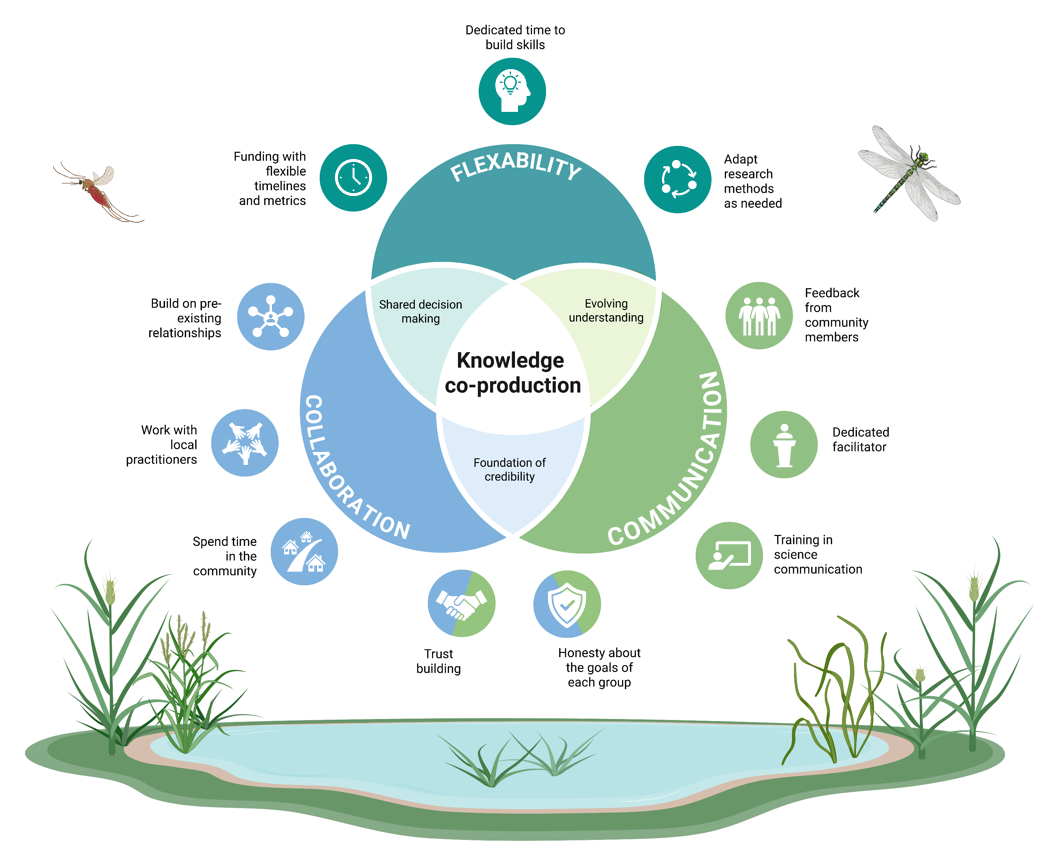
What did we learn?
Reflecting on this highly collaborative, transdisciplinary project, we identified six key themes that contributed to its success:
- Funding
Most project funds aren’t designed for the highly collaborative and time-consuming nature of knowledge co-production. We were able to identify a fund that specifically supports co-produced research and built on pre-existing relationships with regional partners to develop a successful application. We recommend that partners connect early in the proposal writing process to co-develop project goals and do an extensive search to identify funds that support the collaborative activities required for successful co-production.
- Trust building and power sharing
Building trust and sharing power amongst diverse partners is essential to maintain partner relationships in knowledge co-production. We built trust through transparency, specifically regarding the goals of the project, which did not perfectly align for some community members. Potential conflict was avoided by engaging boundary spanners (local researchers and practitioners) to clearly communicate these goals with community members. We recommend building relationships well before the start of the project, especially if engaging Indigenous partners, and continuing to communicate through all stages of the project to maintain trust.
- Communication
As with any collaboration, regular and clear communication is essential for effective knowledge co-production. To address this, we appointed a researcher with experience working with local community members and practitioners as the communication facilitator. This allowed for clear and consistent communication between partners, which benefited the project by allowing community members to provide local knowledge that might have been missed by researchers. As such, we recommend having a dedicated communication facilitator to streamline communication between project partners.
- Flexibility
Knowledge co-production often involves applied research, which can bring many challenges that require on-the-fly adjustments. We faced a major challenge when plant removal equipment couldn’t be secured in time for the planned removal. Thanks to the flexibility of the project team, we were able to quickly readjust and came up with an alternative plant removal method. We recommend setting an expectation early on that plans will need to be readjusted and that project members maintain an open mind to new ideas throughout the project.
- Skill development
Due to the transdisciplinary nature of knowledge co-production, there are many opportunities to learn new skills, especially for students and early career researchers. For example, students in this project had the opportunity to learn field sampling techniques and gained community engagement skills by participating in public events. Therefore, we recommend encouraging project members to seek both formal and informal learning opportunities to expand their skills and knowledge base.
- Reflection
Project members reflected on the work and shared findings at many stages of the project. One key point of reflection and sharing was a mini symposium hosted by one of the project leaders, which had ~175 practitioner, researcher and community member attendees from the region. Finally, we recommend regular meetings to reflect on progress and identify avenues to share reflections with diverse audiences.
Overall, we recommend considering knowledge co-production best practices early in the process and remembering to stay patient with the process. While knowledge co-production can take longer than other approaches, it ultimately leads to more applicable environmental knowledge.
Read the full article ‘Lessons learned from a co-produced field experiment comparing aquatic vegetation removal methods in recreational waters’ in Ecological Solutions and Evidence.