DUBLIN — High above the cobblestones of Dublin Castle, where diplomats and policy architects gather in quiet intensity, a fundamental question hangs in the air: How does European policy truly touch the daily lives of 450 million citizens?
As Ireland steers the rotating Presidency of the Council of the European Union through the second half of 2026, Dublin is seeking to answer that question not with abstract bureaucracy, but with functional, human-centered action. From safeguarding children in an increasingly complex digital ecosystem to anchoring vulnerable households against economic volatility, Ireland’s presidency is navigating one of the most consequential six-month terms in recent European history.
1. Taming the Digital Frontier: Concrete Protection for Children Online
At the very heart of Dublin’s legislative push is a issue that hits home for millions of European families: online child safety.
As the European headquarters for many of the world’s tech giants—including Meta, Google, and TikTok—Ireland occupies a unique position as both a global digital hub and a chief regulator under the EU’s Digital Services Act (DSA). Rather than treating online safety as a distant regulatory exercise, Irish ministers are actively driving functional enforcement mechanisms across the bloc.
Key Functional Actions Underway:
- Enforcing Age Assurance Standards: Pushing for unified, privacy-preserving age-verification frameworks across member states to prevent minors from accessing harmful or sexually explicit content.
- Tackling Addictive Design: Leading Council negotiations to curb “dark patterns”—such as infinite scrolling and auto-play mechanics—that target psychological vulnerabilities in young users.
- AI Oversight in Youth Spaces: Establishing clear guidelines for generative AI tools deployed in educational and social platforms to protect children from algorithmic exploitation and deepfake harassment.
“Digital spaces must be treated with the same safety standards as physical playgrounds,” noted one senior European policy analyst in Dublin. “Ireland’s dual role as a tech home and a tough regulator gives it the leverage to move these protections from paper into code.”
2. A Resilient Social Contract: Protecting Workers and Vulnerable Groups
As households across Europe continue to navigate post-pandemic adjustments, shifting energy markets, and persistent cost-of-living pressures, Ireland is using its presidency to reinforce the European Pillar of Social Rights.
The goal is to ensure that economic competitiveness does not come at the expense of social cohesion. Through targeted Council formations, Irish ministers are building consensus around concrete labor and health initiatives designed to yield long-standing security:
- Modernizing Fair Work Frameworks: Updating labor directives to address platform work, remote employment rights, and the integration of artificial intelligence in the workplace, ensuring fair wages and transparent working conditions.
- Public Health Resilience: Spearheading cross-border strategies to combat medicine shortages, streamline joint procurement for critical pharmaceuticals, and expand mental health initiatives tailored to youth and frontline workers.
- Shielding Marginalized Communities: Directing EU funding streams toward targeted housing interventions and social assistance programs aimed at preventing structural poverty among single-parent households and elderly populations.
3. Geopolitical Stewardship: Guiding the Roadmap for EU Expansion
Beyond internal socio-economic reforms, Ireland’s presidency is tasked with navigating profound geopolitical realignments. With Russia’s war in Ukraine continuing to strain regional security, the question of European expansion has evolved from a diplomatic consideration into a strategic imperative.
Accession Candidate Evaluation  --->  Institutional Reform Benchmarks  --->  Gradual Integration Framework
      (Ukraine, Moldova, Balkans)              (Governance & Rule of Law)          (Single Market Access Steps)
During its term, Dublin is facilitating crucial ministerial summits evaluating accession readiness for candidate nations, including Ukraine, Moldova, and key states in the Western Balkans.
Rather than relying on vague timelines, the Irish presidency is championing a functional integration model. This approach allows candidate states that meet specific judicial and economic benchmarks to participate incrementally in select EU single-market sectors and environmental initiatives before achieving full membership. By balancing rigorous rule-of-law standards with tangible political commitments, Dublin is helping build a more stable and unified European continent.
The Lasting Legacy: What Lies Ahead
When Ireland’s presidency concludes on December 31, 2026, its success will not be measured merely by the number of legislative files closed in Brussels. It will be reflected in safer online environments for children, stronger safeguards for workers navigating technological disruption, and a clearer pathway for a broader European community.
By grounding complex geopolitical decisions in everyday human reality, Ireland is demonstrating that European governance, at its best, remains deeply connected to the people it serves.
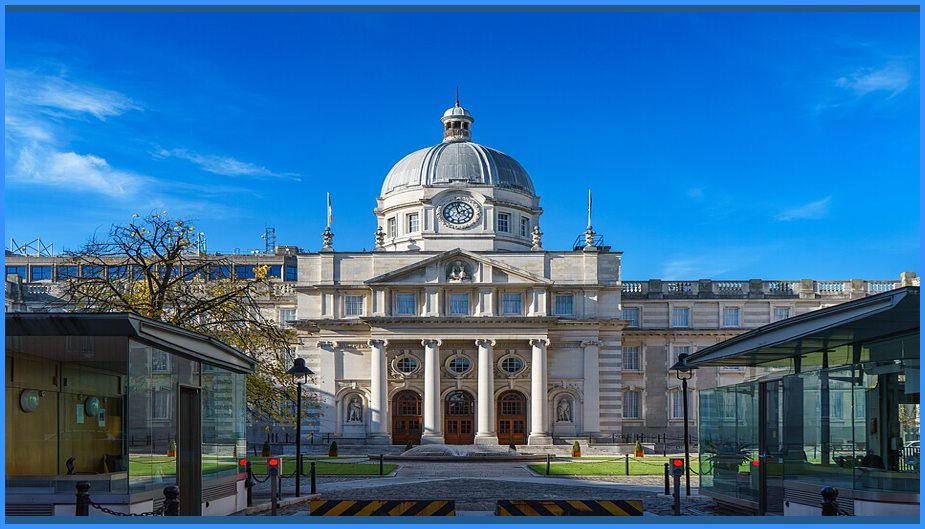
Government Buildings, Dublin, Ireland by David Kernan