
This blog post is also available in Spanish here.
Invasive species are one of the greatest threats to biodiversity, food security, and ecosystem health. When non-native plants spread into new environments, they can outcompete native species, disrupt habitats, and cause long-lasting damage to the natural habitats and the services that ecosystems provide to humans.
Most of the time, invasive species are identified only after they have already become established and are actively spreading into new areas, making control efforts costly and often ineffective. But what if we could predict which species are more likely to become “problematic” before they even arrive? That’s exactly what our research is trying to do.
A machine learning solution
We developed a novel machine learning (ML) framework to predict the invasion risk of non-native plant species before they spread into new habitats. Using data collected from >1,000 plant species introduced to 15 Caribbean islands, our ML models analyzed traits related to species biology, environmental preferences, and invasion histories to identify which plants are most likely to become problematic and invasive. By leveraging the power of ML, we detected patterns difficult to identify in traditional assessments. Remarkably, our models achieved over 90% accuracy in predicting invasion success, providing scientists and policymakers a powerful tool to proactively address potential invasions.
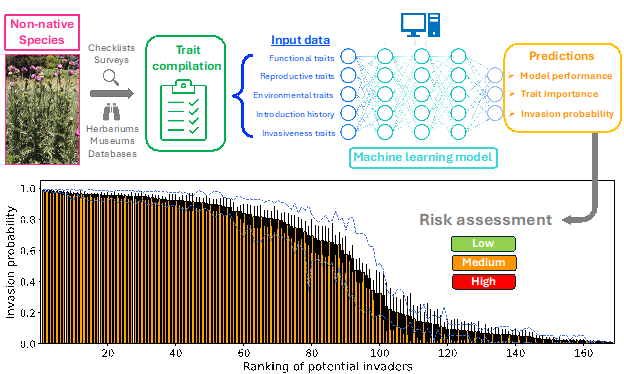
Our framework does not just predict invasion, it also helps us to explain why some species succeed while others fail. Using feature importance analysis (a method that shows which traits contribute the most to predicting invasions), we identified the traits most strongly linked to invasion success. For example, species adapted to grow in areas with frequent disturbances had a significantly higher probability of becoming invasive, while those capable of thriving across a wide range of environments were more likely to spread aggressively. Additionally, plants that have successfully invaded other regions tend to have a higher likelihood of succeeding again.
These findings highlight the crucial role of ecological adaptability and the importance of historical invasion context in understanding and managing invasion risk.
A tool for proactive biosecurity
One of the most promising applications of our ML framework is its ability to flag high-risk invaders not yet present in a given region and rigorously quantify the prediction uncertainties, giving decision-makers a clearer understanding of potential risks. This allows us to design evidence-based strategies such as targeted monitoring, import regulations, and early control measures, before non-native species become invasive and cause ecological damage.

Relaying on different sets of traits, our ML framework is scalable and can be efficiently adapted to be applied to other regions and ecosystems.
Why this matters
Globalization and climate change are accelerating the movement of species around the world, increasing the risk of biological invasions. Our research offers a data-driven, proactive approach to predict and manage the problem of invasions.
By combining machine learning with ecological knowledge, we can better protect biodiversity, safeguard food security, and plan for sustainable ecosystem management. This work provides a powerful way to stay ahead of biological invasions and reduce their impacts before it is too late.
Read the full article, ‘Machine learning for biosecurity: A probabilistic framework for invasive species management’, in Journal of Applied Ecology.








