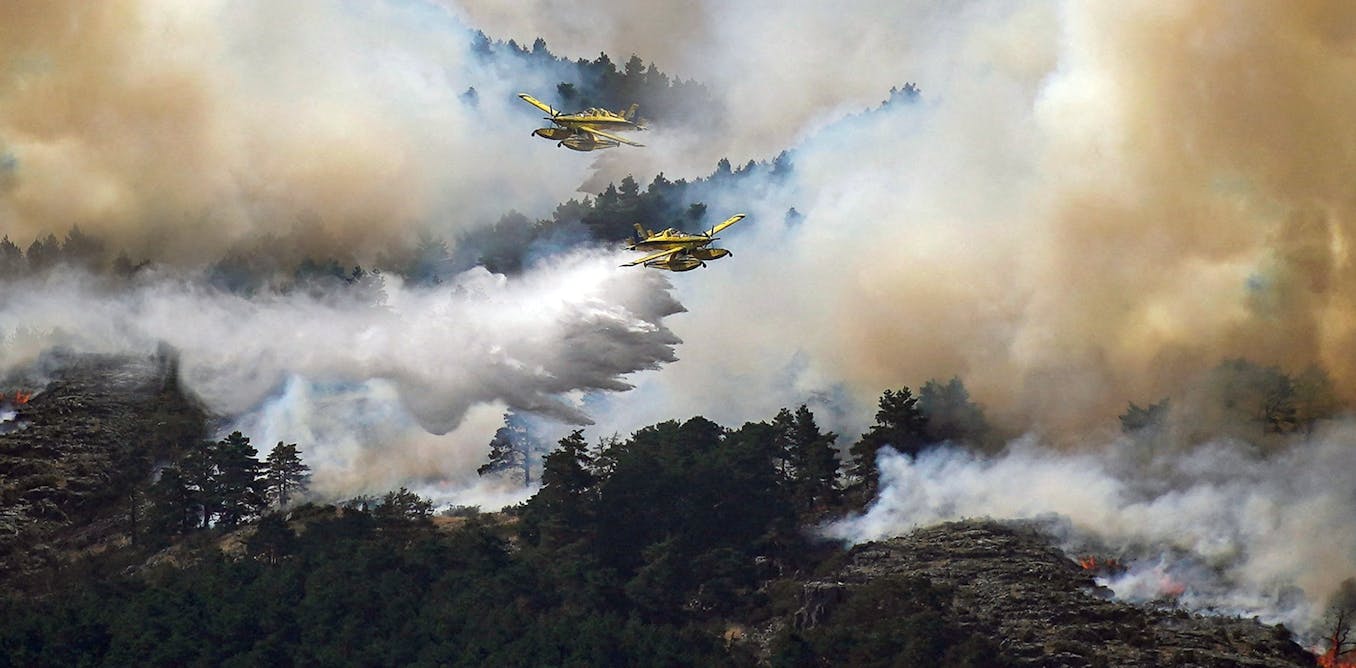
Forest fires have raged across Spain throughout July 2026, leading many people to ask whether the country has enough firefighting resources.
The answer is complex, particularly in emergency situations where homes and lives are at stake. However, the broad scientific consensus is that the key lies not in increasing the resources allocated to firefighting, but in investing more in prevention and land management.
Firefighting budgets
During wildfire season, the prevailing view tends to be that we need more aircraft or firefighting teams to tackle fires. However, a very large proportion of public budgets is already allocated to this exact purpose.
Spain has a robust fire-fighting system which absorbs a growing budget. Despite this extensive spending, the country is seeing an increase in large, highly dangerous fires.
In Spain, managing forest fires is a decentralised responsibility. Each region – known as an autonomous community – has exclusive responsibility for forest management, and for drawing up its own annual prevention and firefighting plans.
Since there is no central fund, budgets depend on the decisions of each community. This means the available information is fragmented and difficult to compare, and the criteria for allocating expenditure are not standardised. There is also a lack of transparency and difficulty in accessing information on how money is spent. This makes it hard to analyse how efficient and effective fire-fighting policies are.
These limitations mean any estimate of total expenditure should be interpreted with caution. Nevertheless, according to the available data we have been able to consult, the budget for forest fire prevention and suppression in Catalonia in 2025 was 327 million euros. This year, the Valencian Regional Government will allocate 298.47 million euros for this purpose, Andalusia 271 million, and Galicia 213 million.
The total estimated budget for the country as a whole may exceed 1.8 billion euros per year. Of this, around 78% is allocated to fire-fighting operations and 22% to prevention.
For its part, the General State Administration provides support and coordination through the Ministry for Ecological Transition, for which it allocates some 109 million euros.
This does not include the cost of the resources deployed for logistics, security and evacuation, nor the expenditure incurred by local authorities, nor the resources mobilised through the EU Civil Protection Mechanism.
A national state of emergency has been declared after the fires in the Community of Madrid, Ávila and Toledo. This is the second time this has ever been declared in Spain, and the first time due to fires. It is a rare example of all possible resources being mobilised, under the command of the national Military Emergency Unit (known in Spain as the UME) and coordinated by the Ministry of the Interior.
But a continuous increase in spending is not economically sustainable. The estimated allocation for firefighting exceeds the annual budget of the State Research Agency, and in some cases it far exceeds the budgets of some regional ministries. In Galicia, for instance, more is spent on firefighting than on the Ministry of the Environment and Climate Change.
This does not, of course, mean that spending on putting out fires is unnecessary. As well as preventing damage and major economic losses and protecting the population, it is unquestionably effective in the initial stages of a fire – a large proportion of Spain’s fires are extinguished in their early stages (less than 1 hectare).
But this is where we get what is known as the suppression paradox: the more effective a system is at eliminating small and moderate fires, the higher the proportion of extreme fires which are the most costly, dangerous and difficult to control. Therefore, although firefighting will remain essential, prevention offers greater social and economic returns in the long term.
Read more:
Spain wildfires: with 13 dead, we need to start measuring fire damage in lives – not just hectares
Investing in prevention
Research has identified specific situations where firefighting capacity is lacking or requires specific preparation:
-
Extreme fires, which are very intense and behave unpredictably, require specialised resources that often exceed those available. However, it is economically unviable to design a fire suppression system that can cope with the worst-case scenario across a large geographic area.
-
Fires in urban-forest interface areas often overwhelm fire services, as they have to simultaneously put out the fire, evacuate communities, and protect buildings. Instead of just more resources, this scenario requires specific capabilities and specialised preparation. It calls for operational protocols, training in the protection of buildings, and self-protection plans for the public, as well as land-use planning that prevents housing from expanding into high-risk areas.
-
When multiple fires occur at the same time, resources are spread thin. They become significantly less effective, exacerbating the lack of resources as the number of fire fronts multiplies. Under these circumstances, prior preparation of the territory – through strategic management areas, firebreaks, water sources, and a robust network of access roads – has a greater impact than the number of personnel available.
Read more:
Eight lifesaving ways to improve wildfire risk management
Rather than indiscriminately increasing fire-fighting spending, we need specialised and well-coordinated capabilities to respond to the most complex scenarios. At the same time, we also need to manage the land and learn to live with fire. It is not a question of choosing between fire-fighting and prevention, but of understanding that prevention is the main challenge still to be addressed, and the most cost-effective investment.
While fire-fighting measures come into play once a fire has started, prevention tackles the structural causes of the problem, and reduces the risk of fires escalating into major disasters.
The challenge posed by large-scale forest fires will not be solved simply by deploying more helicopters or more fire crews, but by sustainably managing the land that is at risk – long before it starts burning.
A weekly e-mail in English featuring expertise from scholars and researchers. It provides an introduction to the diversity of research coming out of the continent and considers some of the key issues facing European countries. Get the newsletter!