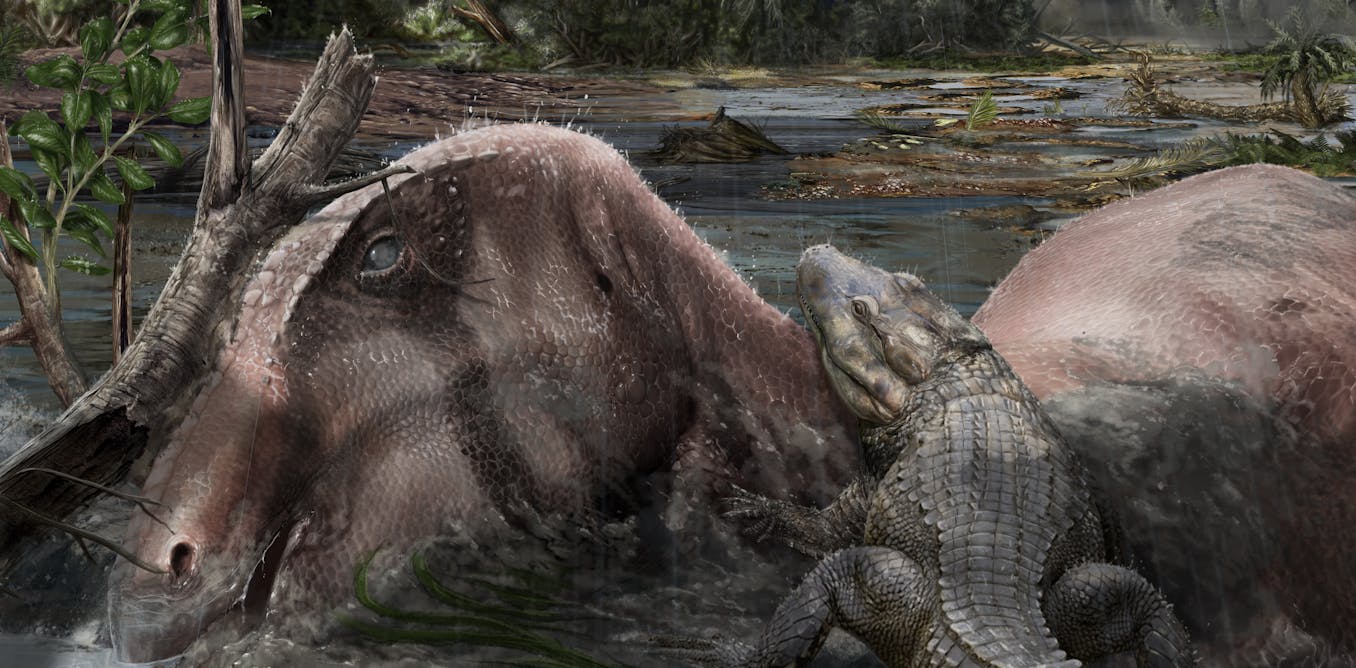
Around 80 million years ago, a stretch of tropical coastline in what is now north-eastern Italy was lashed by monsoon rains and tropical cyclones. Those storms swept dinosaur carcasses, crocodiles, plants and river mud onto a tidal flat, where the tides and a film of microbes sealed everything away with extraordinary preservation.
My colleagues and I have published a new study that reconstructs the violent tropical climate behind the Villaggio del Pescatore Lagerstätte near Trieste and reveals it preserves just four decades of life, recorded almost day by day.
The Villaggio del Pescatore site near Trieste is one of the most important Late Cretaceous fossil localities in the Mediterranean. It is the only known site in the region to preserve large land animals, including dinosaurs such as Tethyshadros insularis, from the final 15 million years or so of the age of dinosaurs.
Tethyshadros insularis was a plant-eating, duck-billed dinosaur that lived in what is now north-eastern Italy around 80 million years ago. It was initially interpreted as a dwarf island species, shaped by the “island rule” – that large animals evolve smaller bodies in environments with limited space and resources.
However, the discovery of larger specimens challenged this idea. Up to 11 individuals are potentially preserved in this succession of rocks, with at least three other fairly complete skeletons still waiting to be extracted from the hard (and expensive to cut) limestone rock. Geological evidence has also revealed that the site was about 10 million years older than previously thought and was not part of a tiny, isolated island. Instead, it lay near a larger landmass connected through the ancient Mediterranean region.

Tiziana Brazzatti, CC BY-ND
The fossils of tiny crocodilians named Acynodon (with shorter muzzles than modern crocodilians) have also been found at this site.
After years of research, Professor Federico Fanti of the University of Bologna and I led a multidisciplinary team of palaeontologists, physicists and geologists to determine exactly how this fossil treasure trove formed. Our findings overturn decades of competing interpretations.
In a study published in Global and Planetary Change, we show that the site was not a quiet, isolated lake or sinkhole, as previously suggested. Our results suggest it was a storm-battered tidal flatland at the edge of a tropical sea.
Villaggio del Pescatore is not simply a place where fossils happen to be beautifully preserved. It is also a record of the weather that shaped the site. We can identify individual storms and floods in the rocks, almost day by day. Very few fossil sites on Earth allow us to do that.
Reading the rock like a calendar
The fossils at Villaggio del Pescatore are concentrated in a finely layered carbonate rock, marked by thousands of paper-thin light and dark bands. For years these were interpreted as annual layers (like tree rings) laid down season by season.
Our new analysis tells a different story. Using high-resolution X-ray scans at the Elettra Synchrotron in Trieste, alongside detailed geochemical and microscopic analyses, we showed that the bands were not annual but daily. A synchrotron accelerates electrons (particles with a negative charge) to almost the speed of light. This produces powerful X-rays that can penetrate dense materials such as rock. This allowed us to examine structures inside the rocks and bones at a resolution of fractions of a millimetre.
The scans revealed that the layers were deposited by ocean tides, two pairs each day. These tides varied according to the familiar fortnightly cycle of stronger and weaker tides that still happen today. We could count these tidal layers, thanks to this unparalleled resolution.
The entire fossil-bearing rock pile, our results calculate, accumulated in only about 40 years, a single human lifetime, frozen in stone. Most fossil deposits containing several individuals average together thousands or millions of years. Here, we’re looking at a few decades.
Monsoons, cyclones and microbes
To explain why storms were so central to the preservation of the fossils, the team ran climate simulations. The models consistently placed the site at around 29° north, inside a powerful, summer-dominated monsoon belt. This was a tropical regime of intensely wet summers and recurring tropical cyclones, sustained by the greenhouse climate of the age.
Monsoon-driven floods and cyclone surges created pulses of sediment, nutrients, plant debris and animal carcasses onto the tidal flat. The tides trapped this material, and mats of microbes rapidly stabilised it. This encouraged the sediment to harden right after the carcass was deposited, before it started rotting or predators could scavenge its dead tissues. These storms were the main agents behind this preservation.
The site’s three most important Tethyshadros insularis dinosaurs show a range of fates: one buried so quickly that soft-tissue outlines survive, another bearing the cracked, sun-dried bones of a carcass that lay exposed inland before being washed in by a flood. Crocodilians such as Acynodon adriaticus, fish and shrimps were also local residents, entombed close to where they lived and died.
We propose that this combination of “ingredients”, monsoon floods, tidal trapping and microbial sealing, represents a recipe for creating exceptionally preserved fossil sites in hot, tropical greenhouse climates – precisely the kind of setting in which rapid decay would normally destroy organic remains.
The study also offers an ancient perspective on how intensifying monsoons and cyclones can reshape coastlines, ecosystems and what becomes preserved along tropical shores.
Villaggio del Pescatore has been studied for more than four decades, yet it still has new stories to tell. Understanding how extreme storms transformed this ancient coastline may also help us think about how modern coasts could respond to a warmer and more turbulent climate fuelled by high levels of CO₂.

Alfio Alessandro Chiarenza works for University College London, Department of Earth Sciences. He receives funding from The Royal Society as a Newton International Research Fellow.