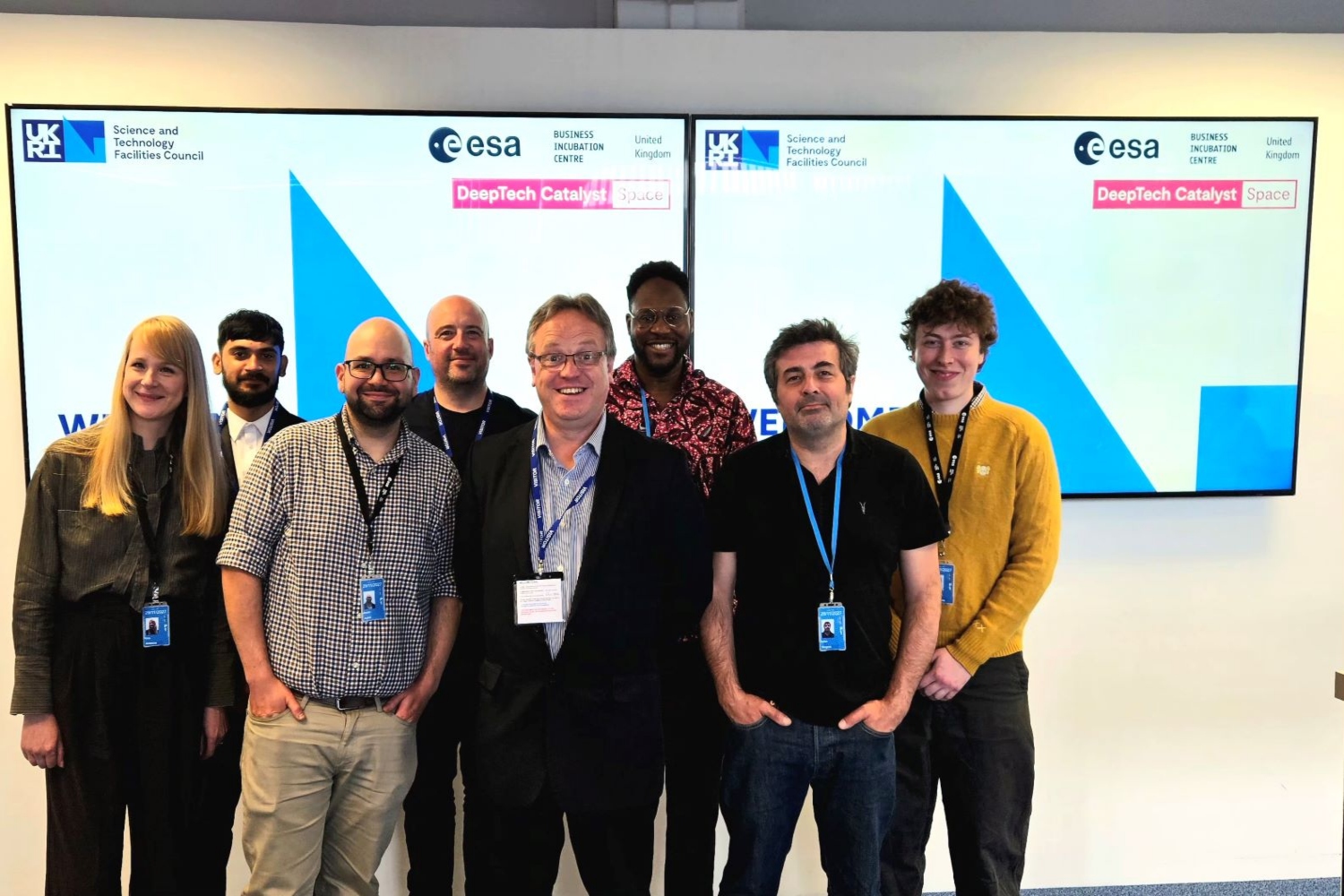
Seven UK start-ups have joined the European Space Agency Business Incubation Centre UK (ESA BIC UK), to develop technologies that address industrial challenges and deliver practical benefits in space and on Earth.
Together, they aim to boost productivity, efficiency and decision-making across sectors from construction to environmental monitoring, helping strengthen the UK economy and the services people rely on every day.
Space innovation solving everyday challenges
The ESA BIC UK is managed by the Science and Technology Facilities Council (STFC) in collaboration with the UK Space Agency and the University of Leicester.
It provides startups with access to cutting-edge research and development facilities and expertise, with specialist business support and funding.
It aims to help startups turn bold ideas into real-world solutions, accelerating their journey from concept to market and commercial success.
Meet the new cohort
From port operation to earth observation, meet the new cohort joining the ESA BIC UK.
ViableSite: supporting faster housing and infrastructure delivery
ViableSite is developing an artificial intelligence (AI) platform that delivers a ‘Go or No-Go’ development conclusion on small housing sites, replacing a fragmented and costly consultant process.
It is using Earth observation, combined with planning policy, geospatial data, and live market values, to assess viability, model margins, and hard-to-see below-surface risks before any land is purchased.
By automating feasibility and validating every conclusion with a chartered architect, it aims to:
- unlock thousands of small sites that currently go unbuilt
- turn unviable sites into biodiversity revenue rather than dead ends
Looking ahead, ViableSite is exploring how the same methodology can extend beyond housing to support the delivery of new infrastructure.
Nestimate: an AI commercial engine for construction
Nestimate is an AI platform that prices construction work from the information companies already have: tender packs, drawings, scans, paper records, site photos, videos and voice notes.
It reads messy and legacy project information, turns it into structured commercial data, then uses AI reasoning to produce the commercial outputs needed from bid to project change in minutes.
When information is missing, Nestimate uses ESA-supported satellite data and other sources to make clear, evidence-based assumptions, helping contractors reduce guesswork, protect margins and win more work.
Panspectra: ground truth for a changing planet
Panspectra is developing calibrated, decision-grade AI for measuring physical change, built on geospatial foundation models that read satellite Earth observation data across the electromagnetic spectrum and over time.
This makes change on the ground reliable enough to act on, starting with environmental compliance such as deforestation-free sourcing, with applications extending to areas like insurance and infrastructure monitoring.
Spectra Defence Limited: transforming space domain awareness
Spectra Defence Limited is developing Synthetic Aperture LIDAR (SAL), a breakthrough optical imaging technology that enables small satellites to identify and characterise objects in orbit at much higher resolution than conventional space-based telescopes.
As Earth’s orbit becomes increasingly congested, SAL could improve space domain awareness, helping to reduce collision risks and strengthen the resilience of critical space infrastructure.
Spiral Grey
Spiral Grey is developing Sapphire, a space-based sensor suite leveraging light detection and ranging built to empower satellites that seek to approach uncooperative objects, such as space debris.
As space becomes increasingly industrialised, Sapphire could enable greater reliability and performance for:
- in-space servicing, assembly and manufacturing
- debris mitigation
- national security missions
Falcon Tag: bringing real-time visibility to ports and improving trade efficiency
Falcon Tag is developing Piervue, a live digital dashboard for port operators that integrates operational data, including satellite and logistics data, to improve visibility of activity and support faster decision-making.
The platform could:
- help reduce congestion
- improve efficiency
- strengthen security and safety
- support the resilience of supply chains that support international trade
Infinect: transforming connectivity with next-generation satellite antennas
Infinect is developing the first hybrid flat panel antenna for broadband satellite communications, designed to improve access to high-speed connectivity in remote and hard-to-reach locations.
It uses satellite communications technology to enable more reliable and flexible data transmission where traditional infrastructure is limited or unavailable.
This could help make high-speed connectivity more widely accessible, supporting digital inclusion, remote working and more resilient communications in rural and isolated areas.
Supporting early-stage innovation
Established in 2011 as STFC’s first business incubation programme, ESA BIC UK is part of the DeepTech Catalyst (DTC), a nationwide network supporting start-ups across:
- space
- biotechnology
- advanced healthcare
- quantum technologies
Recently ranked among the Financial Times’ Europe’s Top SME Hubs 2026, the DTC helps startups access the facilities, expertise and investment needed to grow into globally competitive businesses.
Driving economic impact
Since 2011, the DeepTech Catalyst has supported more than 230 startups, which have collectively:
- raised more than £300 million in private investment
- created around 1,100 high-skilled jobs
- achieved a 95% survival rate
- generated an estimated £25 in economic return for every £1 invested
The programme also contributes around £150 million in gross value added to the UK economy each year.
Supporting UK Modern Industrial Strategy
As part of UK Research and Innovation, STFC uses the DeepTech Catalyst to support the UK government’s Modern Industrial Strategy.
This includes the eight sectors it identifies as having the greatest growth potential over the next decade.
It also has a a critical role in driving economic security and resilience, delivering net zero, and promoting regional growth.
From exploration to economic growth
Paul Vernon, Executive Director of Business and Innovation at STFC, said:
Space technology is increasingly helping to solve challenges far beyond the space sector.
From reducing port congestion to support international trade, to monitoring environmental change such as flooding and deforestation, these innovations demonstrate how space-enabled technologies can deliver benefits across the economy and society.
The companies joining ESA BIC UK are applying cutting-edge science and technology to real-world challenges. By turning research and innovation into practical solutions, they can boost productivity, strengthen resilience and unlock new opportunities for growth across the UK.
Through ESA BIC UK and the DeepTech Catalyst, STFC is helping ambitious businesses translate world-class research into commercial success, supporting the Government’s Modern Industrial Strategy and creating high-skilled jobs across the country.
Get involved
The ESA BIC UK is now open to applications for its next cohort. If you are a UK-registered business, less than five years old, with a demonstrable space connection, you could be eligible.
The next application deadline is 28 August 2026. Discover more on ESA BIC’s website.