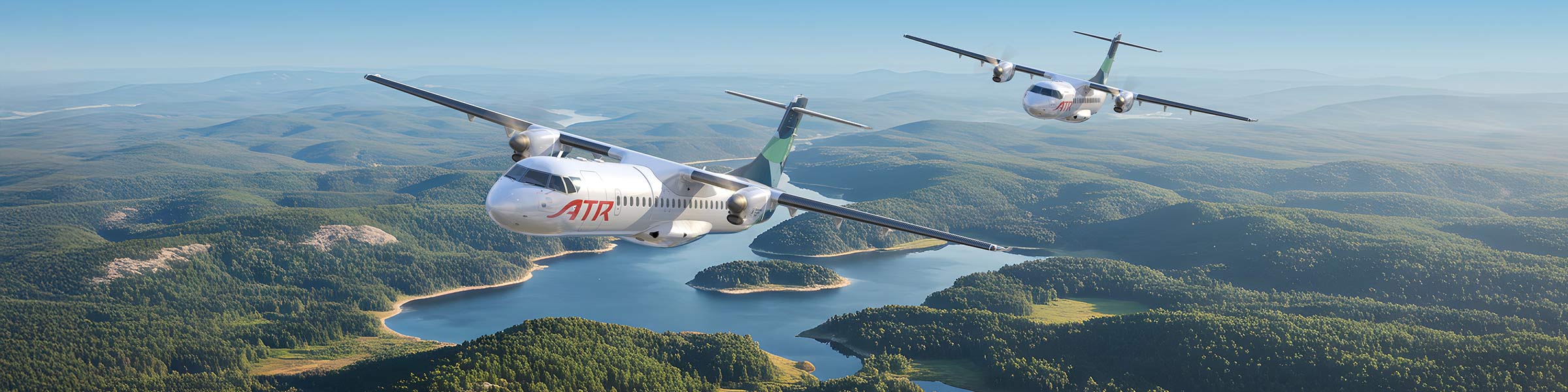
Hybrid cars are a regular sight on European roads today. Sitting between internal combustion engines and fully electric vehicles, they run on fuel for some of the journey and electricity for the rest. That concept might be about to shake up the aviation industry.
Aviation accounts for around 2.5% of global carbon emissions, a share that is rising as incomes grow and more people take to the skies.
While road transport is rapidly decarbonising through electric vehicles, aviation, which follows a longer technological cycle, remains a hard-to-abate sector – and emissions released at altitude warm the planet even more than those at ground level.
The Clean Aviation Joint Undertaking – a public-private partnership between the European Commission and the aviation industry – aims to address this issue by uniting the talent, know-how and capabilities of the private and public sectors.
And this is becoming increasingly urgent. “If no action is taken, the emissions and climate impacts of aviation will keep increasing,” said Laure Dupire, project manager at ATR, a European manufacturer specialising in regional aircraft – passenger and cargo planes designed for regional flights rather than long international routes.
“The aviation sector has set itself the goal of achieving climate neutrality by 2050. We cannot meet those objectives without new technologies.”
Dupire is one of the researchers working across four projects co-funded by Clean Aviation. They share a goal: an ultra-efficient hybrid-electric regional aircraft that could cut emissions significantly.
Instead of relying solely on a combustion engine, such an aircraft would combine conventional propulsion with electrical power. The four projects – PHARES, DEMETRA, OSYRYS and HERACLES – are each tackling a different part of that challenge, with the aim of putting a hybrid-electric regional airliner into service by 2035.
This phase builds on an earlier round of EU-funded research that mapped out the overall architecture, demonstrated early electrical systems and worked through how to manage the substantial heat a hybrid-electric powertrain generates. The current four projects take that further. Their job is to build, integrate and fly the technology.
Building the hybrid prototype
ATR, a French-Italian joint venture between Airbus and Leonardo, coordinates two of the projects. Dupire leads DEMETRA, which will develop a flight test demonstrator to validate the technologies produced by the others.
Alessandro Sgueglia, an aerospace engineer at ATR, coordinates HERACLES, which will integrate those technologies into a single aircraft concept. ATR will also fully supervise the work on battery choice, their performance and integration.
“
This new design will reduce emissions by 30%, while delivering performance and range comparable to, or better than, today’s regional aircraft.
“This new design will reduce emissions by 30%, while delivering performance and range comparable to, or better than, today’s regional aircraft,” said Sgueglia.
PHARES, which is developing the hybrid-electric propulsion system, is expected to deliver up to 20% of that target. The remaining 10% will come from airframe innovations – a new fuselage and wings – though that work falls to a separate, follow-on project. For now, the four projects are focused on getting the propulsion and energy systems right.
HERACLES also integrates an engine optimised to run on 100% sustainable aviation fuel, meaning the aircraft is designed to be compatible with the cleaner fuels airlines are already beginning to adopt.
The 30% emissions saving is measured against a 2020 state-of-the-art regional aircraft – roughly the benchmark set by aircraft like the ATR72, one of the world’s most widely operated regional turboprops, with more than 1 200 built.
For Sgueglia, starting with regional aircraft is deliberate. “Innovation in aviation always starts from smaller aircraft, after which they are adapted to larger counterparts,” he said.
The goal, he stressed, is not simply a demonstrator, but a viable commercial product. “We want to develop something that can capture a significant share of the regional aviation market. That’s a critical step to transfer these technologies to larger aircraft.”
Why not go fully electric?
The answer, for now, comes down to weight. “Today’s batteries are limited by their low energy density,” said Anne Saint-Roch of Pratt & Whitney Canada, project coordinator of PHARES, referring to how much energy a battery can store per unit of mass.
“
If we wanted to power a regional aircraft with just batteries, there would not be enough space for passengers or cargo. That’s why we need a hybrid concept.
“So even though the technology continues to improve, fully electric is mostly applicable for smaller, shorter range or low payload aircraft,” she said. “If we wanted to power a regional aircraft with just batteries, there would not be enough space for passengers or cargo. That’s why we need a hybrid concept.”
In practice, the electric element would likely carry the heaviest load at take-off and climb. “The electric engine could provide a portion of the necessary power here, but might also be used in cruise flight,” said Saint-Roch.
Pratt & Whitney Canada’s role as coordinator also carries a broader significance. “We are the first Clean Aviation project led by a Canadian company since Canada and the EU entered an association agreement on Horizon Europe in 2024,” said Saint-Roch.
She stressed that collaboration between Europe and Canada is essential if hybrid-electric technology is to make it into commercial service.
Rewiring the aircraft
A hybrid-electric aircraft does not just need a new engine – it needs a completely rethought electrical system. That is the territory of OSYRYS, coordinated by French aerospace company Safran.
“It will be the first time that we will have a voltage of 800 volts on an aircraft,” said Pierre-Julien Sonnette of Safran. “That will be much higher than what we’re used to. We will have to entirely redesign the electrical system.”
The higher voltage is needed to deliver the power that electrical propulsion demands, which is well beyond anything currently certified for commercial aircraft. On the reference ATR aircraft, for example, the voltage reaches a maximum of 115 volts.
Then there is certification. Aviation’s safety record is the envy of almost every other form of transport, but that rigour has historically made it slow to embrace new technology.
To avoid that bottleneck, all four projects are bringing the European Union Aviation Safety Agency in from the start – rather than presenting finished technology for approval once the work is done.
“We need to involve authorities from the beginning,” said Sonnette. “In the end, they will be the ones who decide if the aircraft is allowed to fly. We need to familiarise them with these new technologies and show that they are still safe. That’s the main goal of the aviation industry: to be safe.”
Taking it to the skies
The four projects can be thought of as parts of a living system. PHARES provides the propulsion “heart” that powers the aircraft. OSYRYS develops the electrical “nervous system” carrying power and signals through the aircraft. HERACLES acts as the “brain”, coordinating and integrating the different technologies into a single concept.
DEMETRA, which launched in January 2026, is the “body” where it all comes together. Its job is to take what the other three projects have built, integrate the hybrid powertrain, electrical systems and batteries onto a real aircraft, and fly it – testing the whole package under real-world conditions.
The target is Technology Readiness Level 6, the point at which a technology is considered mature enough to move towards a commercial product. ATR aims to fly the demonstrator by the end of 2029, with entry into service targeted for 2035.
If the flight tests go to plan, a new generation of more sustainable regional aircraft could be in the air sooner than many once thought possible.
Research in this article was funded by the EU’s Horizon Programme. The views of the interviewees don’t necessarily reflect those of the European Commission. If you liked this article, please consider sharing it on social media.