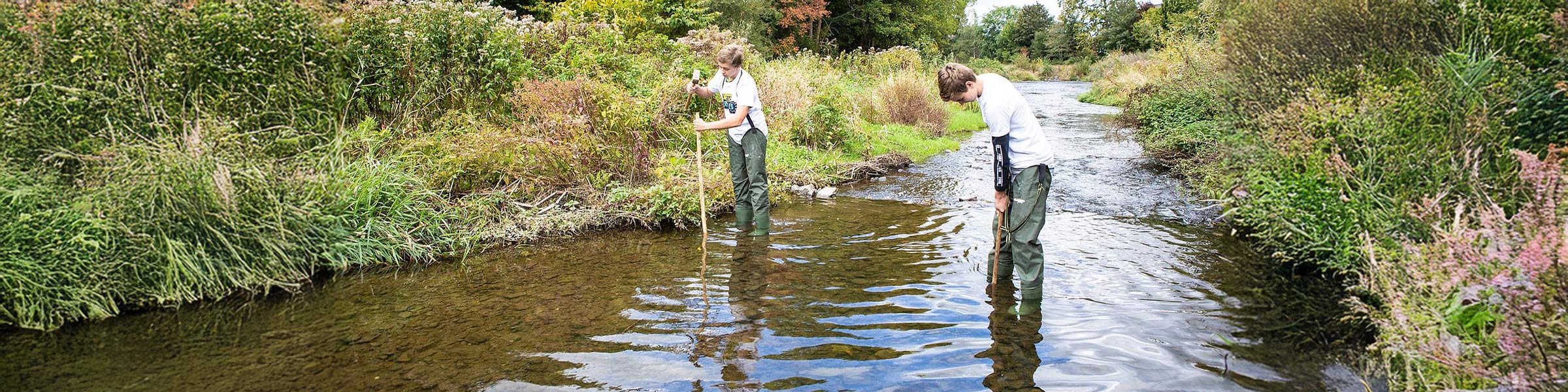
Along a small stream in Spain, groups of teenagers are at work. One hovers around a black tarpaulin covered in wet pieces of plastic. Another stands on a small bridge, fishing with a net. Others sort small pieces of plastic, cigarette butts and various other things they’ve recovered from the stream.
What looks like a school outing is in fact part of a European experiment. Can pupils help fill a significant data gap on plastic in rivers and support an EU-wide drive to clean up our waters?
From Germany to 14 countries
Plastic Pirates – Go Europe! is a citizen science initiative that started in Germany in 2016 to enlist the wider public in scientific research. It gave pupils aged between 10 and 18 the responsibility to monitor plastic pollution in streams and rivers.
The idea grew out of concern that rivers and streams, where plastic often starts its journey, receive far less attention than coastlines.
An EU-funded project called PlasticPiratesEU took the original German initiative and scaled it across Europe from 2022 to 2025. Today, the Plastic Pirates campaign continues in several countries, with national teams still supporting schools and fieldwork.
“Rivers account for 70% of plastic that flows into oceans,” said Philip Ackermann, the coordinator of PlasticPiratesEU, who works for the DLR Project Management Agency in Germany. “At the same time, there’s a huge data gap. We don’t know how much plastic is flowing down these waterways.”
Over those three years, the initiative moved from national campaigns to coordinated fieldwork across Europe. It involved schools and research partners in 14 EU countries – all following one common scientific protocol.
“
We don’t know how much plastic is flowing down these waterways.
Between 2022 and 2025, more than 25 000 teenagers sampled 390 rivers, streams and beaches across Europe. Armed with nets, gloves, notebooks and cameras, they helped create one of the first large-scale open datasets on plastic pollution in European rivers and waterways.
The data has been made freely available through Zenodo, an open research repository, and EMODnet, an EU platform that brings together environmental and marine data from around Europe.
The team also published Lessons Learned from Upscaling a Citizen Science Initiative Across Europe, a practical guide sharing 12 hands-on tips for teachers, researchers, policymakers and environmental groups interested in developing similar citizen science activities.
A separate coastal booklet expanded the effort to beaches, offering young people step-by-step guidance on collecting scientific data along coastlines.
The work contributes to the EU Mission: Restore our Ocean and Waters, which aims to protect and restore marine and freshwater ecosystems by 2030. By feeding fresh, comparable data into European databases, PlasticPiratesEU gives the Mission another tool to understand where pollution is most severe and how it changes over time.
From riverbank to database
The teenagers taking part in this effort are split into four groups, each with a different task. One takes a section of the river and tracks the quantity of plastics they encounter. Another collects and categorises the plastic litter they find.
A third group tracks microplastics by using a fine mesh net, which is sent to a lab to see how many small plastic particles were caught.
A fourth handles the final task: verification. They take as many pictures as possible of the entire process. These pictures are then used by researchers to double-check what the pupils caught and see whether they made the right calls.
“One of the reasons why there’s this data gap on plastics in rivers is that it’s immensely costly to do,” said Ackermann. “Through PlasticPiratesEU, we can do it in a more cost-effective way.”
“
Teenagers are at a complicated age. But when they get excited by science, that’s very rewarding.
But is this data credible? Can teenagers with no scientific training match the precision of professional researchers? Ackermann thinks so.
“We found that the data is quite reliable,” he said. “If you take a lot of samples, the importance of individual errors is reduced. On top of that, we check all the results through the photos.”
Teenagers, he added, are often very keen to follow protocols like professional researchers and approach the work seriously. For many, it is a first chance to wear gloves, record field observations and see their findings become scientific evidence.
“At some points, the children’s data has actually proven more reliable than the ones gathered by professional researchers,” Ackermann said.
Findings and impact
Meritxell Abril Cuevas, a freshwater ecologist, is one of the researchers who guided the pupils. She works at the Beta Tech Centre, a research centre focused on biodiversity, ecology and food technology and affiliated with the University of Vic – Central University of Catalonia, Spain.
Working with the teenagers, with support from the Spanish Foundation for Science and Technology, has given her pollution data from rivers and streams that would otherwise be impossible to gather at this scale.
“I like to work with them a lot,” said Abril. “Of course, teenagers are at a complicated age. But when they get excited by science, that’s very rewarding.”
The researchers have started to identify regional pollution patterns across Europe. Spain, Abril’s home country, stands out for one particular kind of pollution.
“In Spain, for example, a surprising amount of pollution came from wet wipes, which isn’t the case in other countries,” she said. “These insights might help drive policy changes in the future.”
But some types of pollution keep coming up, wherever you look. In all countries, single use plastic items such as straws, food containers or plastic bags make up the majority of litter. The researchers found that residents and visitors near beaches or rivers were among the main sources of plastic pollution.
Plastic Pirates also aims to teach children about the harm plastic pollution causes. “That’s one of the primary motivations for what we do,” said Ackermann.
“If you want to tackle plastic pollution in the future, you have to raise awareness among the younger generations. They are the ones who will need to combat this problem head on. If they are already aware of the extent of the problem in school, then you go to the root cause.”
Teachers also noticed an unexpected side effect. “They said that their classrooms are tidier after the pupils take part in the initiative,” laughed Ackermann. “Apparently, when confronted with the scale of the pollution issue, teenagers start taking better care of their own environments.”
**The project in this article received funding as part of the EU Mission: Restore our Ocean and Waters. EU Missions are EU-funded initiatives that mobilise research, policy and citizens to tackle major real-world challenges by 2030.