If Israel and the US hoped their attack on Iran would force the country to capitulate quickly, they were wrong. Despite the death of the supreme leader, Ayatollah Ali Khamenei, and many other senior figures, Iran has managed to continue firing drones and missiles at targets across the Middle East.
This poses a challenge for the US and its allies, including Israel and the Gulf states. The challenge is that they might run out of air defences before Iran runs out of airborne projectiles.
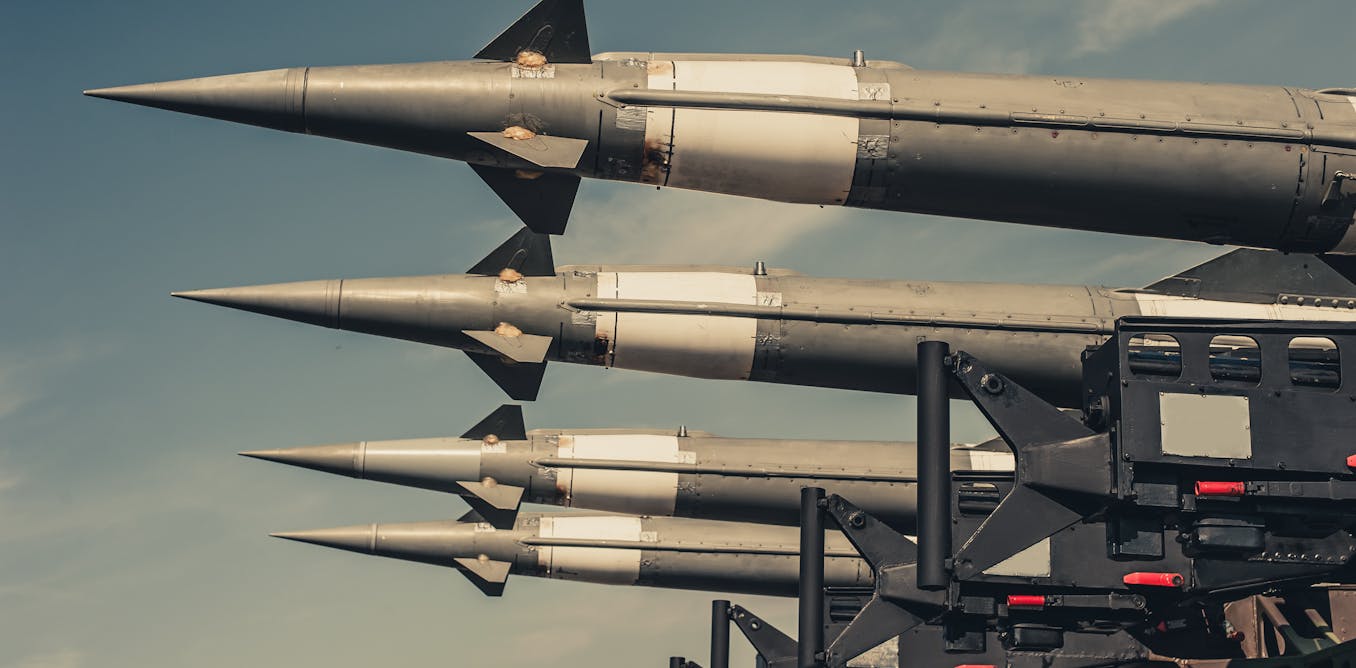
The US and its allies use a number of weapons platforms to knock down incoming missiles and drones. The most important are Thaad interceptors, Patriot systems and SM-family naval missiles, while Israel also uses longer-range Arrow interceptors. However, the supply of these interceptors has been under severe strain in recent years.
Many have been provided to Ukraine, which faces relentless Russian aerial assault. Others have been used in the Red Sea to protect shipping against attacks by the Iran-aligned Houthis. And more still have been stationed in the Indo-Pacific to defend South Korea and Taiwan from possible North Korean and Chinese attacks.
Despite their importance to modern warfare, US stockpiles of these munitions are dangerously low. There are simply too many competing priorities, and production has only recently been increased. The 12-day war the US and Israel fought with Iran in June 2025 is thought to have consumed around a quarter of the entire US inventory of Thaads.
When stocks of these munitions diminish during a war, choices have to be made about which targets to protect – and which not to protect. This usually means focusing on the defence of strategic military installations, allowing some civilian areas to be hit. Israel is widely believed to have made this choice during the 12-day war.
That moment may be approaching again. However, this time it is not just Israel that is at risk, but half a dozen other Middle East countries. The main problem is in the Gulf states, which are in range both of the sort of long-range missile that Iran fires at Israel and its shorter-range projectiles.
These Arab countries can also be hit more easily by Iran’s Shahed exploding drones. The drones are much easier to launch than missiles, require less risk to do so and can reach some targets in the Gulf within minutes. Iran is estimated to have 80,000 of them.
Stringer / EPA
Ukraine has faced this type of attack mix for years and it has developed complex, multi-layered air defences to counter it. This means using expensive interceptors (each Patriot missile costs US$4 million) to take down ballistic missiles and using a combination of other things – even a machine gun will do – to take down drones.
It’s an effective system that has kept Ukraine in the fight and ensures it does not use too many interceptors. The Gulf states have not done this. Instead, they appear to be using Patriot missiles and other extremely expensive and scarce missiles to take down everything from ballistic missiles to US$20,000 (£15,000) drones.
Missile defence systems are designed to launch several interceptors at each incoming projectile, meaning their stocks can run down quickly. Probably within a few days, the Gulf states are going to have to shift their tactics.
Stocks running low
Even if the Gulf states are the most exposed, the situation is not rosy for Israel or US military forces across the region either. Some US forces are in range of Iran’s Shahed drones and short-range missiles. Others are in range of Iran’s long-range missiles.
The exact size of missile defence stocks is classified. But a look at budgetary and procurement data suggests that US forces will become stretched within a matter of days or several weeks at the very most. At that point, the US will have to begin drawing down missile defence stocks from the rest of the world.
According to South Korean media, discussions are already underway about removing Thaads and Patriot systems from South Korea and sending them to the Middle East. Ukraine will get fewer. And US military readiness will be severely degraded around the world, inviting aggression and the possible opening of a second front.
The other side of the equation is Iran’s capabilities, which are something of an unknown. Long-range missiles are the type of munition it has the least of, and they are also the riskiest to launch. The US and its allies can be fairly confident that over time they will significantly degrade Iran’s ability to launch these missiles. Whether it will be fast enough to happen before a critical interceptor shortage is less certain.
But Iran’s short-range missiles and drones are another matter. The drones, especially, can be launched without large, visible weapons platforms, which make an easy target for US and allied air strikes. Particularly if Gulf air defences become very degraded, there are a host of highly damaging targets for them to hit – ranging from US bases to oil and gas infrastructure to shipping.
Ultimately, the answer to how prepared the US and its allies are for a protracted conflict seems to be “not very”. Even if it runs out of long-range missiles, Iran can probably continue its drone attacks for a very long time, causing chaos throughout the region and spiking energy prices by disrupting production and shipping. Stopping them will not be easy.