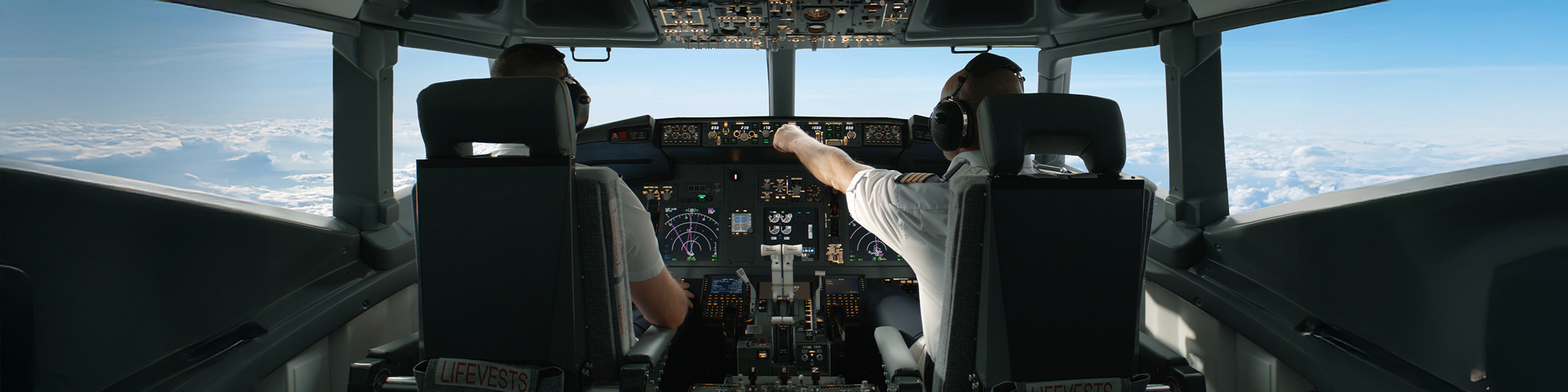
On 4 June 2025, air traffic controllers in Spain’s Canary Islands held a clear, uninterrupted conversation with a commercial pilot flying high above the Atlantic.
To most people, that might sound routine. For flights far from land, it is anything but.
Over oceans, clear and instant air traffic communication is still the exception rather than the rule. Instead, long gaps between messages force pilots onto less efficient routes and make it harder to manage traffic over vast stretches of open sky.
Delivering a single European sky
To tackle these communication and surveillance blind spots, a cross-border team of satellite engineers, air traffic specialists, airlines and research organisations from Spain, Portugal and Germany joined forces in a four-year EU-co-funded initiative called ECHOES.
The team set out to modernise Europe’s air traffic management.
Running until December 2025, this initiative tested space-based very high frequency (VHF) radio and satellite aircraft tracking systems (ADS-B) to improve air traffic management in oceanic and remote airspace.
“Currently aviation relies on VHF radio as the main means of communication, but there are a lot of areas in the world that lack this,” explained Gabriel García, ECHOES coordinator and programme manager at Startical, a Spanish public-private enterprise developing global satellite services for air navigation.
A gap over the oceans
Once planes leave the range of coastal ground stations – typically around 350 kilometres offshore – they disappear from radar and lose standard VHF radio contact. From that point on, communication becomes slower, patchier and less precise.
Instead, communication switches to older high-frequency radio, where transmissions are often affected by interference, background noise and delays. Pilots can still report their position and receive instructions, but not instantly.
The communication delay can be significant. Captain Pablo Poza, a veteran pilot flying transatlantic routes, said exchanges between pilots and controllers over oceans can involve gaps of up to five minutes, and in urgent cases, three minutes each way.
“
To have continuous, global coverage, we have calculated that we would need around 300 satellites.
“If I have any kind of problem when flying over the ocean and I have something to tell the control, their answer could take up to six minutes,” Poza said.
The wait, he explained, adds stress and reduces the time available to respond if something goes wrong.
Because controllers cannot continuously monitor aircraft with radar or speak instantly with pilots, they compensate by increasing separation distances. Over land, aircraft may fly 8 to 10 nautical miles apart.
Over oceans, that can expand to 50 or even 80 nautical miles. The system is safe, but it limits capacity and efficiency.
A call from orbit
The ECHOES team set out to change that. Building on earlier proof-of-concept work, the researchers developed and launched two nanosatellites into low Earth orbit in 2025. Weighing around 35 kilograms each, they carry VHF antennas capable of relaying the same voice and data signals aircraft already use to communicate with ground stations.
“Space technology has evolved, and miniaturisation and the lower costs of satellite launchers have made this VHF provision realistic,” García said.
The nanosatellites sit in low Earth orbit (altitudes between 160 and 2 000 km). This proximity to Earth and aircraft flight paths helps reduce time delay and keep VHF communications clear.
The breakthrough came when researchers successfully demonstrated, for the first time, real-time VHF data communications from space. In simple terms, they proved that aircraft could not only talk via satellite as they normally would over land, but also send and receive operational data messages through space.
After that first conversation, the ECHOES team ran further successful trials with planes from several airlines flying over the Atlantic between Europe and the Americas. These demonstrated that space-based VHF can work alongside ground systems and satellite-based aircraft tracking to provide continuous coverage in oceanic airspace.
For pilots, the experience felt reassuringly familiar. “We just talked to them as we normally do with ground-based VHF stations,” Poza said after participating in the tests. “I did not notice any difference. What I noticed was that it was normal.”
That normality is precisely the point.
Safer skies, greener flights
Now that the ECHOES team has shown that space-based VHF communication works, the next step is to expand it worldwide. A truly global service would need many more satellites.
“To have continuous, global coverage, we have calculated that we would need around 300 satellites,” García said.
Reliable satellite links could let pilots adjust routes in real time in response to weather, turbulence or congestion.
“
Worldwide VHF communication via satellite changes how pilots and air traffic controllers stay connected.
“If we could communicate with air traffic control continuously and they could ask other pilots for reports, that would improve feedback about what is happening around us,” Poza said.
Aircraft could fly more direct routes, cutting fuel use and emissions. Better communication would also allow more aircraft to safely use busy oceanic corridors, increasing airspace capacity.
“Worldwide VHF communication via satellite changes how pilots and air traffic controllers stay connected,” Poza said.
“By extending VHF coverage from space we can ensure continuous standardised communication. That improves safety by reducing delay and giving pilots reliable two‑way communication.”
If scaled up, the system could ensure that aircraft over the mid-Atlantic are as connected as those flying above Europe’s busiest skies, turning today’s communication gaps into a seamless global network.
By bringing standard VHF into orbit, Europe’s aviation innovators are showing how space technology can quietly transform everyday flying – making long-haul journeys safer, more efficient and better for the planet.