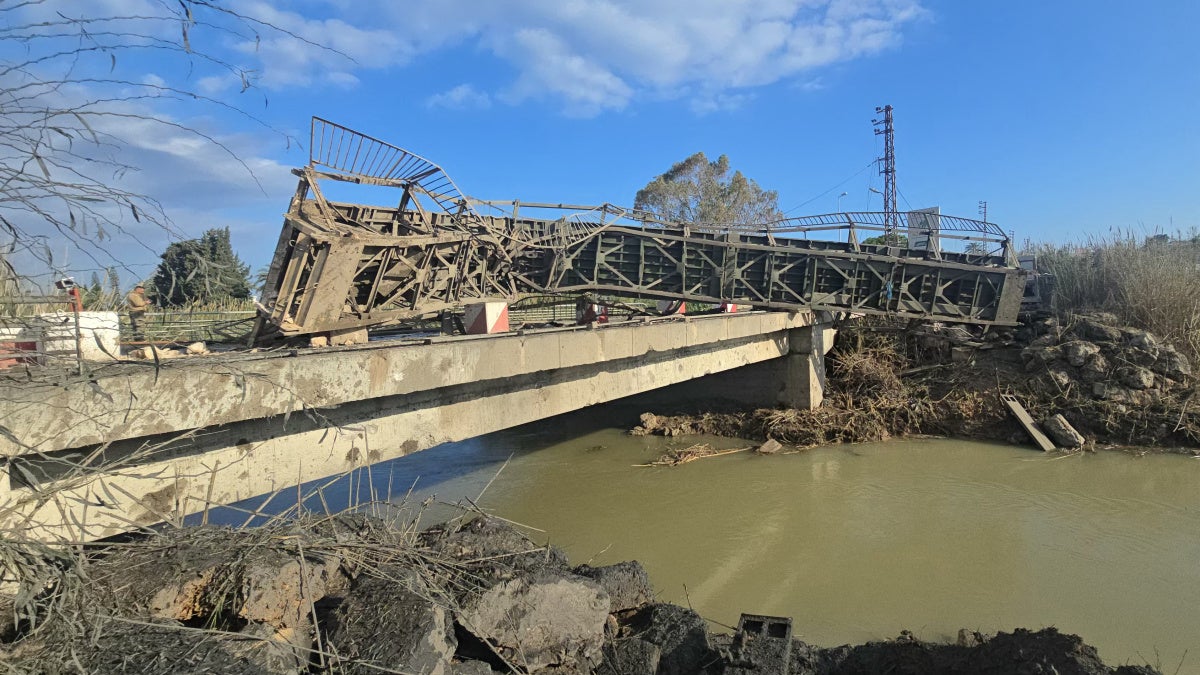
(Beirut, April 17, 2026) – The Israeli military’s destruction of the Qasmieh bridge on April 16, 2026, which took place hours before a ceasefire was announced, threatens to cut off Lebanese territory south of the Litani River from the rest of the country, Human Rights Watch said today. As the deliberate attack destroyed the last main operational crossing for civilians and aid, with the prospect of immense civilian harm, the attack should be investigated as a potential disproportionate attack on civilians, which would be a war crime.
Tens of thousands of civilians remain in areas of Lebanon south of the Litani River, local officials told Human Rights Watch. Donor countries should immediately take measures, including supporting the establishment of temporary crossings during the ceasefire, to try to secure access for civilians to items essential for their survival, such as water, food, and medicine. Should temporary crossings be established, other countries should pressure Israel to respect international humanitarian law and ensure civilians have safe passage over those crossings.
“The Israeli military’s systematic and repeated attacks on bridges, which threaten to isolate civilians in southern Lebanon from access to means of survival, demonstrate a callous disregard for the welfare of the tens of thousands of people still living there,” said Ramzi Kaiss, Lebanon researcher at Human Rights Watch. “Other countries should urgently pressure Israel’s military to stop putting civilian welfare at risk.”
Prior to April 16, the Israeli military had systematically destroyed or severely damaged all the main bridges connecting areas south of the Litani River to the rest of the country, making the Qasmieh bridge the sole main operational crossing for civilian use despite it also being damaged in an April 8 attack.
The earlier strikes had already significantly limited civilians’ ability to move safely and that of state institutions, humanitarian organizations, hospitals, and healthcare facilities to deliver aid and provide medical care. Other smaller crossing points may still be intact, but they are in difficult terrain, limited in size, and in some cases not connected to road networks, which would make it difficult for civilians to reach safer areas north of the Litani River or for humanitarian aid to be delivered safely.
Human Rights Watch verified photographs and videos shared by journalists and posted online of the moment of the attack and its aftermath. A verified video shows at least two large munitions striking the bridge, with smoke plumes and debris rising afterward. Vehicles can be seen approaching the bridge from both directions. The videos and photographs showed a large crater on the southern side of the bridge, which completely destroyed the crossing.
Tens of thousands of people living south of the Litani River depended on the Qasmieh bridge for access to humanitarian aid, food, and medical supplies, local officials, healthcare workers, and a hospital official in Tyre told Human Rights Watch weeks before the bridge was struck.
The United Nations Office for the Coordination of Humanitarian Affairs (OCHA) and the spokesperson for the UN high commissioner for human rights had warned that Israel’s strikes on bridges were isolating residents in southern Lebanon, severing connectivity between various areas, and impeding the delivery of essential supplies and severely limiting humanitarian access.
The Israeli military had accused Hezbollah of using bridges over the Litani River for military purposes, including moving combat equipment and fighters to the area south of the river. The Israeli military did not issue a statement offering any justification immediately after the April 16 strike, but they have previously stated that the strikes on bridges were “to prevent the movement of reinforcements and means of combat” into southern Lebanon.
However, even if bridge crossings are dual-use and become military objectives—that is, they are making an effective contribution to military action—any attacks on them are still subject to the requirements of proportionality. Disproportionate attacks include those that may be expected to cause excessive damage to civilians and civilian objects in relation to the concrete and direct military advantage anticipated from the attack.
Since the Qasmieh bridge was the last main operational crossing over the Litani, Israel should have expected the potential harm to tens of thousands of civilians to have been extensive. By contrast, it is not apparent what concrete and direct military advantage Israel would have credibly anticipated to justify such civilian harm.
The attack should be investigated to determine if the Qasmieh bridge did constitute a military object and, if so, if it was a disproportionate attack, which would be a war crime, Human Rights Watch said. If the bridge was not a military object, the strike would amount to an attack deliberately directed at a civilian object, which is also a war crime.
Israeli attacks have killed more than 2,196 people in Lebanon since March 2, according to Lebanon’s Health Ministry. This includes more than 172 children, 260 women, and 93 medical workers, as of April 7. Hezbollah attacks have killed at least two civilians in Israel, BBC reported.
Donor states should work with the Lebanese government to reestablish temporary crossings into the areas south of the Litani and commit to securing sustainable and predictable access to humanitarian aid for residents in southern Lebanon. All parties to the conflict should ensure that civilians have access to items essential for their survival, in addition to safe passage for those who choose to leave.
Israel’s allies, including the United States, the United Kingdom, Germany, and other European Union states, should suspend all arms sales, arms transit, and military assistance to Israel and impose targeted sanctions on officials credibly implicated in ongoing grave crimes. The EU should immediately suspend the trade pillar of its Association Agreement with Israel as long as Israel’s atrocity crimes persist, Human Rights Watch said.
Lebanon’s judicial authorities should initiate domestic investigations of serious international crimes, and the government should accede to the International Criminal Court’s Rome Statute and submit a declaration accepting the court’s jurisdiction prior to the date of accession, including since at least October 7, 2023.
“Other countries will only effectively signal to Israel that war crimes will not be tolerated through concrete actions,” Kaiss said. “They should start by suspending arms sales and sanctioning officials who are committing abuses.”