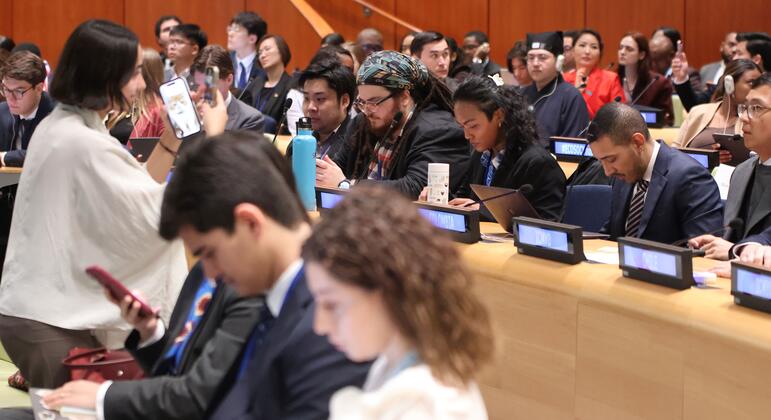
Young leaders, innovators and advocates from around the world are gathering at UN Headquarters in New York until Thursday for the 2026 Economic and Social Council (ECOSOC) Youth Forum.
The event aims to advance innovative solutions to accelerate progress on the Sustainable Development Goals (SDGs).
Held under the theme Innovate, Unite and Transform: Youth Shaping the Road to 2030, the forum reaffirms young people as essential partners in building a sustainable, inclusive and resilient future.
Bringing the ‘sunshine’
Acknowledging that it is rare to see a full room with such positive energy, General Assembly President Annalena Baerbock thanked participants for bringing “sunshine” into the halls of the UN.
Emphasising that young people must be included now, not just in the future, she told the audience they were there to do more than talk: “it’s a test of whether we are truly ready to act.”
She shared three messages with delegates, ministers and young leaders:
“First, to delegates and Permanent Representatives in New York: follow through, no excuses. (…) Second, to Ministers and representatives from capital: the discussions here must move beyond this chamber. (…) And last, to young people: keep pushing boundaries. Keep questioning. Keep leading.”
Ms. Baerbock also urged participants to seize the opportunity to engage with policymakers and remain authentic: “Let nobody tell you that you have to dress like diplomats in a dark suit or speak like a diplomat to be taken seriously. Because we need your voices precisely because you are uniquely you.”
Agents of change
Opening the forum, ECOSOC President Mr. Lok Bahadur Thapa highlighted the challenges facing young people today, including geopolitical tensions, climate change, economic uncertainty, widening inequalities, technological disruption and digital divides.
“Amid these challenges, young people stand not only as those most affected, but also as indispensable agents of change. Across communities and sectors, young people are not only advancing solutions but actively shaping a more inclusive, sustainable, and resilient future for all,” Mr. Thapa said.
Stressing the importance of youth leadership, he added that hope, solidarity and innovation are “already alive in every region of the world.”
Calling for truly inclusive progress, Mr. Thapa underscored the need to “ensure that all young people, regardless of geography, gender, ability, or socioeconomic background, have equitable access to opportunity, voice, and influence”.
Many excluded
According to, there are 1.2 billion young people aged 15 to 24 years, accounting for 16 per cent of the population. By 2030 – the target date for the Sustainable Development Goals (SDGs) that make up the 2030 Agenda – the number of youth is projected to have grown by 7 per cent, to nearly 1.3 billion.
Echoing calls for greater inclusion, Mr. Jaewon Choi – executive director of the DMUN Foundation, a youth-led, non-governmental organisation that empowers youths to be active stakeholders – and keynote speaker of the event, warned that many young people remain excluded from the very systems meant to serve them.
“Every 4.4 seconds, a young person dies…from malnutrition, from preventable disease, from violence, from natural disasters, and from the tragedy of being excluded from every system that was mandated to protect them,” he said.
Stressing the urgency of action, he added: “We are the ones who will, and are already, inheriting the consequences of every decision that is formed or avoided. We deserve the fundamental right to be part of making these decisions.”
Discussions at the Forum are focusing on clean water (SDG 6), energy (SDG 7), infrastructure (SDG 9), sustainable cities (SDG 11), and partnerships (SDG 17), the latter to be explored further at the 2026 High-level Political Forum in July.