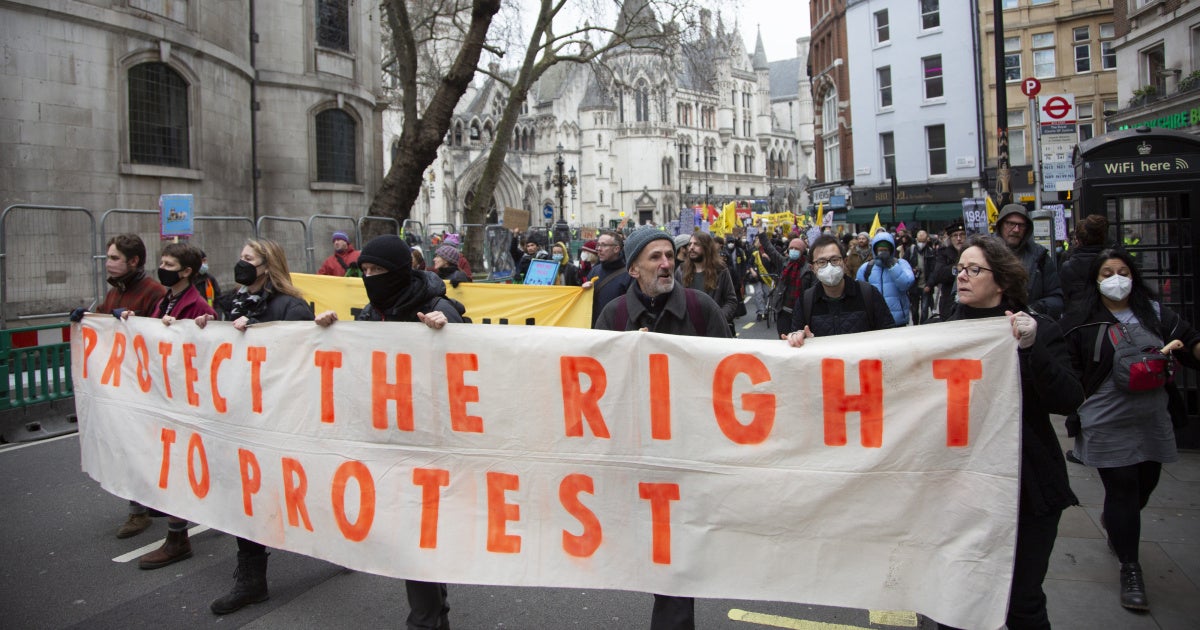
- UK authorities have severely restricted the right to protest, in contravention of their international human rights obligations.
- The Labour government, instead of curbing repressive measures against protesters in previous legislation under the Conservative government, is in the process of expanding them.
- The UK government should repeal anti-democratic protest restrictions and review and publicly account for all protest arrests and convictions made under laws that courts have ruled unlawful.
(London, January 8, 2026) – UK authorities have severely restricted the right to protest, in contravention of their international human rights obligations, creating an environment in which peaceful dissent is increasingly treated as a criminal act, Human Rights Watch said in a report released today.
The 47-page report, “‘Silencing the Streets’: The Right to Protest Under Attack in the UK,” documents that the UK’s Labour government has failed to reverse sweeping anti-protest laws introduced by the previous Conservative government. Instead, Labour has attempted to expand them with the Crime and Policing Bill 2025 and through the unprecedented misuse of terrorism legislation to target and criminalize peaceful protest. The Crime and Policing bill, pending before parliament, is to be debated in the House of Lords in January 2026.
“The UK is now adopting protest-control tactics imposed in countries where democratic safeguards are collapsing,” said Lydia Gall, senior Europe and Central Asia researcher at Human Rights Watch. “The UK should oppose such measures, not replicate and endorse them.”
The Labour government has taken a deeply alarming direction on protest rights and appears to be determined to suppress these rights further instead of requiring government accountability for policing, Human Rights Watch said.
Recent protest restrictions result from a combination of vague statutory provisions and broad police discretion, creating a legal environment in which the authorities can curtail demonstrations with limited oversight. The Police, Crime, Sentencing and Courts Act 2022 (PCSCA 2022) and the Public Order Act 2023 (POA 2023) broaden police discretion to impose conditions on protesters, make pre-emptive arrests, and pursue prison sentences for nonviolent protest activity, which in the past typically resulted in fines or community service.
The report, based on research in 2024 and 2025, shows that protesters are increasingly detained, charged, and in some cases sentenced to multi-year prison terms for non–violent actions such as attending planning meetings. The inconsistent and sometimes arbitrary enforcement of these provisions contributes to confusion and has a chilling effect on dissent.
A striking example of overreach is the case of a retired social worker, Trudi Warner, arrested and charged with contempt of court for quietly holding a sign outside a courthouse informing jurors of their rights. The High Court dismissed the case as “fanciful” and confirmed that she had not attempted to influence any juror. Despite this, the Labour government initially filed an appeal before abandoning the case.
A stark illustration of the escalating crackdown on peaceful protest is the case of five Just Stop Oil activists who, in July 2024, were sentenced to between two and five years in prison for merely joining a Zoom call to plan a protest.
On appeal, the High Court ruled in March 2025 that the sentences were “manifestly excessive” and disproportionate to the nonviolent conduct involved. Nevertheless, the court only reduced the activists’ prison sentences marginally, in one instance from five to four years.
Such cases raise serious concerns for democratic accountability, as the expansion of state authority risks suppressing public participation and weakening the ability of people to hold the government to account.
The new Crime and Policing Bill 2025 would deepen the crackdown on protest by expanding police powers to ban face coverings by protesters, restrict demonstrations near places of worship, and impose conditions that could put people with insecure immigration status, such as asylum seekers and undocumented persons, at risk of deportation. Domestic and international human rights bodies have warned that such restrictions are vague, disproportionate, and unnecessary.
The UK remains legally obliged to protect freedom of expression and peaceful assembly under both domestic and international law, including the Human Rights Act 1998, the International Covenant on Civil and Political Rights (articles 19 and 21), and the European Convention on Human Rights (articles 10 and 11).
The government should repeal or amend the PCSCA 2022 and POA 2023 to remove unnecessary restrictions on protests, strengthen the Human Rights Act to prevent political interference with protests, and stop using counterterrorism legislation against protesters, Human Rights Watch said.
The UK government should also establish a substantial public inquiry into the policing of protests under the PCSCA 2022 and POA 2023 and ensure that policing of protests complies with international human rights law.
“The UK should be protecting the right to protest instead of stripping away people’s rights,” Gall said. “Lawmakers should revise the new law to remove measures that would further restrict the right to protest.”