“And when he woke up, the oil was still there…”
The Dinosaur is a one-sentence story, penned in 1959 by Guatemalan author Augusto Monterroso. One of the shortest stories ever written, it likely refers to the “dinosaurs” of power, to Central America’s numerous, longstanding dictators, and to the ghosts that survive apparent changes.
In the above adaptation of the story, the dinosaur is not only the authoritarianism, ideologies and slogans of the 1960s, but also oil as a structural factor that has conditioned political decisions, ideological alliances and models of state survival in Cuba and Venezuela.
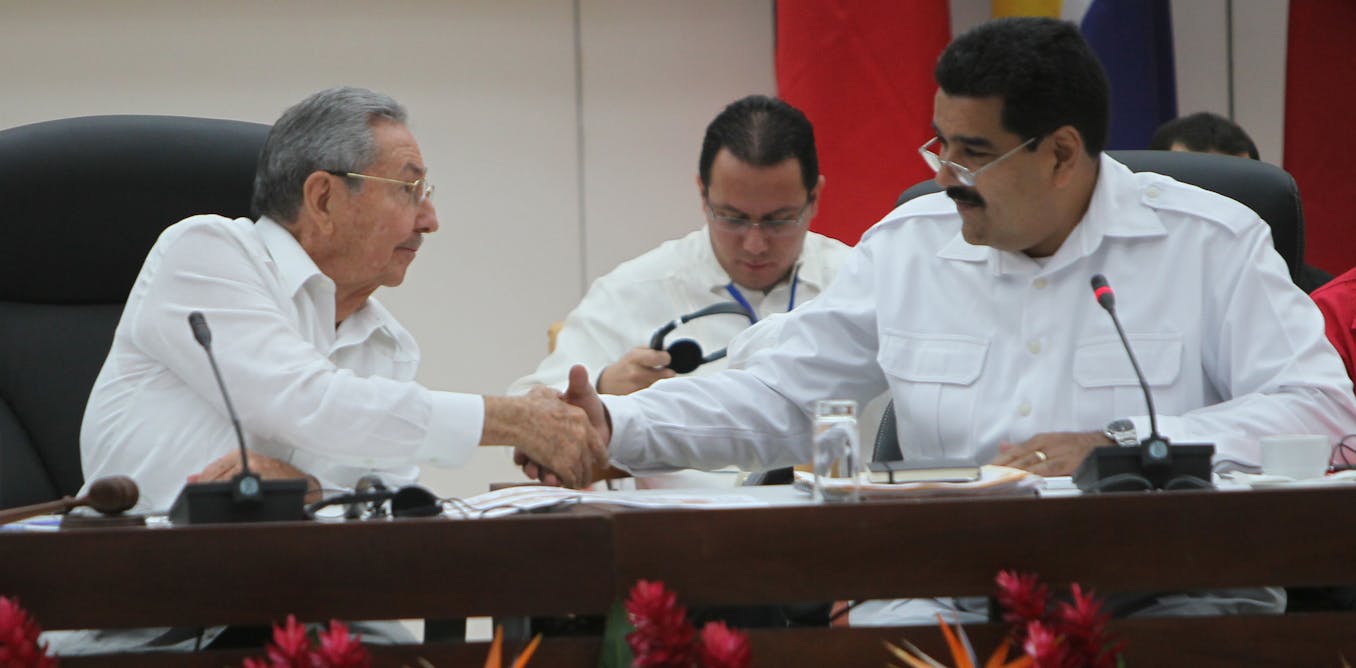
The relationship between the two nations, a cornerstone of Latin American politics for more than six decades, has been permanently defined by oil. The recent arrest of Nicolás Maduro in Venezuela therefore marks a geopolitical turning point for Havana, whose energy, strategic and political ties with Caracas sustained much of its survival as a state.
Donald Trump has asserted that Cuba is “ready to fall”. Indeed, the history of Venezuela and Cuba in the 20th century can be understood as two parallel trajectories that began in the same year.
1958 saw the fall of Marcos Pérez Jiménez and the subsequent beginning of Venezuelan democracy, as well as the triumph of the Cuban Revolution, which would culminate in 1959 when Fidel Castro rose to power. Two political projects were born simultaneously, but destined to follow radically different paths.
The comparison has an enduring significance. When Fidel Castro died in 2016, in his bed after being dictator for life, Venezuela had already had ten elected presidents in power. This difference epitomises two models of relationship to power, society and freedom.
Castro’s mistrust of Venezuela
From very early on, Castro set his sights on on Venezuela as part of a strategic calculation. The rapidly expanding oil-based democracy had key energy resources and considerable regional influence.
In the early days of Venezuelan president Rómulo Betancourt’s government, Castro was welcomed as a global hero, the leader who had defeated Fulgencio Batista’s dictatorship. However, the honeymoon was short-lived. When Castro requested financial and political support for his revolution, Betancourt flatly refused. From that moment on, the relationship became openly hostile.
The consequences soon became evident, as Cuba promoted and attempted to export armed struggle to Venezuela. This included an attempted invasion via the town of Machurucuto in 1967, during the government of Raúl Leoni, when guerrillas trained under Castro’s Sierra Maestra model attempted to replicate the Cuban experience on Venezuelan soil. Other dramatic accounts, including an alleged assassination attempt on Betancourt involving a syringe containing cobra venom, illustrate the intensity of the conflict.
Decades later, the relationship between the two countries would take a decisive turn with the emergence of Hugo Chávez. After two attempted coups d’état in 1992 and his subsequent amnesty under the government of Rafael Caldera, Chávez was invited to Cuba and received by Fidel Castro with the honours of a head of state. Chávez was deeply impressed by Castro and the Cuban revolutionary struggle. From that point on, a political and personal relationship was forged that would have profound consequences for Venezuela.
Close relations with Chávez
When Chávez came to power through elections in 1998, a raft of cooperation agreements with Cuba were swiftly formalised in the areas of health, education, sport and social welfare. Cuban doctors arrived in historically disadvantaged areas of Venezuela, laying the foundations for a narrative of solidarity and social justice.
However, there was another less explicit element to the relationship. The Cuban regime shared its experience in political control, intelligence, espionage, repression and authoritarian survival in exchange for resources, predominantly oil. By supplying Cuba with tens of thousands of barrels of crude oil per day, Venezuela alleviated pressure on the Cuban economy, helping to sustain basic services and exports of health professionals to Cuba’s fraternal networks in Latin America and Africa.
This was probably Cuba’s most significant contribution to Chávez’s project. The island had survived decades of confrontation with the United States thanks to Soviet subsidies. After the fall of the USSR, it went through a period of extreme precariousness until it found a new source of support in Venezuela. In exchange for Venezuelan oil, Cuba exported a proven and effective model of power control.
In addition, Chávez found Castro to be not only an ally, but also a mentor. This apprenticeship explains much of Venezuela’s subsequent authoritarian drift. What began as a political project with electoral legitimacy ended up adopting the practices of a regime designed to never leave power. And so the parallel paths of Venezuela and Cuba converged again, decades later, in authoritarianism.
Cuban forces in Venezuela
Venezuela’s subordination to Cuba’s security apparatus was firmly underscored on January 3, 2026, when 32 Cuban officers were killed defending Nicolás Maduro during the US military operation that culminated in his capture. Havana described this as “combat actions” in the fulfilment of official duties.
The deployment of Cuban military personnel to protect the Venezuelan president and their death in combat explicitly demonstrate the loss of autonomous control of Venezuela’s defence by its own armed forces. They also reveal the existence of a parallel security structure directed by Havana.
Both sides had officially denied this military presence on several occasions. However, it clearly demonstrates that the Chávez’s regime had delegated a central function of sovereignty – presidential security – to agents of the Cuban state. This is unprecedented in the contemporary history of the region.
No oil, and a struggling tourism industry
Cuba-Venezuela relations cannot be understood without recognising oil as its true common thread: first as a strategic promise, then as an economic and political lifeline, and today as a void that redefines the Cuban regime’s room for manoeuvre in an increasingly hostile international context.
Since the mid-20th century, it has been the linchpin of the relationship between Havana and Caracas. Currently, Mexico is also an important energy supplier for the island, but oil has been the contemporary equivalent of Monterroso’s dinosaur: a timeless presence.
Another key element of Cuba’s economic predicament is the collapse of its tourism sector. Historically, this was one of its few significant sources of foreign currency not linked to oil.
A recent analysis by Global Affairs found that the island has not managed to recover pre-pandemic levels of international tourism – in 2019 it received more than 4.2 million foreign visitors, while in 2023 there were just 2.4 million. The figures for 2024 and 2025 show a further downward trend.
Without Venezuela as an energy supplier or a robust tourism industry to bring in money, the Cuban economy faces a critical deficit of external resources. The decline in both sources of income exposes the fragility of a dependent economic model that cannot sustain itself in unfavourable external conditions.
A turning point for Cuba
Trump’s tight control of Venezuelan oil exports is exacerbating the current crisis in Cuba, which is now at a tipping point that threatens the regime’s survival.
In this panorama, US Secretary of State Marco Rubio has emerged as a central figure, bringing together his personal background as the son of Cuban immigrants and his political vision, which places Cuba at the epicentre of diplomatic and strategic confrontation in contemporary US foreign policy.
The outcome of this new chapter will be determined by a combination of sanctions, internal pressures, and geopolitical realignments.
For Cuba, oil is still there, but no longer as an automatic source of support for the regime. It is now a critical absence, one that exposes the country’s structural weaknesses and will play a decisive role in its future over the coming months.
A weekly e-mail in English featuring expertise from scholars and researchers. It provides an introduction to the diversity of research coming out of the continent and considers some of the key issues facing European countries. Get the newsletter!