After weeks of relentless rain and flooding, and even more forecast, 2025’s droughts and hosepipe bans feel like ancient history. But they shouldn’t.
The UK is increasingly caught between these wetter winters and warmer, drier summers. What if this year’s summer brings water shortages again? The seemingly endless rainfall causing flooding across the UK right now could help solve future summer drought problems – if we capture it right.
The stakes are high in Speyside, home to around half of Scotland’s malt whisky distilleries. They had to cope with 2025 being the UK’s warmest and sunniest on record, where prolonged dry conditions led to widespread restrictions on water abstraction. Multiple distilleries were forced into temporary closures, costing the industry millions of pounds and highlighting just how vulnerable even Scotland’s famously wet regions are to water scarcity.
Whisky production represents one of the UK’s biggest industrial water users. Large quantities of water are required for the distilling process and the product itself, so understanding water conservation is both extremely important for the industry, and can also help others recognise the benefits.
If it was possible to retain this winter’s rainfall and release it gradually when it was needed, the nation could become more resilient to both floods and droughts without building expensive new reservoirs.
Managing droughts with floods
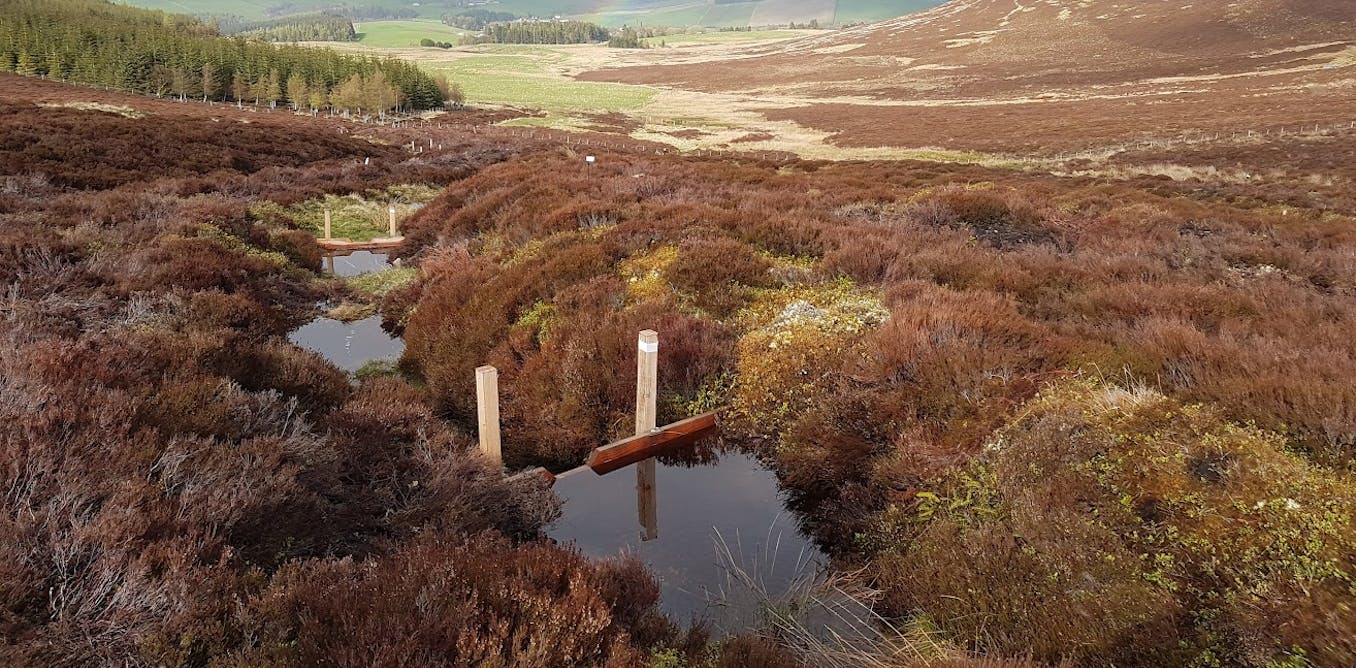
Across Speyside, they’re testing ways to slow, store and steadily release water by working with the landscape rather than against it. Distillers have invested in leaky dams (small barriers built across temporary upland streams) to slow the flow of water during heavy rain and allow the rainwater to soak into soil and recharge groundwater.
Leaky dams hold the water at surface level as well helping it store underground. Water in the soil and deeper groundwater move through the subsurface much more slowly than over land – taking weeks or months rather than hours or days – which is why rivers still flow even after long dry spells.

Ondrej Zeleznik/Shutterstock
There are other examples of useful interventions. Peatland restoration, wetland creation and tree planting all work by increasing temporary storage in the landscape and slowing the movement of water into rivers.
Research across upland catchment areas in Cumbria and West Yorkshire shows how the principles being tested in Speyside could translate to elsewhere. A large academic review of natural flood management evidence concluded that measures increasing water storage, slowing the flow of water over the land or enhancing soil structure can consistently reduce the peak level of a flood.
This growing body of evidence supports a simple but powerful idea: the UK and other countries could be more resilient to droughts and floods by redesigning landscapes to keep water around for longer.
Three lessons for the rest of the UK
1. Design and location matter
Local factors and hydrology (the study of the movement and management of water) can determine what works best where. For example, planting trees “somewhere” delivers far less benefit than planting them in the right places, especially near rivers, near the source of the river, or where soil can absorb water.
2. Benefits must stack up or they won’t be adopted
Leaky dams and other projects, such as tree planting, are relatively inexpensive, compared with traditionally engineered flood defences or having to deal with flood and drought consequences. They can deliver benefits at a fraction of the cost, while potentially also increasing biodiversity, soil health, carbon capture and improving water quality.
But there are trade-offs, which need to be assessed early. For example, in some cases, large-scale tree planting can also reduce summer water availability in already stressed catchment areas. Tree canopies can temporarily store water on the leaves, but if this water evaporates it doesn’t return to the soil. Tree roots improve the soil so it absorbs and stores more water, but trees can also use more water. The net effects depend on factors such as climate, soil type and tree species.
3. Good governance will unlock funding
When water security has clear economic benefits, businesses are willing to engage. However, investment is not always private, and a recent review showed public funding is often fragmented, with inconsistent planning rules. Strengthening overall governance of these kind of schemes is essential, because farmers, businesses and landowners are far more likely to participate if they benefit.
Managing our landscapes appropriately won’t stop all floods or prevent every drought, but it can make both less severe, while restoring habitats, supporting farming, and protecting industries that rely on dependable water supplies.
Every river carrying floodwater to the sea represents water that could be stored for drier months. Thinking ahead for what happens during heavy rains can be part of forward planning for more extreme weather in years to come.

Josie Geris receives funding from the Natural Environment Research Council, Royal Society, the Scottish Government via CREW (Scotland's Centre of Expertise for Waters), and Chivas Brothers.
Megan Klaar receives funding from the Natural Environment Research Council, The Leverhulme Trust and National Trust.