Flashing light can do more than illuminate a room. Delivered at specific rhythms and viewed through closed eyelids, it can produce vivid visual hallucinations, geometric patterns, bursts of colour and sometimes even full scenes in people with no underlying illness and no use of drugs.
These experiences are known as stroboscopic hallucinations. They offer a window into how the brain constructs perception and how conscious experience shifts when the signals reaching the visual system are altered.
Eyelids are not a blackout curtain. Even with eyes closed, light can pass through and reach the retina, the light-sensitive layer at the back of the eye. If that light flashes at particular rates, it can nudge brain rhythms into the same timing as the light, so the brain’s natural electrical activity begins to synchronise with the external flicker.
This becomes especially pronounced when the flashing frequency overlaps with the brain’s resting rhythms, roughly eight to 12 hertz, or eight to 12 flashes per second. In this “sweet spot”, large groups of brain cells fire in sync, and that coordinated activity spreads across visual areas at the back of the brain.
The brain then interprets these patterns as meaningful experience. When the signal is strong and structured enough, perception can emerge even without an external scene.
Often, people see simple hallucinations: geometric patterns, kaleidoscopic colour shifts, spirals, lattices, tunnels or cobweb-like grids. These have been documented for well over a century and appear consistently across many people. Because they arise from the visual system itself, similar shapes also appear in psychedelic drug experiences, migraine aura, sleep-related states and certain neurological or visual conditions.
Read more:
Pseudo-hallucinations: why some people see more vivid mental images than others – test yourself here
Sometimes people report more complex hallucinations with recognisable content such as objects, places or landscapes. In these cases, the brain appears to impose familiar meaning on an unusually powerful visual signal, organising abstract input into something coherent.
From a neuroscience perspective, this is what makes these experiences useful. Hallucinations reveal how the visual brain constructs reality and what happens when the balance between sensory input and internal expectations shifts. Vision is not a passive recording process. The brain continuously interprets, fills in and predicts. Hallucinations show what perception can look like when those internal processes temporarily dominate.
A brief history
Stroboscopic hallucinations have been described scientifically since at least 1819, when the Czech anatomist Jan Evangelista Purkyně reported patterned visuals induced by candlelight flickering through moving fingers held in front of closed eyes.
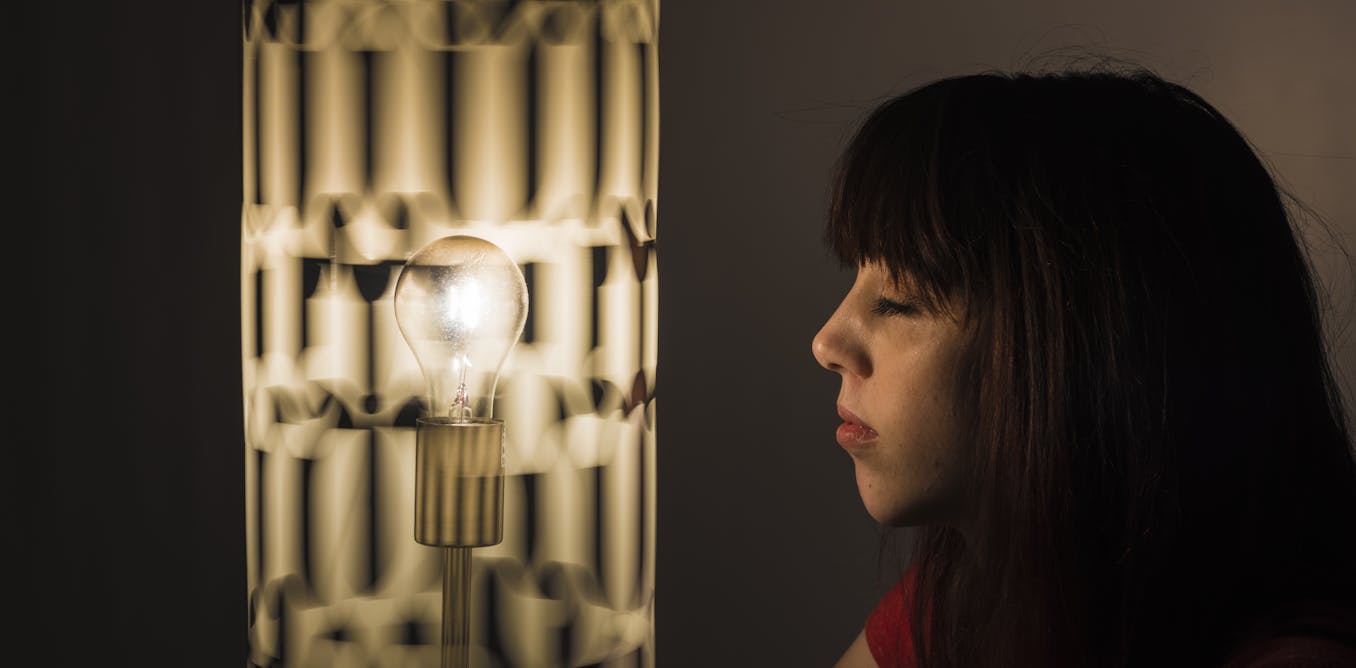
In the 1960s, the phenomenon entered popular culture through the “Dreamachine”, created by artist Brion Gysin and mathematician Ian Sommerville. A lightbulb inside a rotating cardboard cylinder cut with shapes produced flicker rates that reliably induced hallucinatory imagery in people sitting with closed eyes. Gysin imagined it replacing television, with people gathering to generate inner imagery rather than watch programmes. That never happened, but it captured how immersive these experiences can be.
Read more:
Manipulating light can induce psychedelic experiences – and scientists aren’t quite sure why
In 2022, I was involved as a scientific adviser in a large-scale modern reimagining of the Dreamachine as part of Unboxed: Creativity in the UK, a UK-wide public arts and science festival. The installation used stroboscopic technology, immersive sound and carefully designed sessions to create a structured public experience.
More than 40,000 people took part. Many drew what they had seen afterwards, generating over 10,000 images. That created an unusual scientific opportunity. Laboratory studies of hallucinations typically involve small samples. Here, we had thousands of visual reports.
Working with colleagues, we used machine learning tools to group the drawings by shared visual features such as symmetry, repetition and curved shapes. This allowed us to identify familiar pattern types already described in scientific research, as well as a wider range of geometric forms that have received less attention.
People’s inner visuals are not random. Similar patterns appear again and again across different people, suggesting they reflect shared features of how the human visual system is organised.
Therapeutic
Following reports of improved wellbeing after Dreamachine sessions, we began investigating whether controlled stroboscopic stimulation might have therapeutic potential, including for depression. Research on psychedelic-assisted therapy, where substances such as psilocybin are used in carefully supervised clinical sessions with psychological support, suggests that aspects of the experience itself, such as feelings of awe or shifts in self-perception, can predict later clinical improvement.
Because stroboscopic stimulation can induce some of these features without medication, it raises the possibility of a more accessible approach.
I am currently involved in a study exploring whether this kind of stimulation can be used safely in people with depression. Initial findings are encouraging, but the research is still at an early stage and focused on safety rather than effectiveness.
Stroboscopic stimulation is also being explored in other areas. In Alzheimer’s disease, for example, researchers are investigating whether synchronising brain activity at specific frequencies might influence processes linked to the disease. Clinical trials are under way, though the field is still developing.
The main medical risk associated with strobe exposure is a photosensitive epileptic seizure. Only a small proportion of people with epilepsy are photosensitive, but the risk is not zero. Responsible research groups and public installations screen participants and use established safety procedures.
Some people may experience milder effects, including headaches or discomfort, particularly if they are sensitive to bright light. A small number report little or no visual effect at all.
The broader scientific interest lies in what these experiences reveal about conscious perception. How the brain produces a unified experience of the world remains one of neuroscience’s most challenging questions. By studying simpler visual components such as colour, symmetry and movement, researchers can begin to unpack how experience arises.
Read more:
How higher states of consciousness can forever change your perception of reality
Altering visual input in a controlled way allows us to observe how the mind constructs reality. That helps us understand not just hallucinations, but normal conscious experience itself.
Strange Health is hosted by Katie Edwards and Dan Baumgardt. The executive producer is Gemma Ware, with video and sound editing for this episode by Anouk Millet. Artwork by Alice Mason.
Listen to Strange Health via any of the apps listed above, download it directly via our RSS feed or find out how else to listen here. A transcript is available via the Apple Podcasts or Spotify apps.

David Schwartzman receives funding from the Medical Research Council (UKRI083) and was partly supported by a grant from the UK Government for his participation in the Dreamachine Programme, as part of Unboxed2022.