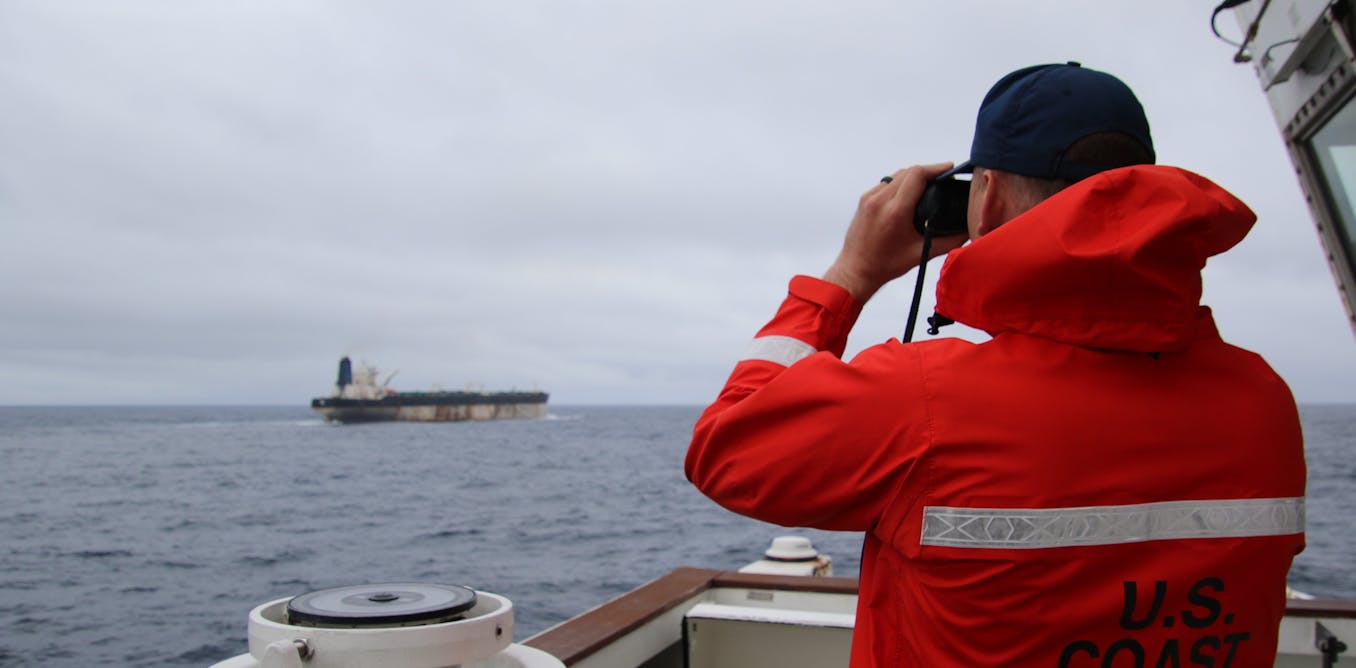
Relations between the US and Russia have hit a fresh bump after the US coastguard boarded a vessel sailing in the Icelandic waters, claiming it was in breach of sanctions on Venezuela. The incident immediately sparked claim and counter-claim from the US and Russia.
The US claimed it was acting correctly to execute a warrant issued by a US federal court. Russian officials, meanwhile, were reported by the country’s Tass news agency as saying this was in clear breach of the law of the sea, saying “no state has the right to use force against ships properly registered in the jurisdictions of other states”. The statement asserted that the Bella 1 – which was recently renamed as the Marinera – had received a temporary permit to sail under the Russian flag on December 24.
Unlike the dramatic abduction of Venezuela’s president, Nicolás Maduro, from his Caracas palace on January 3, which the United States (US) does not even appear to be trying to defend in international law terms, the interdiction of the Marinera/Bella 1 appears to raise a new point of the law of the sea which may offer at least some prospect for Washington to show itself to be on the right side of the law.
Before the change of flag, the US seemed to be selecting with some care the ships carrying Venezuelan oil that it was targeting. These were either stateless or suspected of flying a false flag, which provides no protection under Article 92 of the United Nations Convention on the Law of the Sea (Unclos), which is also the customary international law rule for non-parties such as the US.
Stateless ships are vulnerable
Being stateless, or acting in a way that gives warships on the high seas a valid basis for treating it as though it were stateless, is a position that any ship would be recommended to avoid if at all possible. A ship that is stateless has by definition no flag state to assert the protective exclusive jurisdiction over it on the high seas.
Unclos also provides that a ship which sails under the flags of two or more States, and swaps them depending on the circumstances, “may not claim any of the nationalities in question with respect to any other State”. This means it can be regarded legally as stateless.
Thus, until the change of flag reported on December 31, not just the US but any State was entitled to treat the Marinera/Bella 1 as stateless. This made it vulnerable to interception on the high seas and the exercise of domestic law enforcement jurisdiction over it by the State of the interdicting warship or coastguard vessel.
So the legal position remains unclear. It may be a question of whether the US was already pursuing the Marinera/Bella 1 when it changed its flag. If so the US may be entitled to disregard the reregistration.
Unclos allows for what it refers to as “hot pursuit”. It says that: “The right of hot pursuit ceases as soon as the ship pursued enters the territorial sea of its own State or of a third [another] State.” Since no other circumstance in which the right ceases is mentioned, including the ship ceasing to be stateless, this leaves it open to the US to argue that it was already pursuing the Marinera/Bella 1 and was thus not required to call off its pursuit.
But this argument has limited usefulness as there’s doubt as to whether this was actually a hot pursuit at all. The term is used for pursuits that begin in one of the maritime zones of the State conducting it – not on the high seas.
Claim and counter-claim
So far the Russian Ministry of Transport has claimed that the US action is contrary to the Article 92 rule. Russia insists that the change of registry occurred as long ago as December 24. To counter this, the US could say that it wasn’t until the Russian flag was painted on the ship’s hull, which was reported on December 31, that the Article 92 rule could be invoked against the US.
Article 92 also lays down that: “A ship may not change its flag during a voyage or while in a port of call, save in the case of a real transfer of ownership or change of registry.” This is often misunderstood and assumed to mean that a change of flag in mid-voyage – such as appears to have occurred in this case – is not permitted at all. But a closer reading reveals that this is not the case. What it prevents is a change of flag without a corresponding change of registration.
But that is not the position here. Assuming there was a real registration to Russia, that is what counts. Painting on a flag because you don’t have a physical one is simply evidence of that.
Reflagging while under pursuit is a new point in the international law of the sea to the extent that no previous incident of it is known. In the absence of a clear answer on this, the way this incident plays out is itself going to set the precedent for the future on this issue. We’ll need to hear the competing legal narratives of the US and Russia to see which of them is the more convincing.