A couple of years ago I dug up an artefact buried under soil, grass and leaves in a park close to my home in Exeter. It was not some ancient object but rather a granite memorial plaque laid down by the local city council only three years before. Dedicated to regional victims of the COVID pandemic, it had been created, forgotten and swallowed by the ground in swift succession.
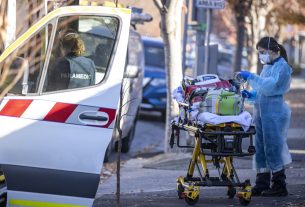
This illustrates our conflicted relationship with remembering the pandemic in Britain. The urge to memorialise sits awkwardly alongside forces of forgetting and indifference. COVID killed over 230,000 people in the UK and had profound effects on health, wellbeing, child development and economic stability. Yet many people treat it with the ambivalence of waking from a strange dream.
Following its official response to the UK Commission on Covid Commemoration late last year, the British government is now formally stepping into this slippery space of remembering and forgetting. March 8 has been designated as a day of reflection on the pandemic, with the Department for Culture, Media and Sport taking the lead.
And yet how much difference will this day make? What media coverage will it receive? How much public appetite is there for it? In my own work on British remembering and forgetting of the pandemic, I have found much evidence of uncertainty about what should be remembered, who should be centred and when commemoration ought to begin.
Despite the death toll and social consequences, public memory of the COVID pandemic has been marked by hesitancy about what should be remembered, when commemoration should happen, who it should involve and how it should be enacted.
A key challenge is the absence of a unified narrative. Pandemic experiences ranged from bereavement, illness and profound suffering in lockdown to mild inconvenience or even a welcome respite from normal life. Depending on luck and the situation with which you entered into the pandemic, it was anything from deeply traumatic to something people are quietly nostalgic about.
When I asked for short public recollections of the period, I received stories of loss, disrupted lives and exhausted health workers, but was also inundated with descriptions of birdsong and country walks. The responses were later compiled into an online audiobook. Public memory of the pandemic has to find a way of holding these incongruities together.
The day of reflection also has a disorientating relationship with time. COVID had no neat end point, no convenient armistice day around which to orient ourselves. The question of when public remembrance should begin was therefore unclear. Some informal memorials were created not long after the pandemic started, but when the government launched the UK Commission on Covid Commemoration in 2022, it was criticised for being too soon. In reality there is probably no perfect moment for public memorialisation, with the time always feeling either too early or too late for different people.
The question of who should organise remembrance is equally fraught. The state’s slow response to recommendations from the UK Commission on Covid Commemoration has been shaped in part by an awareness that this is politically sensitive terrain. Perhaps remembrance should not be led by the state at all. The grassroots activist group COVID-19 Bereaved Families for Justice UK created the National Covid Memorial Wall in London, and the bereavement charity Marie Curie oversaw earlier versions of the day of reflection.
Focusing collective recollection solely around loss of life nonetheless leaves major gaps in terms of the variety of people’s experiences. But there are also risks in wholly levelling the playing field. The loss of a loved one is not equivalent to Zoom quizzes and sourdough baking. Nor should collective memory erase the extent to which the pandemic’s impacts were systemically uneven, with higher mortality rates in some ethnic minority communities.
Remembering through the lens of war
The day of reflection also sits awkwardly alongside existing patterns of how British people remember. These habits are most prominently shaped by rituals of war memory. The various memorial spaces associated with fundraiser and veteran Captain Sir Tom Moore emerged partly because he so neatly fused thoughts of COVID and the second world war.
But the pandemic was not much like a military conflict. While there were praiseworthy instances of public service, most deaths did not fit a narrative of heroic sacrifice, the virus was not an ideological or national enemy, and comparisons between prime ministers Boris Johnson and Winston Churchill have not endured.
Despite the difficulties of what is remembered, when it should happen, who should lead it and what form it should take, there has been an abundance of memorial creation since 2020.
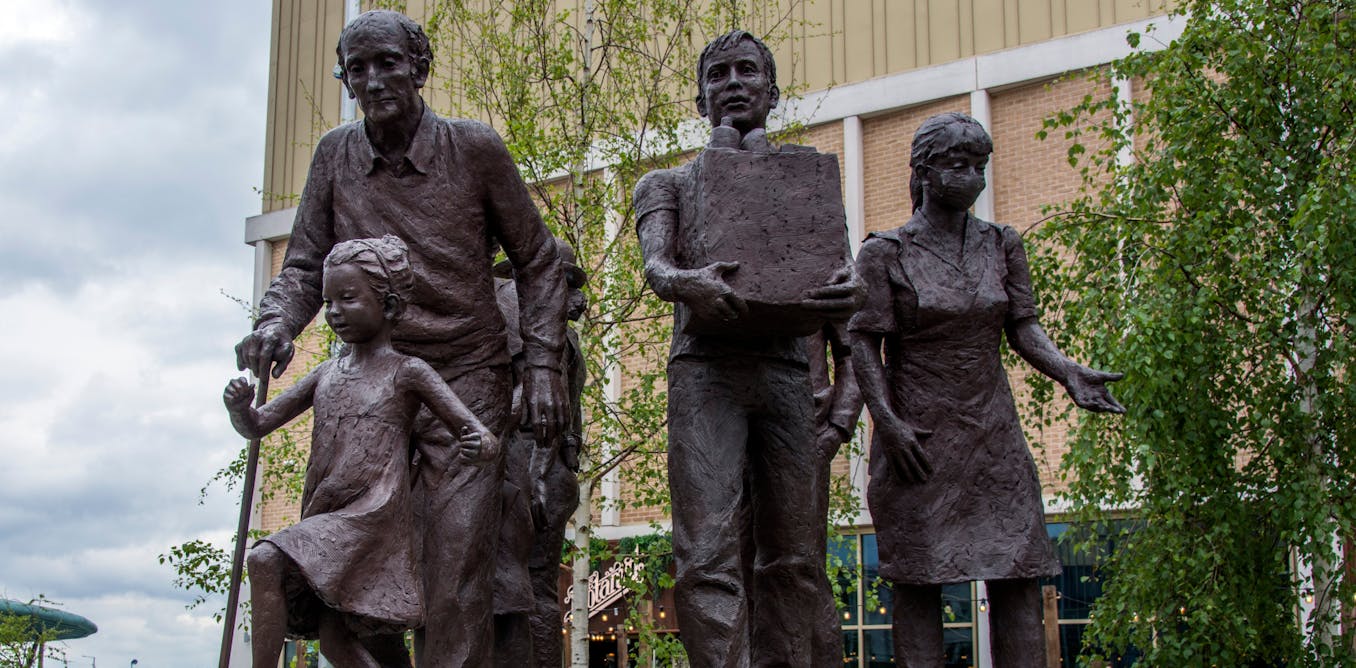
When researching a book on the topic, I visited one built high up a Welsh mountain. I saw one constructed elaborately from wood and later ceremonially set ablaze. Another was framed as a defiant celebration of working-class heroism. One depicts exhausted medical staff cast in bronze. There were many others. Their narratives, forms and origins vary considerably, but what they share is a tenuous grasp on public consciousness. Generally they are little known and, in some cases, their long-term survival is uncertain, dependent on funding, maintenance or continued public interest.
The March 8 day of reflection will not settle the question of how Britain remembers or forgets COVID, but it will reveal how willing we are to try. Any national act of remembrance will only feel meaningful if it can hold together grief, inequality and ambivalence without pretending they are the same.

During 2021-2022 David Tollerton received funding from the Arts and Humanities Research Council to research this topic.