Since December 2025, thousands of people in Iran have once again taken to the streets. The regime has responded with brutal repression. Amnesty International speaks of massacres of protesters. What began as protests against inflation rates of nearly 50 percent, corruption and economic hardship has long since turned into an open uprising against the Islamic regime. In this guest essay, Shoura Hashemi, a native Iranian and Managing Director of Amnesty International Austria, explains why the feminist mass protests of 2022 laid the groundwork for today’s demonstrations, why the Shah is not a savior figure, and how a transition to a peaceful and free Iran can succeed.
When Jina Mahsa Amini was killed in September 2022 and thousands of Iranians poured into the streets, it marked a turning point. Not because the regime was toppled – it was not – but because a line had been crossed. Women burned their hijabs in front of running cameras, schoolgirls refused to honor Khamenei, and the slogan “Woman, Life, Freedom” echoed through the cities of the country. The world watched. Celebrities shared videos, governments condemned the violence, and for the first time in decades, Iran’s women’s movement stood at the center of international attention.
That “success” came at a price. Hundreds killed, thousands arrested, young protesters executed. The regime survived – weakened, but still in power. And it is precisely this weakness that created the conditions for new protests. More than that: the “Woman, Life, Freedom” movement crossed a psychological threshold. It showed that people can oppose the regime openly and loudly.
The current protests in Iran
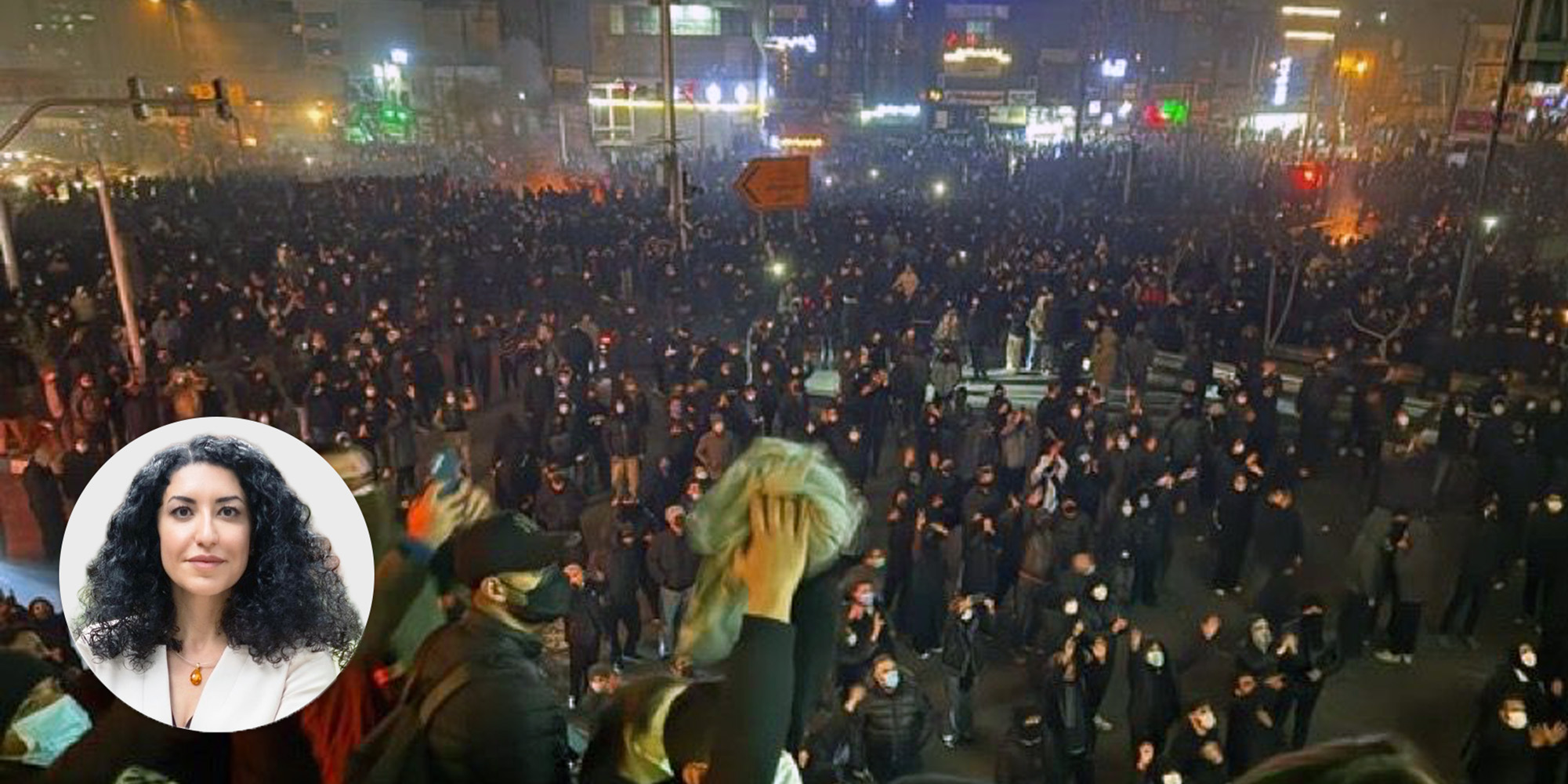
The latest wave of protests began on 28 December 2025 with strikes and demonstrations in Tehran’s Grand Bazaar, but quickly spread to all provinces. Iran’s leadership responded by shutting down the internet and deploying security forces, the Islamic Revolutionary Guard Corps (IRGC), and the police, who cracked down on demonstrators with extreme brutality and targeted use of firearms. The Iranian human rights organization HRANA (Human Rights Activists News Agency) estimates at least 2,571 people killed and around 18,470 arrests. Amnesty International speaks of “mass killings on a scale without precedent so far.”
The bazaar as the engine of protest: Former supporters now chant “Down with the dictator”
The demonstrations that began in late December 2025 differ fundamentally from those three years ago. They did not start with a symbolic act of resistance by young women, but in the narrow alleys of Tehran’s bazaars – the traditional trading centers that have formed Iran’s economic backbone for centuries.
The bazaaris, the merchants and traders, were once key supporters of the 1979 Islamic Revolution. Their alliance with the Shiite clergy brought Khomeini to power. But that alliance has long since collapsed. By the end of December 2025, the Iranian rial had reached a record low of 1.45 million per US dollar. Inflation stood at 48.6 percent in October 2025. Years of mismanagement, corruption and the crushing effects of international sanctions have pushed even traditionally conservative businesspeople to the edge of survival. What began as protests against the massive collapse of the currency turned within days into a political movement with enormous momentum. “Down with the dictator,” chanted the same traders who had once celebrated the revolution.
Reza Pahlavi, son of the last Shah: A symbol without substance
Into this vacuum steps a figure who, just a few years ago, was little more than a historical footnote: Reza Pahlavi, the son of the last Shah, who fled into exile in 1979. Through a massive social media presence supported by professional campaigns and, as many suspect, a significant use of bots and AI-generated posts. The 63-year-old has, over the past three years, effectively appointed himself as the leader of what he calls a “transitional government.”
For 8 January 2026, Pahlavi called spontaneously for mass protests and a general strike. Millions indeed took to the streets across the country that evening, many shouting “Long live the Shah!” But as Iran expert Daniel Gerlach analyzes:
“Many people in Iran who include the name Pahlavi in their protest chants do so because it upsets the regime as much as possible. They do not do it because they have any hope that Reza Pahlavi is a savior figure.”
For many Iranians, the Pahlavi era is not nostalgia but history – and not a particularly good one. His father’s dictatorship, the corruption of the royal family, the brutality of the SAVAK secret police: none of this is an argument for returning to monarchy, even if Pahlavi insists he only wants to lead a “transitional phase.”
A man whose only legitimacy is his last name cannot be the answer for a movement fighting for freedom and self-determination.
Pahlavi is a projection surface, not a solution. For some in exile, he symbolizes a supposedly better past. For others inside Iran, he is merely a tool to provoke the regime. But as a leader for a democratic Iran, he lacks any legitimacy, any rootedness in the country, and any political experience beyond orchestrated media campaigns.
The Iranian diaspora could play an important role. It is committed and dynamic, but also traumatized after decades of exile and immense suffering – a mirror of the country’s own fragmentation. There are monarchist supporters of Pahlavi, left-wing groups, liberal democrats, secular nationalists, Kurdish activists, ethnic and religious minorities, and feminist movements that refuse to accept a male figurehead.
On top of this come different generations in exile with their own stories of flight: the 1979 generation, those who fled during the Iran–Iraq war, the activists of the 2009 Green Movement, and the most recent wave following the 2022 Woman–Life–Freedom protests.
This complex diversity could be a strength, if it could be brought together. Instead, the diaspora fights proxy battles that help no one inside Iran and confuse audiences outside the country. Online and offline, people accuse each other of being “agents” of the regime. Even organizing a joint demonstration against the universally hated regime becomes, every single time, an exhausting act and an exercise in diplomatic finesse.
This fragmentation has real consequences: it undermines the credibility of the Iranian opposition in international forums, makes it harder to mobilize shared resources, and renders it almost impossible to develop a coherent vision for a post-Islamist Iran. While people inside the country risk their lives, the diaspora gets lost in ideological trench warfare.
Divide et impera, divide and rule: whether it is the regime’s deliberate strategy or a historically grown rift that the regime skilfully exploits, the result is the same. The diaspora’s internal divisions are one of the Islamic Republic’s greatest strategic successes.
<iframe width=“696″ height=“392″ src=“https://www.youtube.com/embed/iL7QiDZRskY“ title=“I RAN from IRAN: Shoura Hashemi“ frameborder=“0″ allow=“accelerometer; autoplay; clipboard-write; encrypted-media; gyroscope; picture-in-picture; web-share“ referrerpolicy=“strict-origin-when-cross-origin“ allowfullscreen></iframe>
The invisible power: Why the Revolutionary Guards are the real problem
The true center of power in Iran is not the mullahs, but the Islamic Revolutionary Guard Corps (IRGC). They are a state within a state, with their own army, navy, air force, and intelligence service. They control large parts of the Iranian economy, especially in the oil, gas, and petrochemical industries.
Here lies the heart of the problem and at the same time the only way forward: any serious systemic change in Iran requires making an offer to those who are still tied to the system, whether ideologically or for economic reasons. Without such offers, there will be no peaceful transition.
And this is the uncomfortable truth: there are hundreds of thousands of people in Iran: Basij militiamen, Revolutionary Guards, police officers, civil servants, officials, whose livelihoods depend on the current system. Many of them may inwardly reject the regime, but they see no alternative. As long as these people are backed into a corner, they will fight. To the last bullet.
History teaches us: South Africa did not overcome apartheid through revenge, but through truth and reconciliation commissions. Iran needs political processes that offer ways out of the system as well. Concretely, that means: amnesties for those who have not committed serious crimes. Truth commissions instead of show trials. Economic prospects for those who will lose privileges. Security guarantees for those who defect. Programs to reintegrate former security forces into civilian life.
This has nothing to do with naivety, but with democratic maturity. Justice matters – but we must find a way to live together.
The alternative is a decade of civil war, where old scores are settled, revenge is taken, and in the end no one wins. This does not mean there should be no accountability. Serious human rights violations must be documented and addressed. But it does mean distinguishing between those who serve the system out of opportunism and those who have systematically, and out of conviction, committed crimes. It means creating incentives for defectors, whistleblowers, and those willing to testify against their former commanders.
These processes must be prepared now, not only after the regime falls and chaos erupts. What guarantees can be given? What procedures are conceivable? What would a transitional government look like that includes both reformers from within the old system and representatives of the opposition? These questions are uncomfortable. They feel wrong when you have seen videos of protesters being killed. But they are necessary.
Because without answers to these questions, Iran will not become free, only differently unfree. Without institutional mechanisms that bring perpetrators and victims to the table, without clear rules for amnesty and punishment, without economic integration for former pillars of the system, any regime change will end in violence. This is not moral weakness, but political wisdom.
What could come after the regime – an honest answer
Iran currently has no functioning opposition structures and no institutional foundation for a transition. A democratic Iran requires building civil society structures, abolishing the theocratic elements of the current system, and demobilizing the Revolutionary Guards. But the “Woman, Life, Freedom” movement and the current protest movement have shown that change must, and can, come from within.
The people on the streets deserve our solidarity, not our naivety. They need the political wisdom to understand that the end of the regime is not the end of the struggle, but the beginning of the most difficult phase: building an Iran in which former enemies must live together. That is the only path to lasting peace and self-determination.
The rights to the content remain with the original publisher.
Post Views: 295