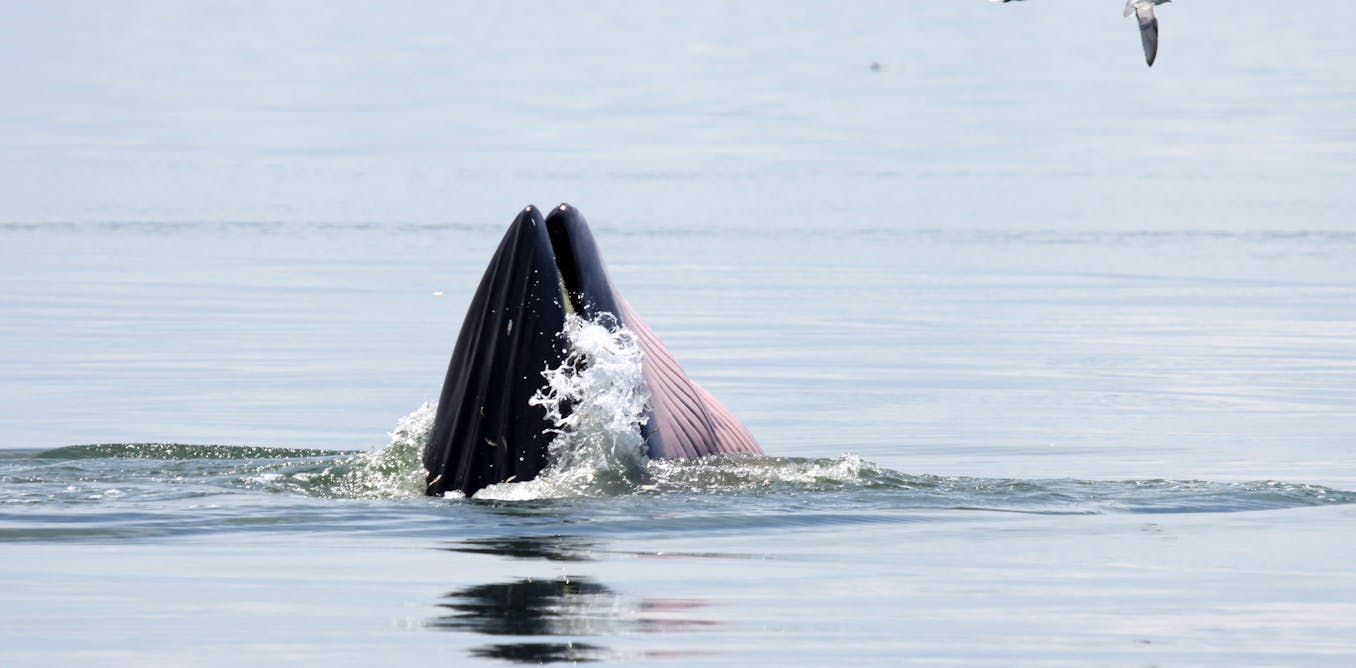
The Mediterranean Sea is home to some of the ocean’s largest animals. Among the nine species of cetaceans commonly found along its western shores are the fin whale (Balaenoptera physalus, the world’s second-largest marine animal), and the sperm whale (Physeter macrocephalus). These species can reach lengths of up to 23 and 18 metres respectively, and their populations are genetically isolated from their Atlantic counterparts.
But despite their size, these enormous animals can be difficult to spot. The sperm whale, for example, lives mainly in the open ocean, where it feeds on squid and deep-sea fish found at depths of over 1,500 metres. Its dives tend to last between 30 and 60 minutes, after which it briefly surfaces to breathe and rest for five to fifteen minutes before beginning a new dive.
Their size and behaviour put these whales at high risk of collision with ships. They are also affected by other human activities like shipping traffic, noise pollution and habitat degradation. The International Union for Conservation of Nature (IUCN), has classified the Mediterranean populations of sperm and fin whales as endangered – both are on its Red List of Threatened Species.
To protect these whales, scientists are seeking to better understand their ecology and behaviour in order to develop effective conservation plans based on solid evidence.
Studying cetaceans at sea
The scientific community uses a range of different techniques to study and monitor cetaceans. Visual surveys have been the most widely used method to date. They involve directly observing the animals from a platform – either a boat or an aircraft – along predefined transects. This means a straight line is drawn across an area to record data such as presence, distribution, numbers, stage of development (calf, juvenile or adult) and behaviour.
Acoustic recordings also allow us to detect vocalisations produced by cetaceans. This is done using hydrophones, instruments that work in a similar way to microphones in the air. They capture underwater sounds that can then be analysed using specialised software. The recordings can be used to identify species and, in some cases, even individual animals.
Tagging cetaceans with electronic devices is highly effective for individual tracking. This technique uses sensors to track animals’ movements and to record environmental variables. The information obtained is key to understanding their distribution areas, behaviour patterns and habitat use, which are fundamental in designing more precise conservation strategies.
Additionally, when cetaceans die they often wash up on nearby shores, and these events also provide valuable information. Among other things, beached animals can provide genetic and parasitological samples, and data on dietary patterns. This makes it possible to assess the status of populations, their ecological interactions, threats, origins and genetic structure.
Read more:
Sex, birth and whalesong: life on the humpback highway
Environmental DNA: a revolutionary research tool
All living organisms are made up of one or more cells containing DNA, the molecule that stores the genetic information responsible for a species’ identity.
These cells are continuously released into the natural environment through processes such as skin shedding, defecation, or the release of gametes. Though invisible to the human eye, these particles are widely distributed in soil, water, air or even snow. In the case of marine animals like fin whales and sperm whales, DNA is released into the water when, for instance, they shed fragments of skin or defecate.
This means that when a whale passes through an area, the cellular debris it leaves behind serves as an unmistakable sign of its presence. A simple water sample may contain fragments of environmental DNA that can be extracted, sequenced, and analysed.
Since the early 21st century, a technique known as metabarcoding has made it possible to isolate and amplify DNA from multiple species present in a single environmental sample. Through computer analysis, the sequences obtained can be identified at the species level or within specific taxonomic groups, making it possible to determine which organisms were present in the sampling area during a particular period prior to the sample being taken.
This means, when properly analysed, a single water sample can reveal the presence not only of cetaceans such as sperm or fin whales, but also of other marine vertebrates.
Read more:
How (apparently) identical animals can have different genomes – new research
Using environmental DNA to study whales
Since 2023, the University of Valencia’s Marine Zoology Unit has been systematically collecting water samples along the coast of the Valencian Community for environmental DNA analysis. The results are significant, as they have enabled us to detect genetic material from up to five species of cetaceans – including the fin whale and the sperm whale – as well as various species of fish, sharks, rays and sea turtles.
These observations make it possible to identify areas frequented by the animals, and to analyse their spatial and seasonal patterns. This information can, in turn, be shared with government organisations to help design marine protection reserves, or to implement specific conservation measures.
Furthermore, we can use vessels that already sail regularly in the Mediterranean – such as ferries, research vessels and fishing boats – to collect water samples. Projects dedicated to the study of cetaceans and other marine vertebrates, such as LIFE CONCEPTU MARIS in the western Mediterranean, use commercial vessels both for on-board observation and for the systematic collection of samples for environmental DNA analysis.
This approach helps to reduce costs, minimise the environmental impact of sampling and promote a more open, collaborative approach to science that is accessible to the public.
A weekly e-mail in English featuring expertise from scholars and researchers. It provides an introduction to the diversity of research coming out of the continent and considers some of the key issues facing European countries. Get the newsletter!