DAVOS, Switzerland — The World Economic Forum 2026 convened this week under the theme “A Spirit of Dialogue,” yet the atmosphere in the Swiss Alps was defined by a stark collision between national populism and the borderless acceleration of technology.1 From the return of the U.S. presidency to the Davos stage to the promise of an “AI Factory” future, the summit exposed a global order in the midst of a radical, and perhaps permanent, realignment.
The Geopolitical Standoff: Trump, Milei, and El-Sisi
The arrival of U.S. President Donald Trump dominated the discourse, as he reinforced a doctrine of “sovereignty through coercion.” Trump stunned the assembly by formalizing his intent to acquire Greenland, labeling it “imperative for national and world security.”2 He coupled this territorial ambition with a warning to European allies: a 200% tariff on French goods remains on the table unless a new trade deal is struck, asserting that “there can be no going back” on American expansionism.3
Argentine President Javier Milei provided a philosophical anchor to this populist wave. In a full-throated defense of free-market capitalism, Milei warned that the West is in peril due to a “vision of the world that inexorably leads to socialism.”4 He hailed business leaders as the “true heroes” of history and declared that Argentina would serve as a “staunch, unconditional ally” to those resisting state intervention.
Navigating the middle ground, Egyptian President Abdel Fattah El-Sisi focused on regional pragmatism. Meeting with Trump on the sidelines, El-Sisi emphasized Egypt’s role as a cornerstone of Middle Eastern stability.5 His address called for a “new financial architecture” to support emerging markets, balancing domestic economic reforms with the urgent need for international coordination on security.
Voices of Crisis: The Palestinian Mandate
In a somber “Conversation with the Prime Minister,” Mohammad Mustafa of the Palestinian National Authority addressed the terminal humanitarian crisis in Gaza. He laid out a rigorous framework for 2026 focused on:
- Fiscal Sovereignty: Demanding the release of withheld clearance revenues to sustain health and education.
- Unified Governance: Presenting a $67 billion, five-year reconstruction plan for Gaza under a single, legitimate legal system.
- Statehood Transition: Announcing that local elections scheduled for April 2026 would serve as a “practical pathway” toward a two-state reality.
Silicon Sovereignty: Jensen Huang and the “AI Factory”
While political leaders debated borders, NVIDIA CEO Jensen Huang spoke of a world redefined by data. Huang introduced Vera Rubin, a next-generation supercomputer platform designed to function as an “AI Factory.”6 He argued that we have entered the age of “Physical AI,” where intelligence is no longer just digital but perceives and acts in the real world—powering everything from autonomous fleets to humanoid robotics. Huang’s message was clear: in 2026, computing power is the new “sovereign raw material.”
Economic Realism: Jamie Dimon’s “Hazards”
Providing the final reality check, JPMorgan Chase CEO Jamie Dimon issued a cautious warning against “Davos optimism.” While the U.S. economy remains resilient, Dimon pointed to three looming “hazards”:
- Sticky Inflation: Driven by unprecedented government spending and energy transition costs.
- Geopolitical Rupture: The risk that trade wars and the “Greenland standoff” will fracture the global supply chain.
- Fiscal Discipline: The urgent need for proactive policy to manage ballooning national debts.
| Speaker | Primary Focus | Strategic Takeaway |
| Donald Trump | National Security & Territory | US policy is pivoting toward territorial acquisition and trade coercion. |
| Javier Milei | Market Absolutism | Socialism remains the primary threat to Western prosperity. |
| Jensen Huang | Vera Rubin Supercomputing | AI is transitioning from software to physical infrastructure. |
| Jamie Dimon | Macroeconomic Hazards | A “soft landing” is not guaranteed; inflation remains a structural risk. |
The Davos 2026 summit concluded not with a consensus, but with the realization that the “old order” of global cooperation is being replaced by a multi-polar struggle for silicon dominance and national sovereignty.
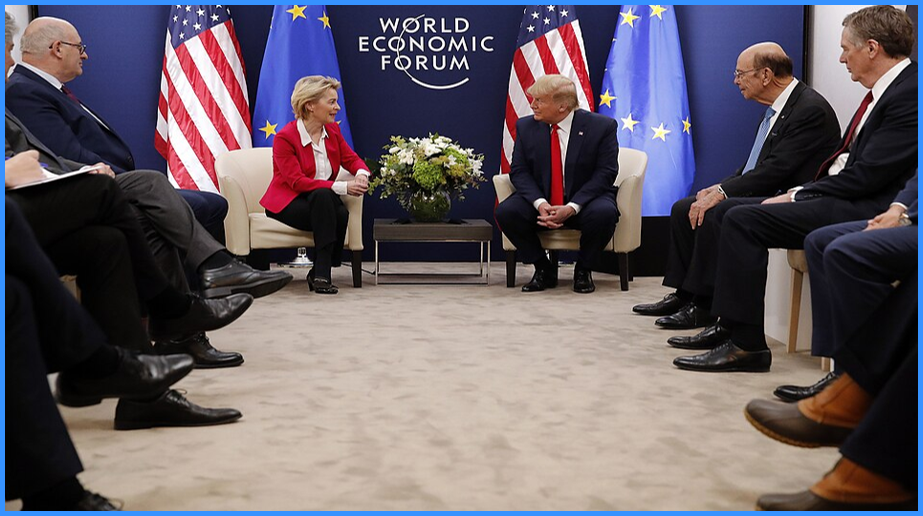
President Donald Trump and Ursula von der Leyen at WEF, Davos, Wikimedia Picture by European Commission