WASHINGTON, D.C. — In a coordinated effort to stabilize a domestic economy under the strain of “Operation Epic Fury,” the U.S. government moved on two fronts Wednesday, March 18, 2026. While the Federal Reserve held interest rates steady to assess the fallout of the Iran conflict, President Donald Trump enacted an emergency 60-day waiver of the Jones Act of 1920, a century-old maritime law, to aggressively unblock American energy and agricultural supply chains.
The dual maneuvers signal a high-stakes attempt to curb “conflict-driven inflation” as the closure of the Strait of Hormuz continues to disrupt global crude flows.
The Jones Act Waiver: Logistics Over Protectionism
The suspension of the Jones Act—which mandates that goods shipped between U.S. ports must be carried on U.S.-built, -crewed, and -flagged vessels—is a rare executive intervention designed to lower the “transportation tax” on essential commodities.
- Energy Mobility: The waiver allows high-capacity foreign tankers to move oil and Liquefied Natural Gas (LNG) from the Gulf Coast to refineries in the Northeast and California, bypassing the need for more expensive rail or truck transport.
- Agricultural Relief: With fertilizer and grain prices rising, the move is intended to slash the cost of moving domestic farming inputs, providing a “pressure valve” for Middle American producers.
- The 60-Day Window: White House officials confirmed the waiver is temporary but could be extended if the “maritime blockade” in the Gulf persists.
The Fed’s “Wartime Pause”
Against this backdrop of logistical shifting, the Federal Reserve maintained the benchmark federal funds rate at 3.5%–3.75%. Chair Jerome Powell described the decision as a necessary “waiting period” to observe how military escalations affect long-term consumer prices.
- Inflation vs. Stagnation: The Fed raised its 2026 inflation outlook to 2.7%, largely due to a 23% surge in domestic fuel costs since the conflict began on February 28.
- Employment Concerns: Dissent within the board centered on a cooling labor market, with some governors arguing that high rates, combined with energy shocks, risk a “hard landing” for the American worker.
A Global Energy Pivot
To further bolster the supply chain, the administration paired the shipping waiver with a strategic easing of sanctions on Venezuela’s PDVSA. This allows U.S. companies to import Venezuelan heavy crude, providing a vital alternative to the light sweet crudes currently trapped or contested in the Middle East.
| Economic Indicator | Status | Impact |
| Fed Funds Rate | 3.5% – 3.75% | Neutral / Holding |
| Jones Act Status | Suspended (60 Days) | Supply Chain Boost |
| Avg. Gas Price | $3.84 | 30% Month-over-Month Increase |
Market Sentiment
While the American Maritime Partnership criticized the move as a threat to “national security and domestic shipbuilding,” Wall Street responded with cautious optimism. Logistics and retail stocks saw a modest late-day rally, as investors bet that the removal of shipping restrictions would offset some of the rising input costs plaguing the S&P 500.
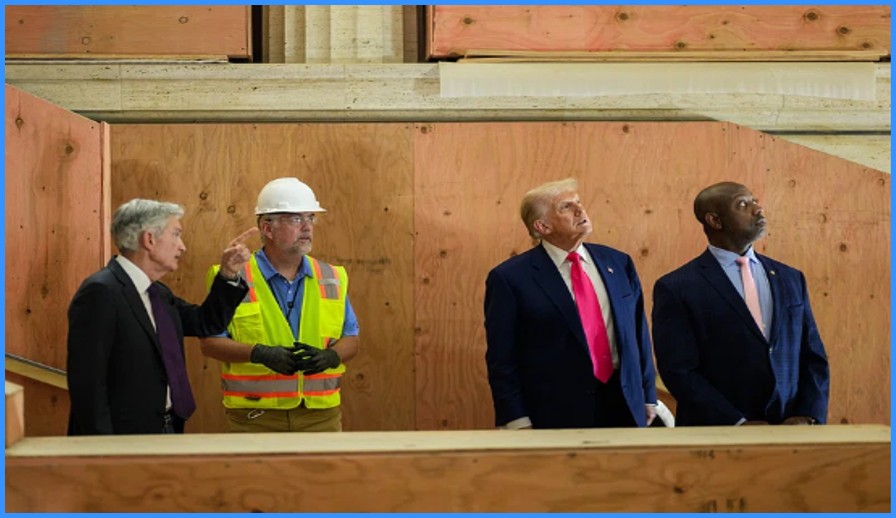
President Donald Trump and Fed Reserve Chair Jerome Powell Picture from Rawpixel