– Advertisement –
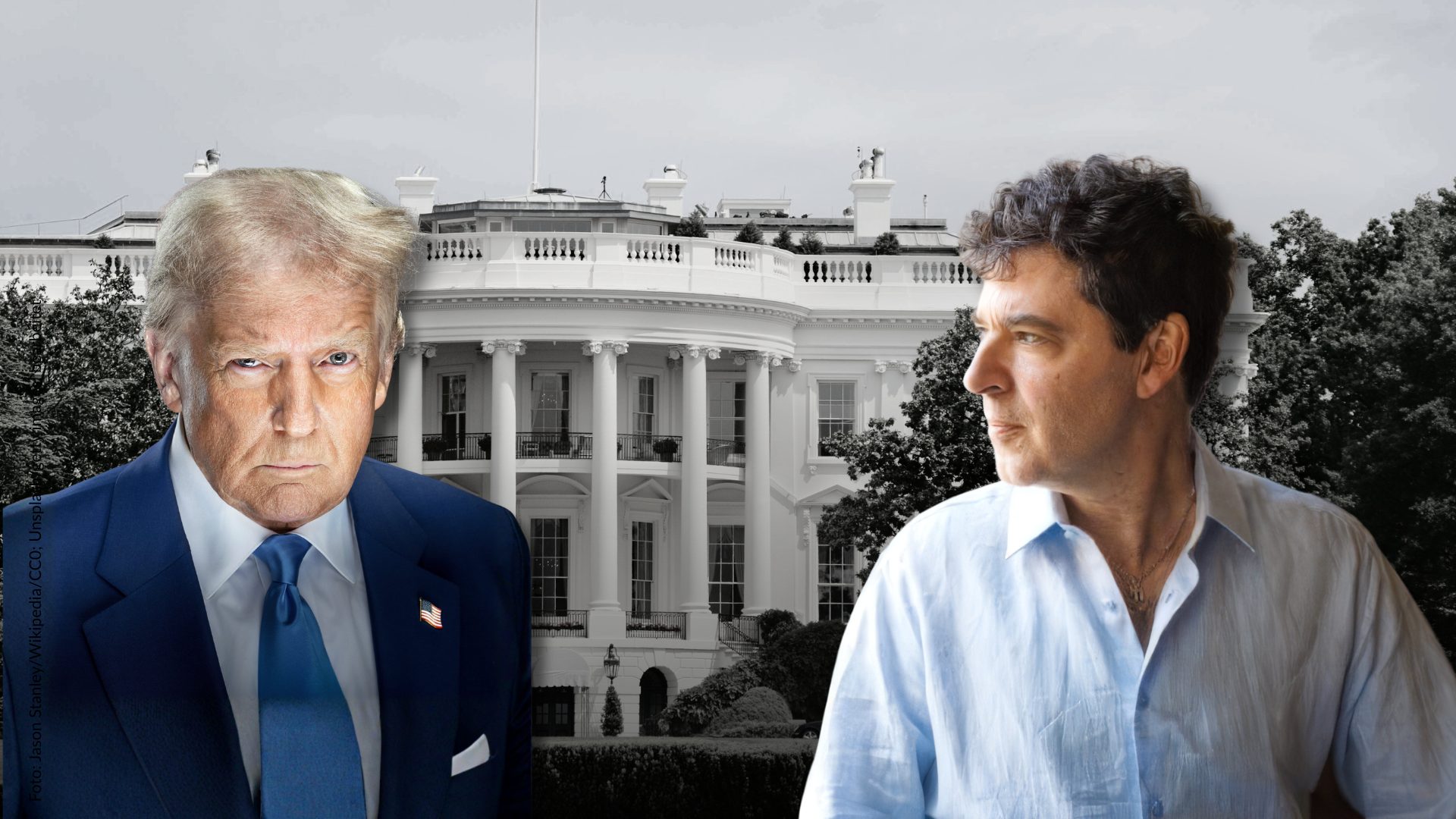
One person who is neither surprised, astonished nor speechless when following the policies of Donald Trump and his inner circle is Jason Stanley. He is a philosopher, a theorist of fascism, and has taught at Yale University for many years. “Donald Trump is an autocrat” – for Stanley, this is beyond dispute. He goes even further. Whereas just a few years ago he warned of fascist tendencies in Trump’s policies during his first presidency, he now states clearly: what we are seeing and experiencing in the US today is fascism. We spoke to Jason Stanley: about the US and why he no longer feels safe there. About promises of peace that are worthless – and why it gives him hope when resistance to an apparent superior force is forming in cities like Minneapolis.
Jason Stanley’s books are international bestsellers. In *How Propaganda Works*, he analyses how political communication manipulates. With *How Fascism Works*, published in 2018, he has produced a book that has been cited time and again ever since whenever the topics of right-wing mobilisation and the erosion of democracy arise.
These are 10 characteristics of fascism according to Jason Stanley
According to Stanley, fascism is not a fixed ideology; it is more of a political method. It operates through division, strong emotional appeal and a distortion of reality. Stanley describes ten typical characteristics:
- Mythologisation of the past – People wax lyrical about an earlier, supposedly better state to which the country must be restored (‘Make America Great Again’).
- Propaganda – A reckless approach to the truth. Facts are denied, twisted or ignored. One does not shy away from lies if it serves one’s own cause.
- Anti-intellectualism – Targeted attacks on science (universities and teaching content), the media and education to undermine trust in expertise.
- ‘Unreality’ (conspiracy theories) – Alternative realities are propagated in which facts are replaced by emotional narratives designed to instil fear.
- Hierarchical thinking – The notion that people or groups are ‘by nature’ unequal. Equality is rejected.
- Victimisation – Dominant groups portray themselves as disadvantaged or under threat.
- “Law and Order” – The call for a tough law-and-order approach, often at the expense of the rule of law and fundamental rights.
- Gender politics – Gender roles are exploited, for example through anti-feminism and the denigration of LGBTIQ people. Self-determination over one’s own – usually female – body is restricted.
- Moral decay (“Sodom and Gomorrah”) – Cities or liberal lifestyles are portrayed as decadent, whilst traditional ways of life are romanticised.
- Division into “hard-working” and “lazy” – Social conflicts are imbued with moral judgement to justify inequality.
These mechanisms are interlinked and aim to undermine democracy. Stanley warns: Fascist politics often begins subtly – and that is precisely why it is crucial to recognise and name its patterns early on.
Kontrast: Mr Stanley, you left the US in 2025 and moved to Canada. That was a major and undoubtedly difficult life decision. Could you tell us how it came about and why you took this step for yourself and your family?
Jason Stanley: I made that decision relatively quickly. I was convinced – and still am today – that the United States is losing its democracy. In the past, I wouldn’t have said the situation was that serious, but I had the impression that things were now completely tipping over.
Donald Trump is an autocrat. Today, everyone can see that, worldwide. It used to be a matter of debate. I warned about this for many years. The US has a long history of white supremacy and also of fascist tendencies. Black Americans were unable to vote in the South until 1965. In many states, Black and white people were not allowed to marry until 1967. Our American version of the ‘Nuremberg Laws’ lasted longer than in Germany.
So I knew the historical background – and I also knew who Donald Trump is. Today everyone can see that, but back then it was still a matter of debate. Many said: he was elected, so he has democratic legitimacy. But that’s not how it works – many fascist leaders have come to power through elections.
“The United States is losing its democracy”
Jason Stanley: Today, the world can see that the United States poses a threat to democracy and freedom. I don’t yet know whether my decision to leave the country was the right one. It depends on what I can do for democracy from here in Canada. I believe I can make more of a difference here than I could in the US.
As a personal decision, it was very difficult. My then-wife came with me; we share the care of our children – that’s complicated. Starting a new life at 56 isn’t easy. I have deep roots in the US, in New York and at my former university.
Then there’s the bureaucracy: residency status, driving licence, taxes – all of that is much more complicated than it seems from the outside.
Why Canada was safer for his family than Europe
Kontrast: You speak German, after all. Would Europe – say, Germany or Austria – have been an option?
Jason Stanley: Yes, in principle, it would have been. I have German citizenship, as do my children, and we often visit Vienna. We like Vienna very much.
But my children are Black and Jewish. The rise of far-right parties in Germany and Austria is a security risk for me. I don’t want my children to be subjected to abuse anywhere simply because they aren’t white.
My children understand what Europe can be. They would rather live in Vienna than in Toronto. But Canada is very diverse – and for us, diversity means security. The more diverse a country is, the harder it becomes to pursue a policy of exclusion.
Brain drain from the US? Why many academics still can’t simply leave
Kontrast: You’re a university professor. Is there currently something akin to an intellectual brain drain from the US?
Jason Stanley: It’s extremely difficult for professors to move abroad. For 99 per cent of them, it’s practically impossible. You need an exceptional career to do so.I was lucky – I’ve published extensively in philosophy and was able to secure a post. But that’s the exception. It’s just as difficult the other way round: hardly any European professor gets a post in the US.
Many American professors are currently trying to find positions at universities such as Toronto. They just don’t talk about it because applications aren’t made public. So there is certainly movement – but it’s invisible. Moving to Europe is more difficult from an academic perspective. Conditions at European universities are often worse: lower pay, more teaching. If Europe wants to attract academics from the US, it needs to improve the material conditions.
Attacks on critics of all kinds: The US is no longer a liberal democracy
Kontrast: A recent report by the University of Gothenburg has concluded that the US is no longer a liberal democracy. Do you share this view?
Jason Stanley: As far as the report as a whole is concerned, there is also criticism of the way it measures things – that is, how it determines where democracy begins and ends. But as far as the US is concerned, I consider the assessment to be accurate. However, you don’t need a report to see that – it’s obvious.
Donald Trump’s government attacks demonstrators, prosecutes them and uses state institutions against critics. Trump is using the Department of Justice to attack journalists. He acts in foreign policy without democratic oversight. So much is happening that it is impossible to list it all.
‘Project 2025’ was a blueprint for what the US is experiencing today
Kontrast: The basis for Trump’s policies over the past year and a half is ‘Project 2025’. You have described this as a ‘coordinated, authoritarian attack on US democratic institutions’. Could you elaborate on that a little?
Jason Stanley: Much of what is contained in it is already being implemented. One example: the chairman of the US media regulator argues that the media must report “in the public interest”. That sounds harmless, but it is interpreted to mean that the media must portray Trump in a positive light.
This is a new form of control: criticism is portrayed as a violation of the ‘public interest’.
Voting rights are also being restricted, for instance through stricter registration requirements. This affects minorities in particular. Under the ‘SAVE America Act’, voters would have to present documents such as a birth certificate or a passport in order to register and vote. But only 48% of Americans have a passport. Among Black Americans, the figure is just 34%. The aim, therefore, is to ensure that fewer people can vote and have a say.
The US is not an ‘old’, stable democracy that is immune to fascism
Kontrast: Many people here say that the US is the oldest democracy in the world – and that this gives it a certain resilience against fascism. How do you respond to such assumptions?
Jason Stanley: That’s a myth. The US is actually a very young democracy. Black Americans were only able to vote from 1965 onwards. Before that, you can’t really speak of a true democracy. The question, of course, is: how do you measure a stable democracy? The US, for example, has an extremely high incarceration rate – far higher than other democracies. That is part of a system of inequality and control. Outside Europe, the US is not seen as a role model either. In Latin America, for instance, many remember that the US has overthrown democratic governments and supported dictatorships.
Jason Stanley also detects fascism in today’s USA under Trump
Kontrast: So how would you describe the political system of the USA today?
Jason Stanley: The USA today is an autocracy. That is hardly disputed anymore. And if you look more closely: the system is anti-democratic, based on exclusion, attacks minorities and presents itself as religious. There is a term for this: fascism. That does not mean it is identical to Nazism. But structurally, there are clear parallels.
Kontrast: Do you see parallels with the propaganda of the 1930s?
Jason Stanley: Yes. Particularly the glorification of violence and the delight in the suffering of minorities. This form of political communication is comparable. Anyone who looked closely knew that Trump’s promises of peace were worthless
Kontrast: During the election campaign, Trump promised not to start any new wars. Now we are seeing the opposite. Why?
Jason Stanley: That was pure rhetoric. Anyone who realised that Trump was acting in a fascist manner could have foreseen this. Anyone who looked and listened closely would have expected it. It really shouldn’t come as a surprise. That is why choosing the right terminology is important – it helps to interpret developments correctly.
Stanley: Europe must defend itself and its liberal values
Kontrast: What advice would you give Europe on dealing with the US?
Jason Stanley: Europe must defend itself – politically and institutionally. The US under Trump poses a threat to democratic systems and supports far-right forces in Europe. It is currently one of the last bastions of liberal democracy. It must actively defend it.
Kontrast: Are there any developments in the US that give you hope?
Jason Stanley: Yes. In Minneapolis, ordinary people have organised themselves to protect their neighbours from ICE and deportation. Without any prior political experience. People have stood up against state violence and shown solidarity. That does indeed give hope.
The rights to the content remain with the original publisher.
Post Views: 23
– Advertisement –