- A February 28, 2026 attack on a primary school in southern Iran was an unlawful attack that reportedly killed scores of civilians, including schoolchildren.
- The laws of war prohibit attacks if the anticipated harm to civilians and civilian objects is disproportionate compared to the expected military gain from the attack.
- The United States and Israel should immediately assess their responsibility for this attack and make the findings public. The responsible party should fully account for the civilian harm and hold those responsible accountable, including prosecuting anyone responsible for war crimes.
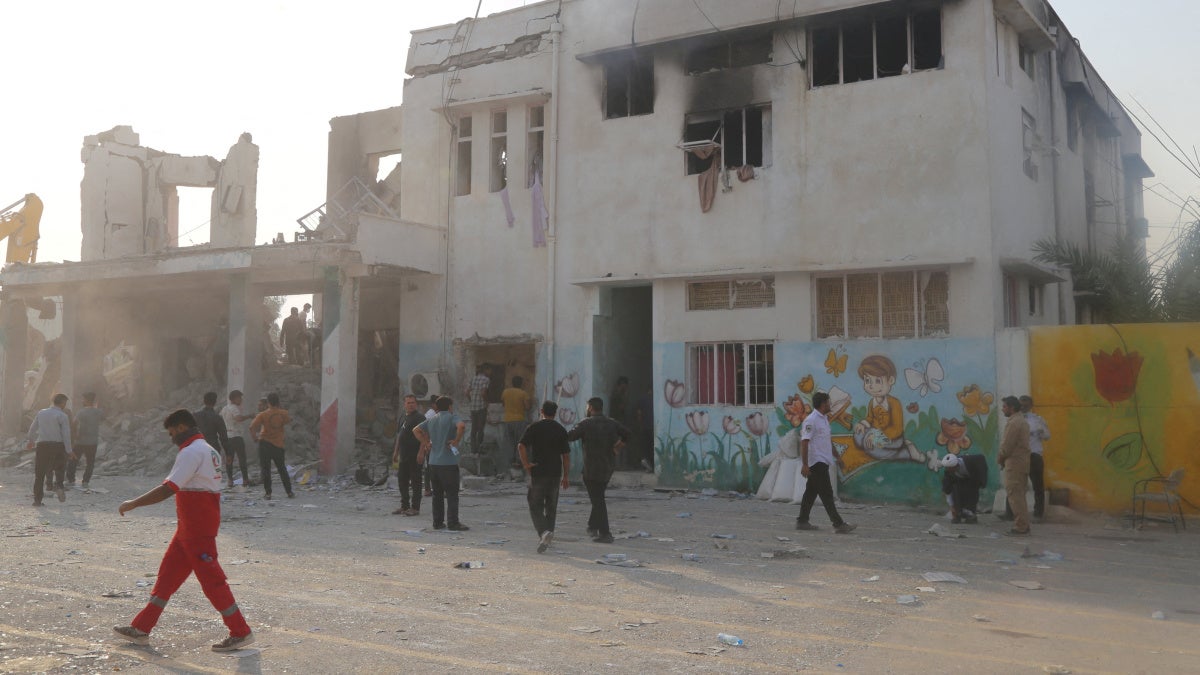
(Beirut, March 7, 2026) – An unlawful attack on a primary school in southern Iran before midday on February 28, 2026, that reportedly killed scores of civilians, including many children, should be investigated as a war crime, Human Rights Watch said today.
The attack was carried out among hundreds of strikes across Iran by Israeli and US forces on the morning of February 28. Neither the United States nor Israel has claimed responsibility for the attack, and an Israeli military spokesperson told Human Rights Watch that it was “not aware of any [Israeli military] strikes in the area.” The Iranian government has blamed the US-Israeli coalition for the attack.
The Shajareh Tayyebeh Primary School in the town of Minab, Hormozgan province, is on the interior border of an Islamic Revolutionary Guard Corps (IRGC) Naval Forces compound. However, information Human Rights Watch reviewed shows that the school is walled off and has a separate entrance to the street from the rest of the compound.
The pattern of strikes in which distinct structures across the compound, including the school, were directly struck, as well as the entry points of the munitions visible on multiple buildings, indicate that the attack was carried out by highly accurate, guided munitions, rather than errant weapons whose guidance or propulsion systems failed or were otherwise disrupted and randomly struck the area.
“A prompt and thorough investigation is needed into this attack, including if those responsible should have known that a school was there and that it would be full of children and their teachers before midday,” said Sophia Jones, open source researcher with the Digital Investigations Lab at Human Rights Watch. “Those responsible for an unlawful attack should be held to account, including prosecutions of anyone responsible for war crimes.”
Human Rights Watch verified and analyzed 14 videos and photographs posted on social media that were recorded immediately after the strike or during search-and-rescue operations, as well as 4 from funerals. Researchers also reviewed about 40 publicly available satellite images captured over the past 25 years as well as satellite images obtained commercially that were captured after the attack, showing both the attack site and the nearby cemetery where victims were apparently buried. Researchers also reviewed statements by the Iranian Red Crescent Society and government officials from Iran, Israel, and the United States, and reports by independent media outlets outside Iran.
Due to the internet shutdown and communications restrictions imposed by Iran’s authorities, Human Rights Watch was unable to safely speak with witnesses or family members of those killed in the strike, limiting researchers’ ability to verify the precise number and identities of children and other individuals killed and other details related to the attack. However, researchers interviewed two sources who had spoken with witnesses and relatives of victims. Human Rights Watch is also investigating Iranian forces’ strikes on targets in countries in the Middle East.
The exact nature of the different sections in the IRGC compound, the extent to which the facilities were in use for military purposes at the time of the attack, and what may have been stored there was not immediately apparent. If any of the facilities within the compound were used for military purposes, Iranian authorities would appear to have been placing civilians at unnecessary risk and therefore also would have been in violation of the laws of war.
Satellite imagery analysis shows that at least eight structures across the compound were directly struck by munitions, including at least one that struck and severely damaged the school, which was walled off from the rest of the compound.
Two videos filmed next to the school in the immediate aftermath of the attack and verified by researchers show black smoke billowing from the top of the school and part of its roof collapsed. In one video, white lines of a soccer pitch, a volleyball net, and brightly painted school walls are clearly visible, as are two smoke plumes from elsewhere on the compound. In the second video, people are gathered around the school, screaming. A third video verified by researchers shows a different angle of the compound, from the south, and plumes of smoke from at least a third location within that compound.
High-resolution satellite imagery reveals that, between February and September 2016, an inner wall was built that separates the school from the rest of the compound. Moreover, a separate entrance without a security post was created during that time frame, allowing street access to the school without having to enter the military compound. Two watchtowers, previously visible on satellite imagery and less than 50 meters from the school building, were also removed in 2016. The front of the school was cleared and marking lines of a soccer pitch were drawn in the courtyard by August 2017.
The compound also contains a medical clinic, under the auspices of the IRGC’s Naval Forces. State media reported that it was inaugurated in January 2025 by Major General Hossein Salami, the then-commander-in-chief of the IRGC.
Low-resolution satellite imagery from March 2, 2026, shows at least seven other impact sites within the IRGC compound in addition to the school, including a clear impact on the medical clinic’s roof. An analysis of very high-resolution satellite imagery captured on March 4 confirms that explosive weapons detonated in at least eight points, including five sites where damage is consistent with a munition entering the structures from the roof and detonating.
Damage to two other structures, as well as the relative distance between these and others attacked, indicate that both structures were most likely also directly attacked with explosive weapons, bringing the total number of impact sites most likely directly attacked to ten. The number of individual strikes and the apparent accuracy with which they struck individual structures across the base, observed in part through the relatively small circular holes that were points of entry for the munitions, indicate that the attack was carried out across a wide set of individual targets on the base with highly accurate, guided munitions.
The school’s location within the IRGC Naval Force’s compound did not, in and of itself, make the school a legitimate target. The school was in use, and children were in attendance on the day of the attack. Human Rights Watch found no evidence that would indicate that the school was being used for military purposes, though researchers were not able to speak to witnesses of the strikes, families of those killed, or other informed sources.
Even if the attackers were targeting a legitimate military target in the vicinity of the school, the laws of war prohibit attacks on military objectives if the anticipated harm to civilians and civilian objects is disproportionate compared to the expected military gain from the attack.
Both the US and Israeli militaries possess and have used advanced and expansive multi-domain intelligence collection methods in their conduct of many combat operations, which allow for enhanced monitoring, assessment and verification of targets.
Human Rights Watch wrote to the US and Israeli militaries on March 2 and to Iranian authorities on March 3. The Israeli military responded on March 3, writing: “After an initial examination[,] [t]he [Israeli military]is not aware of any [Israeli military] strikes in the area,” and that “the incident is being examined.” Neither the US military nor Iranian authorities have responded.
On March 4, US Defense Secretary Pete Hegseth responded to a question in a media briefing about the attack on the school. “All I can say is that we’re investigating that,” he said. “We, of course, never target civilian targets, but we’re taking a look and investigating that.” During that briefing, the chairman of the Joint Chiefs of Staff, Gen. Dan Caine, said that US forces from the USS Abraham Lincoln strike group were providing “pressure” along the “southeastern side of the coast and has been attritting naval capability all along the strait,” as he pointed to an area of a map that included Minab, where the map shows there had been US/Israeli strikes.
A thorough, independent investigation into the strike on the Shajareh Tayyebeh Primary School should be conducted, including to determine whether war crimes were committed, Human Rights Watch said. War crimes are serious violations of the laws of war committed with criminal intent, that is deliberately or recklessly. Those responsible for any war crimes or other serious violations of the laws of war, including military and civilian commanders, should be held to account, while victims and their families should be appropriately compensated.
Schools and other educational facilities are civilian objects and protected from attack. They lose that protection when used for military purposes, although all parties must still comply with international humanitarian law including respecting the principle of proportionality and taking all feasible measures to minimize harm to civilians. The mere presence of military personnel in civilian infrastructure does not in itself automatically make such facilities as whole a legitimate military target. Human Rights Watch has seen no information to indicate that the Shajareh Tayyebeh school was used for military purposes.
Iranian authorities should ensure the protection of schools and other civilian infrastructure.
The United States should immediately assess its responsibility for this strike and make the findings public. If the US military carried out the strike, it should conduct a full investigation into the operational and policy failures that led it to strike a school, fully account for the civilian harm caused, hold those responsible accountable including through prosecution, and commit to changes that would ensure such failures will not be repeated in future operations.
“Allies of the US and Israel should insist on accountability for the Shajareh Tayyebeh school attack and for an end to attacks on civilian infrastructure in all of their operations across the region, before more civilians, including children, are unlawfully killed,” Jones said.
For additional details, please see below.
The school and work week in Iran begin on Saturday morning. The first reports of the US and Israeli attacks in Iran surfaced online before 10 a.m. on Saturday, February 28. The Shajareh Tayyebeh school administration called parents to pick up their children, but “the time between the announcement of the school’s closure and the moment of the explosion was extremely short; many families had not yet arrived,” the Coordinating Council of Iranian Teachers’ Trade Associations said in a statement on March 1.
Satellite imagery from February 28 shows the school intact as of 10:23 a.m. The attack took place sometime before 11:47 a.m., when the first video of the attack surfaced on social media. Local media, citing Iranian officials, said the attack on the school took place around 10:45 a.m.
As of March 4, the death toll from this attack had risen to 168, Iranian state media reported. Human Rights Watch has not been able to independently verify that number. Researchers reviewed a list of 57 names announced by the Special Governor’s Office of Minab County and circulated by news outlets on March 2. Of the names on that list, at least 48 appear to have been children, according to their birth dates on the list. Researchers analyzed this list of names, which included girls, boys, women, and men, and in some cases were able to immediately match names with other identifying information, such as photographs, caskets, body bags, or funerary materials with names, ages, names of family members, and whether they were identified as a student or teacher at the school. The list included the apparent principal of the school and several teachers.
Researchers identified an additional 25 names by reviewing a list published by Iran’s Gymnastics Federation and names written on body bags, caskets, or funerary materials, as seen in photographs and videos published by state media between March 3 and 6. At least 15 of them appear to be children; researchers were unable to determine the ages of the remaining 10. Human Rights Watch was not able to immediately obtain information regarding the remaining individuals reported to have been killed or about people who may have been killed in strikes elsewhere on the compound.
Videos shared on social media on February 28 and analyzed by researchers show an ambulance arriving at the Hazrat Abolfazl hospital roughly two kilometers from the school. Other videos show 12 body bags lying on the ground, and photographs show the bodies of what appears to be 4 girls, their faces covered in dust, dressed in school uniforms lying in body bags. Another video analyzed by Human Rights Watch shows the body of a child with a head wound, who is wearing the same green checkered school uniform as a surviving boy seen in another video analyzed by researchers.
Additional verified photographs taken by Mehr News on February 28 and circulated by the Associated Press show men, including some in uniform, digging through the rubble of the school. At least one body buried in the rubble is visible in these photographs.
On March 2, a video published by the Islamic Republic News Agency (IRNA) shows graves being dug at the Minab Hermud cemetery in preparation for funerals on March 3. Aerial imagery of the cemetery published on March 2 shows at least 100 new grave locations, 83 of them being dug with the use of heavy machinery. Ground preparation for the burials within the same cemetery plot seen in the photos and videos began in the afternoon of March 1, according to satellite imagery analyzed by Human Rights Watch.
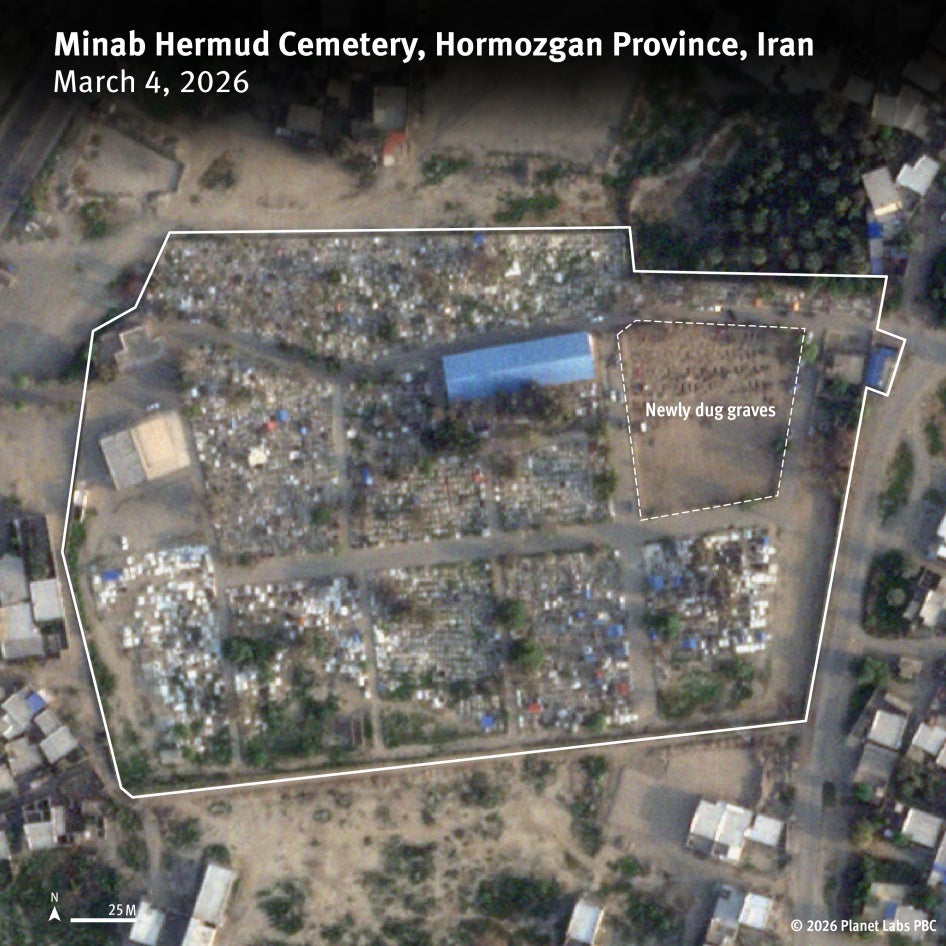
Satellite imagery captured on March 1 and 4, 2026 shows changes at Minab Hermud Cemetery located roughly 3.5 kilometers from the Shajareh Tayyebeh Primary School. Imagery from March 1, captured less than 24 hours after the attack, shows soil preparation for new burials within one plot of the cemetery. By March 4, rows of freshly dug individual graves are visible in the upper half of the same plot.
Image left: March 1, 2026, and Image right: March 4, 2026 © 2026 Planet Labs PBC. Analysis and Graphics © 2026 Human Rights Watch
Photographs published from the funerals on March 3 show crowds of people at the cemetery standing next to the graves. Fourteen caskets had been placed into the graves, while others were empty in one photograph. Human Rights Watch was unable to verify whether all 100 graves were used for people killed in the attack on the school. According to reports online, at least two people’s funerals took place elsewhere outside of Minab.
Further Analysis of Structures in the IRGC Compound and Strike Impacts
In addition to the unguarded entrance from the street to the school, which was walled off from the rest of the compound, at least seven other entrances to different parts of the compound can be seen on satellite imagery from February 19. An undated photograph shows a sign at a southern entrance on the main road that reads “Seyyed Al-Shohada Cultural and Educational Complex” alongside an IRGC logo.
Sixty meters north, at another entrance on the main road, a photograph uploaded to Google Maps in February shows a sign for the “Shaheed Absalan Specialist Clinic, the Health Commandment of the IRGC’s Naval Force.” Human Rights Watch also geolocated a picture published in 2025 showing the facade of the clinic. At the main entrance of the complex, an undated photograph shows a sign with the IRGC logo and the word for “barracks” or “unit.”
Analysis of images taken over the last 25 years shows structural changes within the military compound itself, including the construction of additional inner walls that separate different areas within the compound between 2022 and 2024. As a result, additional separate gates to access the different sections of the compound were constructed between 2022 to 2025.
Low-resolution satellite imagery from March 2, 2026, shows at least seven other impact sites within the IRGC compound, in addition to the school, including a clear impact on the rooftop of the Shaheed Absalan clinic. The buildings all appeared intact on satellite imagery captured at 10:23 a.m. on February 28. A very high-resolution satellite image from March 4 shows at least eight areas that were directly struck. Five buildings, including the school and the medical clinic, show damage consistent with a large munition striking and entering the roof before detonating. Four other buildings are completely destroyed, indicating they were also directly struck by a munition with a large high-explosive yield. Two of the buildings are immediately adjacent to one another, indicating that they were struck by at least one munition.
Two other buildings on the compound exhibit fire damage. Due to the relative distance between them and the nearby structures that were also struck, it is likely that the fire damage is the result of these buildings also being individually struck by explosive weapons, bringing the total number of buildings most likely directly attacked to 10. In all, 14 buildings across the site were damaged, nearly all of the structures within the compound.
Further Legal Background
The laws of war obligate warring parties to take constant care to spare the civilian population. All feasible precautions must be taken to avoid, and in any event to minimize, incidental loss of civilian life, injury to civilians and damage to civilian objects. Unless circumstances do not permit, warring parties should give “effective advance warning” of attacks that may affect the civilian population. Human Rights Watch is not aware of any warning having been given in advance of the attack on the Shajareh Tayyebeh school.
The laws of war also obligate warring parties to avoid locating military targets near densely populated areas.
Serious violations of the laws of war carried out by individuals with criminal intent—that is, deliberately or recklessly—are war crimes. A combatant or commander may have acted recklessly when they consciously disregard a substantial and unjustifiable risk of causing prohibited harm—such as death or injury to civilians or damage to civilian objects—during an armed conflict.
Investigations into the attack on the Shajareh Tayyebeh school should consider whether those responsible acted recklessly, including if they should have known that they were attacking a school, and that an attack during the middle of the day on a school day would have most likely resulted in a large number of civilian casualties.
Individuals may also be held criminally liable for assisting in, facilitating, aiding, or abetting a war crime. Civilian and military commanders may be held criminally liable for war crimes committed by their subordinates that they knew or should have known about and failed to take reasonable measures to prevent the crimes or submit the matter to the competent authorities for investigation and prosecution. All state parties to an armed conflict are obligated to investigate alleged war crimes by members of their armed forces.
Further Context on Access to Information in Iran
On February 28, 2026, internet traffic dropped significantly in Iran, indicating a nationwide blackout following strikes across the country by the United States and Israel. Cloudflare Radar, a network measurement platform that provides real-time information on internet traffic, said that internet traffic dropped by 98 percent, signaling a near-complete blackout. Iranian authorities have a track record of imposing internet disruptions and shutdowns during times of conflict and crisis, including during protest crackdowns, to restrict access to information, conceal atrocities they commit, and obstruct independent documentation of violations.
United Nations member states should urge Iranian authorities to restore internet access, which has been shut down since the start of US and Israeli forces’ attacks on February 28. The near-total internet shutdown across the country severely restricts access to information, including evacuation orders and safety measures, which can be lifesaving. International policymakers and companies should also support the provision of internet services for the civilian population affected by internet shutdowns, including by building out satellite communication services.
Further Context on the United States and the US and Israeli Attacks on Iran
During a March 2 press briefing on military operations in Iran, Gen. Caine, Chairman of the US Joint Chiefs of Staff, said the preparations for the overall attacks were extensive. He added that “[o]n the U.S. side, this marked the culmination of months, and in some cases, years of deliberate planning and refinement against this particular target set.” Caine emphasized that this preparation spanned across multiple aspects of the US operations “[f]rom precision strikes against key military infrastructure, to persistent intelligence and targeting integration, to the close coordination of the components across vast distances.” The Israeli military stated on February 28, as strikes were ongoing in Iran, that the attacks were based on “precise intelligence,” and has since continued to assert that the attacks are intelligence-based.
Human Rights Watch is concerned that under the second Trump administration, the Defense Department has deliberately and systematically weakened its domestic protections meant to ensure its compliance with the laws of armed conflict. Those include the termination of senior military lawyers, reported loosening of targeting protocols, and the elimination of “civilian environment teams” and “red-teams” within the operational chain of command. US Defense Secretary Pete Hegseth commented at a news conference on March 2, 2026, about “stupid rules of engagement,” suggesting that they may interfere with “fight[ing] to win.” The US Congress should hold hearings to understand how and if these rollbacks contributed to any civilian harm verified to be caused by the US military in Iran.