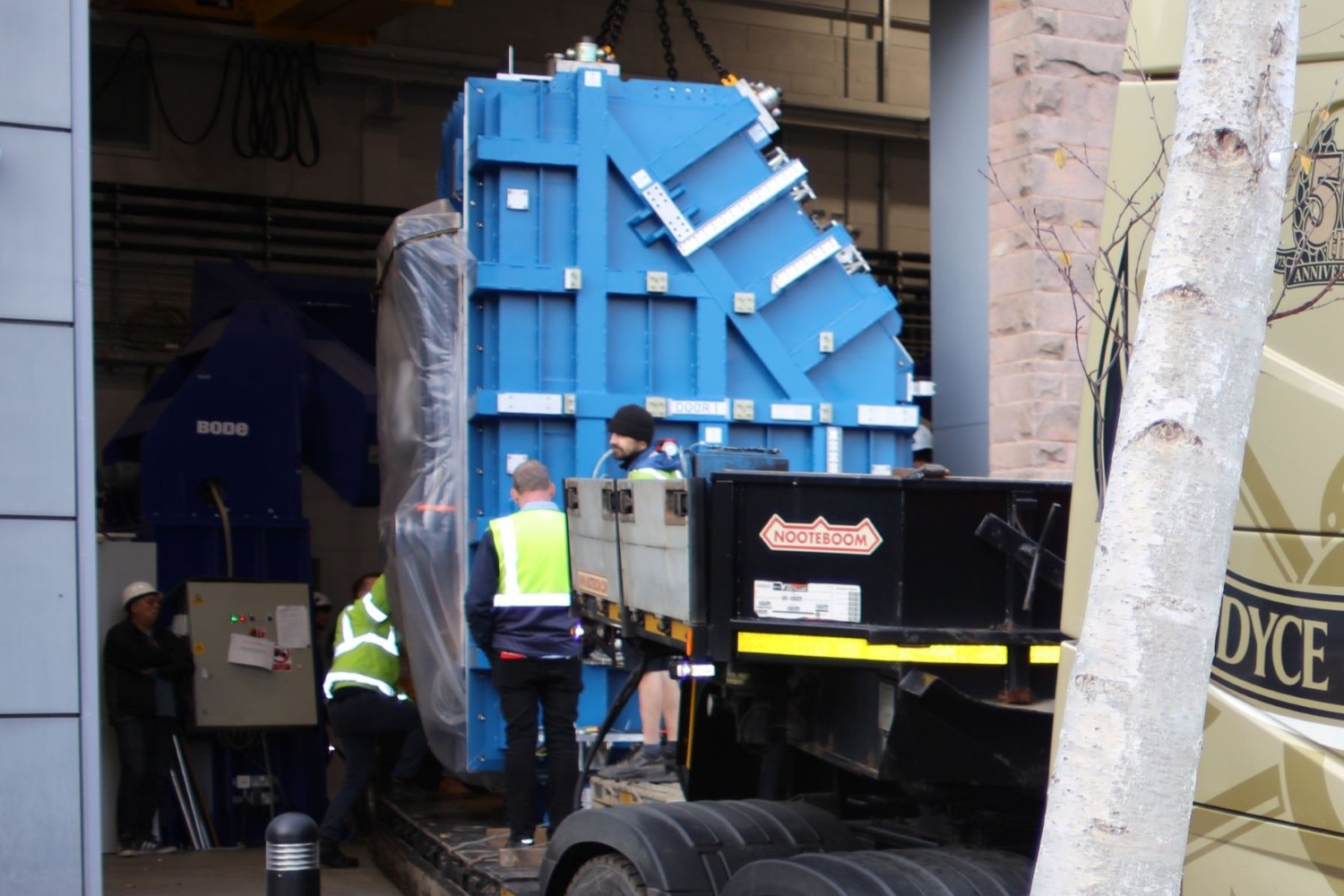
After more than a decade of innovation and collaboration, MOONS (Multi-Object Optical and Near-infrared Spectrograph) departed the UK Astronomy Technology Centre (UK ATC) in Edinburgh.
This marks the start of a 7,000 mile journey to the European Southern Observatory’s (ESO) Paranal site in Chile.
Major international milestone
Built by an international consortium led by the Science and Technology Facilities Council’s UK ATC at the Royal Observatory Edinburgh, MOONS represents a major milestone for UK science and engineering.
This next-generation instrument will transform our understanding of the Universe by capturing light from up to 1,000 celestial objects at once.
It will pave the way for groundbreaking discoveries about galaxy formation and evolution across cosmic history.
Its journey to Chile marks the final step before integration with ESO’s Very Large Telescope (VLT) and first light in 2026.
Ten tonnes of precision engineering
Standing at 4.5 metres tall and weighing 10 tonnes, MOONS is the largest most complex astronomy instrument ever built in the UK.
The instrument was successfully packaged and loaded onto a truck at UK ATC’s Royal Observatory Edinburgh site.
This was a complex and delicate operation to ensure MOONS arrives safely at one of the most advanced astronomical facilities in the world.
Carefully transporting the instrument
The equipment was packed into 15 custom-made boxes. The packaging alone weighing 4 tonnes.
Three articulated lorries were loaded by forklift and crane and transported to Southampton.
The final unit to leave UK ATC was also the largest (a 7-tonne spectrograph).
It required a stopover in Glasgow, where it was carefully rotated onto its side and packed at a specialist facility.
A 7,000 mile journey to the stars
It will all finally be loaded onto a single massive transport trailer and loaded onto a ship in Southampton to start its 7,000-mile sea voyage to South America.
When it arrives in Chile in January 2026 it will complete the final 350-mile journey by road to ESO’s VLT site in the mountains.
Once at Paranal, the instrument will undergo a five-month integration process paving the way for first observations in summer 2026.
Years of work and dedication
Dr Oscar Gonzalez, Head of Project Science at UK ATC and UK Principal Investigator of MOONS, said:
Watching MOONS leave Edinburgh was a proud and emotional moment for our team. This instrument represents years of work and dedication by many outstanding people.
Building MOONS was one challenge; moving it across the globe and installing it at the VLT is another.
The logistics are remarkably complex, and we worked closely with specialists to ensure this unique instrument reaches Chile securely, ready to be installed and see its first light.
Anticipating scientific discoveries
Dr Suzanne Ramsay, ESO Deputy Instrumentation Programme Manager, said:
The ESO team has been really impressed by both the instrument and the dedication of the MOONS team.
We look forward to the installation on Cerro Paranal in keen anticipation of the scientific discoveries to come.
Professor Christophe Dumas, Director at UK ATC, said:
Seeing MOONS begin its journey is a moment of pride for everyone at UK ATC.
This instrument will soon become a key part of the Very Large Telescope, enabling astronomers to explore the Universe in ways we’ve never achieved before.
We’re excited for the discoveries that lie ahead and the new questions they will inspire.
An international effort
MOONS is a collaborative effort led by UK ATC and involving partners from six countries (UK, Italy, France, Portugal, Switzerland and Chile) and ESO.
UK ATC led the project office, and development of the fibre positioner units, calibration unit, cryostat, detector adjustment modules, and metrology camera system.
IA-Lisbon led the delivery of the field corrector, rotating front-end structure, and the cable wrap.
The camera opto-mechanics, assembly and testing was done by University of Cambridge.
The optical design and exchange volume phase holographic grating mechanisms were delivered by INAF-Firenze.
Collaboration on components
INAF-Roma delivered the acquisition camera system and end-to-end modelling of the overall instrument, while INAF-Milano led the delivery of the observation preparation and path analysis software.
The instrument control electronics were provided by University of Geneva and UK ATC.
GEPI-Paris delivered the fibre assembly, slit and shutters, and the data reduction software.
The detector arrays and charge-coupled devices were delivered by ESO.
The instrument control software was jointly developed by Pontificia Universidad Catolica de Chile, BlueShadows Ltd, and UK ATC.
Integration and testing
All these components were integrated and tested in Edinburgh by UK ATC.
Its unique capabilities will allow astronomers to survey millions of stars and galaxies.
It will provide unprecedented data to study the formation and evolution of galaxies and the structure of our own Milky Way, helping answer some of the biggest questions in astronomy.