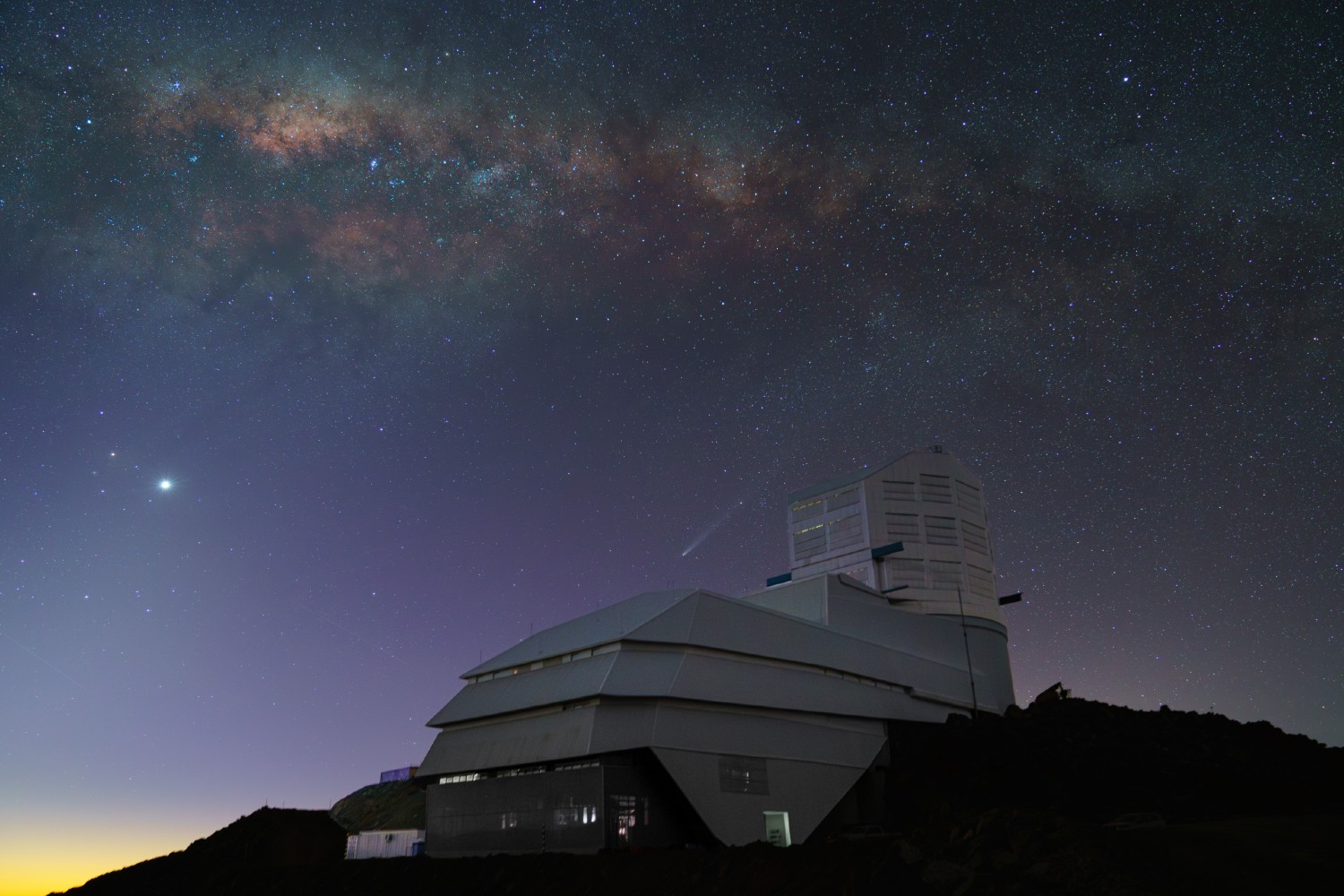
Starting on 25 February 2026, UK astronomers are providing public real-time updates on changes in our Universe, from exploding stars and belching black holes to asteroids cruising through our solar system.
The work is part of a multi-million-pound investment by the Science and Technology Facilities Council (STFC), part of UK Research and Innovation.
It is enabling UK participation in the Rubin Observatory’s Legacy Survey of Space and Time (LSST).
UK-developed software system
The UK-developed software system, Lasair, has been created by a team from:
- Queen’s University Belfast
- The University of Edinburgh
- University of Oxford
The system filters millions of events from the Rubin Observatory alerts stream, unlocking new scientific opportunities faster than ever before.
A deluge of data
Every night, powerful computers in the UK will help to crunch the huge influx of data captured by the world’s largest digital camera.
The data will then be served to the science community through the Lasair web portal.
The computers that run Lasair are part of a wider data facility constructed on IRIS, a network of powerful digital research infrastructure for priority astronomy, particle physics, and nuclear physics in the UK.
Analysing images with supercomputers
Over the next 10 years, UK scientists will use powerful supercomputers to analyse around 10 million images captured by the observatory as part of its LSST.
The supercomputers will identify and measure billions of stars and galaxies, most of which have never previously been detected.
The first Rubin Observatory alerts distributed to researchers around the world were generated on the night of 24 February.
The alerts contained the flares of new supernovae, the flickers of stars, actively feeding black holes in distant galaxies, and asteroids cruising through our solar system.
Sophisticated software
Professor Bob Mann, Professor of Survey Astronomy at The University of Edinburgh and Project Leader for UK participation in the Rubin LSST, said:
The Lasair alert broker is one of the important contributions that UK astronomers are making to the Rubin LSST.
Over the course of a decade, the Lasair team have used data from simulations and a precursor sky survey to develop a sophisticated system that will enable astronomers to detect instances of rare time-varying celestial phenomena of different kinds within the deluge of data that will flow from Rubin.
Today marks a major milestone for them and the start of an exciting decade of science for astronomers in the UK and beyond.
Data will enable early science
Professor Stephen Smartt, the Wetton Professor of Astrophysics at the University of Oxford and scientific lead of the Lasair team, said:
The data that Lasair will serve up — not only to the scientific community but also to the general public — will enable early Rubin science.
Lasair is a Gaelic word that means ‘flame’ or ‘flash’; our broker will enable users to detect things that move and explode in the sky, within minutes of the image being taken in Chile.
The Rubin Observatory uses the largest camera ever built for astronomy, and for 10 years it will take an image every 30 seconds.
Every night, these images are likely to contain around 7 million sources that have changed in some way.
Finding new and unexpected discoveries
Dr Roy Williams of The University of Edinburgh, lead developer of Lasair for over a decade, said:
Lasair is a platform to enable custom filtering: each user imagines and creates their own filter.
Most nights there will be a massive flow of data that Lasair will strain through those filters, and we hope this flexibility will allow users to find new and unexpected discoveries from this glorious deluge.
Filtering for discovery
Lasair will ingest, process, and filter millions of astronomical alerts from the data that Rubin will capture during its 10-year LSST.
This will enable scientists to focus on significant changes in the sky, including:
- supernovae and variable stars
- gamma-ray bursts
- black holes consuming stars
- asteroids in the solar system
Dr Héloïse Stevance of the University of Oxford, a Schmidt Artificial Intelligence in Science Fellow, has used Lasair to build an automated filter for the Rubin data.
The filter will help users identify extragalactic explosions without being overwhelmed by the millions of other alerts generated each night.
Dr Stevance said:
The sky is too vast for us to work alone: discovery in modern astronomy will have to come from a partnership between human experts and smart algorithms.
UK participation
To date, UK participation in the Rubin LSST has been funded by £23 million of STFC investment.
Across 36 research institutions, researchers and software developers are addressing scientific and technical challenges that will enable astronomers to make discoveries within the multi-Petabyte dataset that Rubin will capture over the next decade.
The LSST:UK Consortium has created the LSST:UK Science Centre, a distributed team working to realise the full scientific potential of LSST for UK astronomy.
Computational resources are provided through the STFC-funded IRIS project.
The beginning of scientific alerts marks one of the last major milestones before Rubin Observatory begins its full survey later this year, opening a decade of discovery into:
- the origins of elements
- the behaviour of black holes
- the large-scale structure of the Universe