UK scientists, supported by the Science and Technology Facilities Council (STFC), have played a leading role in the discovery of a new subatomic particle, a heavy proton, at the Large Hadron Collider (LHC) at CERN.
The particle, known as the Ξcc⁺ (Xi cc plus), is a heavier relative of the proton which is one of the fundamental building blocks of matter.
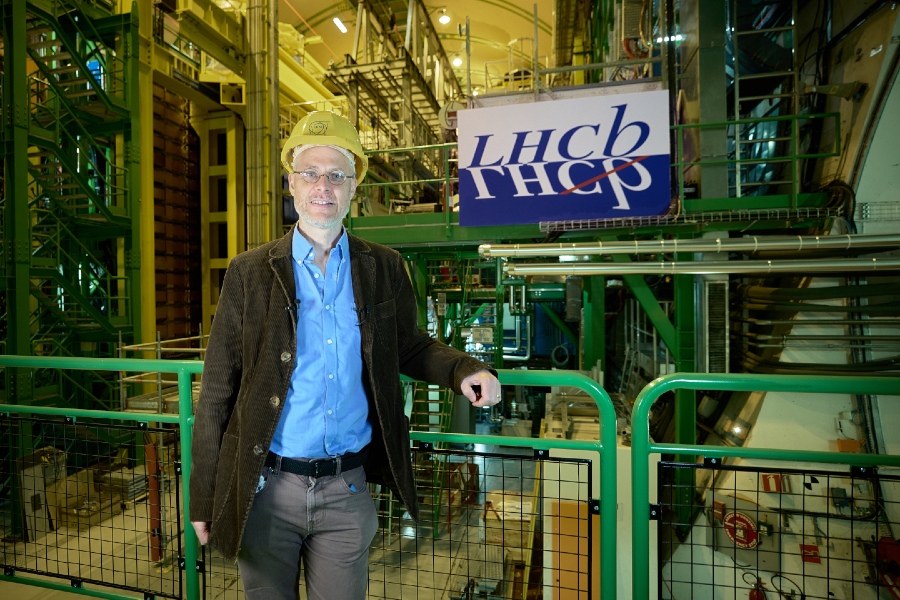
The discovery is the first new particle identified using the upgraded Large Hadron Collider beauty (LHCb) experiment at the LHC, involving more than 1,000 scientists from over 20 countries.
The upgraded detector can record much larger volumes of data than its predecessor, dramatically increasing the chances of spotting rare phenomena.
What are quarks?
Quarks are extremely small fundamental particles that combine to form larger particles such as protons and neutrons, which make up the nuclei at the centre of atoms.
There are several types of quark, the most common are ‘up quarks’ and ‘down quarks’.
A proton is made from two up quarks and one down quark.
The new particle, Ξcc⁺, is similar to a proton but built differently.
Instead of containing two up quarks, it contains two heavier relatives called charm quarks, along with one down quark.
This makes the Ξcc⁺ particle around four times heavier than a proton.
Artist’s illustration of the Ξcc⁺, showing its quark composition. Credit: CERN
Searching for new physics at LHCb
The LHCb experiment is one of CERN’s major particle physics experiments, its main goal to search for signs of new physics by studying how particles behave.
It enables scientists to study rare decays of particles that contain charm and beauty quarks.
By comparing these observations with theoretical predictions, researchers look for tiny differences that could point to physics beyond the Standard Model, the current theory describing the fundamental particles and forces of nature.
UK leadership
Funded by STFC, the UK has made the largest national contribution to the upgraded LHCb experiment detector at CERN.
The UK collaboration includes researchers from:
- University of Birmingham
- University of Bristol
- University of Cambridge
- The University of Edinburgh
- University of Glasgow
- Imperial College London
- University of Liverpool
- The University of Manchester
- University of Oxford
- University of Warwick
- STFC Rutherford Appleton Laboratory
UK teams designed and built several key components of the detector over a decade-long programme of work to plan, design and construct.
The improvements allow scientists to collect much larger amounts of data than before.
The first large dataset from the upgraded detector, recorded in 2024, led directly to the discovery of the Ξcc⁺.
Precision tracking: silicon detector
A major UK-built component is a silicon pixel detector that tracks the paths of particles created in collisions at the LHC with extreme precision.
The Vertex Locator sits just five millimetres from the LHC beams and forms the first layer of the experiment.
This system enables scientists to pinpoint where particles are produced and how they decay, which was crucial for identifying the Ξcc⁺ particle.
Identifying particles: RICH system
UK researchers also contributed to the Ring Imaging Cherenkov (RICH) system, which identifies different types of particles.
It detects light produced when particles travel through a gas faster than light can.
By measuring this light, researchers can determine which particles were created when the Ξcc⁺ particle decays.
A landmark measurement
The Ξcc⁺ was identified by studying its decay into three lighter particles.
These data were recorded during proton–proton collisions at the LHCb in 2024, the first full year of the upgraded experiment’s operation.
The discovery resolves a long-standing question in particle physics.
More than 20 years ago, an experiment in the US reported a possible observation of this particle, but the result was never confirmed.
An extraordinary capability
Professor Chris Parkes, head of the Department of Physics and Astronomy at The University of Manchester, led the international collaboration during the installation and first operation of the upgraded LHCb detector.
He also led the UK contribution to the project for more than a decade.
Professor Parkes said:
More than a century ago Ernest Rutherford famously discovered the proton in a Manchester basement, transforming our understanding of matter.
Now we have used cutting-edge technology to discover its heavier relative, the Ξcc⁺.
This discovery showcases the extraordinary capability of the upgraded LHCb detector and the strength of the UK contribution to the experiment.
New discoveries
Mark Thomson, Director-General of CERN, said:
This major result is a fantastic example of how LHCb’s unique capabilities play a vital role in the success of the Large Hadron Collider.
It also shows how upgrading experiments at CERN leads directly to new discoveries, paving the way for the exciting science expected from the High-Luminosity LHC.
Major advances
Tim Gershon of the University of Warwick has recently been elected to lead the international LHCb collaboration from July 2026. He said:
This is the first major discovery from the LHCb upgrade.
It shows we can now make measurements with just one year of data that were out of reach using a decade of data from the original detector.
I am looking forward to seeing what else we can reveal in the coming years using this unique international experiment.
Read the full press release on the CERN website.
Further information
Additional quotes
Stefano De Capua of The University of Manchester, who led the silicon detector module design and production, said:
The detector is a form of camera that images the particles produced at the LHC and takes photographs 40 million times per second.
It uses a custom-designed silicon chip that also has a variant used in medical imaging applications.
Silvia Gambetta of The University of Edinburgh, who leads the Ring Imaging Cherenkov systems, said:
We identify the particles that the Ξcc⁺ decays into using the cone of light they give off as they travel through our detector system.
The ability to measure individual photons in these cones is one of the reasons LHCb was able to make this discovery.