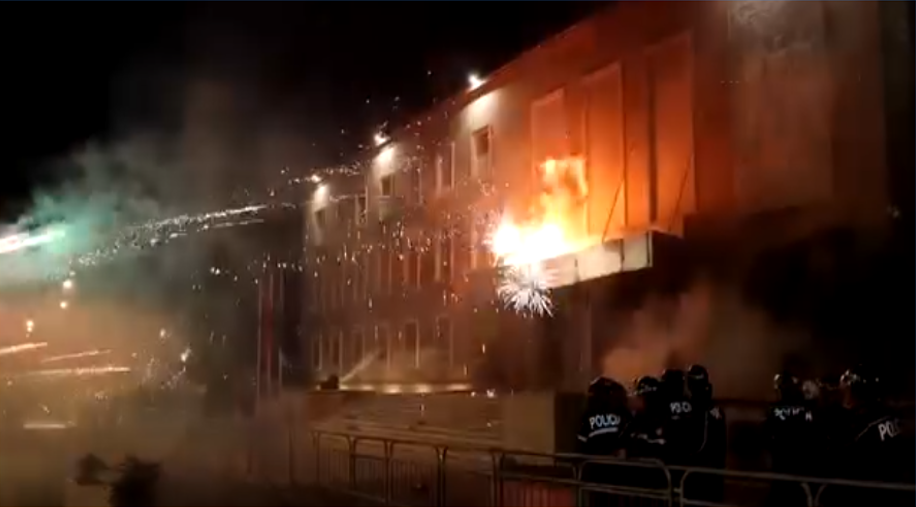
TIRANA, ALBANIA — Violence erupted in the heart of the Albanian capital on Sunday, March 22, 2026, as anti-government protesters launched a coordinated assault on the office and residence of Prime Minister Edi Rama. Riot police deployed high-pressure water cannons and tear gas to repel crowds who hurled petrol bombs, flares, and heavy-duty fireworks at government buildings, marking a significant escalation in a months-long political standoff.
The unrest follows a deepening judicial crisis surrounding former Deputy Prime Minister Belinda Balluku, a key ally of Rama, whose legal immunity has become the center of a national firestorm.
The Catalyst: A Shielded Indictment
Tensions have remained at a breaking point since December 2025, when the Special Prosecution Office (SPAK) indicted Balluku for alleged corruption. The charges include “violation of equality in public tenders” related to multi-million euro infrastructure projects, specifically the Llogara Tunnel and the Tirana ring road.
- Judicial Suspension: An anti-corruption court officially suspended Balluku from public office, a move upheld by the Constitutional Court in February despite government appeals.
- Parliamentary Blockade: On March 12, 2026, lawmakers from Rama’s ruling Socialist Party utilized their comfortable majority to vote 82 to 47 against lifting Balluku’s immunity. The decision effectively blocked SPAK from executing an arrest warrant against her.
- The “Two Standards” Allegation: Opposition leader Sali Berisha and various civil society groups have accused Rama of creating a “political shield” for his inner circle, noting that the government has historically moved faster to strip immunity from lower-ranking officials.
Protests Turn Combative
Sunday’s demonstrations were the most violent since the February riots. As evening fell in Tirana, thousands of supporters of the Democratic Party converged on “Dëshmorët e Kombit” Boulevard.
- Tactical Escalation: Masked demonstrators breached security perimeters, launching Molotov cocktails that set fire to the entrance of the Prime Minister’s office and scorched the surrounding greenery.
- Police Response: Over 1,300 police officers were deployed. After several warnings, authorities utilized water cannons and tear gas to push the crowd back toward Skanderbeg Square. At least 16 people—including both officers and protesters—were reported injured.
- State of “Armor”: Government ministries and the Socialist Party headquarters have been “armored” with metal barriers in anticipation of continued “peaceful uprisings” promised by opposition leaders.
International Stakes and EU Accession
The optics of firebombs in Tirana come at a sensitive time for Albania, which is currently under intense monitoring as part of its European Union accession process. Brussels has repeatedly emphasized that a robust and independent judiciary is a non-negotiable prerequisite for membership, which Albania hopes to achieve by 2030.
The EU office in Tirana issued a statement late Sunday, warning that “rhetoric that sows public distrust in the judiciary is counterproductive” and urging all parties to respect the independence of SPAK.